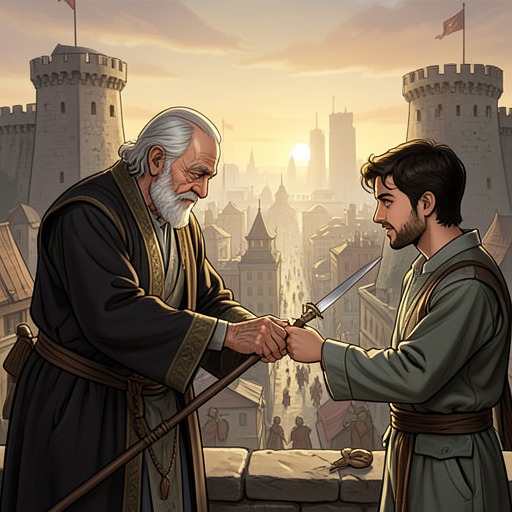
Medea Rejuvenates Aeson
Metamorphoses (Ovid Edition)Medea Rejuvenates Aeson presents Medea’s most elaborate act of restorative magic: she brings the decrepit Aeson to the threshold of death, prepares a compounded medicine, replaces his exhausted blood with an enchanted fluid, and returns him to youth. The decisive transformation is not merely physical. Aeson discovers that his body has changed while his sense and constitution remain continuous, so the episode imagines renewed life as a passage through apparent death without the destruction of personal identity.
Purpose and Setting
Medea undertakes the rejuvenation after returning with the Argonauts and Aeson’s son from their successful voyage. The return carries both public and familial significance: the Aemonian matrons had mourned the absence of their sons, and their joy at seeing the young men safely restored establishes a world in which restoration has already begun at the social level. Against that background, Medea directs a more radical restoration toward Aeson, whose age has reduced him to a decrepit condition.
Her intervention belongs to the same imaginative field as the poem’s other transformations. The transformation of Daphne into a laurel, the transformation of Io into a heifer, and the story of Salmacis and Hermaphroditus each alter the body through forces that exceed ordinary human control, while the story of Venus and Adonis joins desire to bodily vulnerability and loss. Aeson’s rejuvenation reverses the usual movement toward vegetal, animal, hybrid, or dead forms: here magic makes an old body young again, though only by passing through a ritual that resembles killing.
Medea’s Preparation
Medea first seeks the power required for the work through repeated prayers to the infernal ruler, whom she eventually persuades. Her method therefore combines supplication with technical command. The episode does not present rejuvenation as a spontaneous blessing; it is an achieved operation requiring access to powers below the ordinary human world and exact control over substances, timing, and bodily treatment.
When the preparation is complete, Medea orders that decrepit Aeson be brought before her and gives him a sleeping draught. The potion removes his active participation and makes his body appear corpse-like as it lies extended on the earth. This is the first great reversal in the ritual. Aeson must be made to resemble the dead before he can receive renewed life, and Medea’s art consequently occupies the unstable boundary between medicine, sacrifice, and metamorphosis.
She then lights the piles and purifies the sleeping old man three times with sulfur, water, and fire. The repeated lustration gives the procedure a formal, almost ceremonial structure. Each substance marks a different mode of cleansing, while the triple action emphasizes that the body is being removed from its previous condition rather than simply treated for illness. The old identity is not discarded, but its physical signs are methodically stripped away.
The Enchanted Cauldron
Medea prepares a large cauldron in which the medicine boils. Its contents are made from the varied spoils she has recently collected, blended together so that their separate powers become a single restorative compound. The cauldron functions as the episode’s central image of transformation: heterogeneous materials are brought into contact, heated, and converted into a new substance capable of altering a human body.
The preparation is also marked by movement between earthly and extraordinary realms. The materials are not described as an ordinary physician’s remedies, and Medea’s earlier prayers have already secured infernal assistance. Her knowledge turns the natural world into an instrument of reversal, making the cauldron a miniature theatre in which decay is confronted by a counterforce assembled from many kinds of power.
At the moment of application, the imagery shifts from preparation to violent intervention. Medea cuts her patient’s throat and replaces the exhausted blood with a new enchanted flood. The procedure is deliberately paradoxical: the act that ordinarily causes death becomes the means by which life is renewed. The wound is not the final sign of mortality but an opening through which a different vitality enters, and the body’s emptied arteries swell with fresh supplies.
Aeson’s Renewal
The result astonishes the spectators, who can scarcely believe what they see. Their disbelief matters because the transformation is not merely inward or allegorical; it is publicly visible and confirmed through the changed body. Medea’s power is therefore established before witnesses, and the scene converts secret magical knowledge into a spectacle whose evidence is the renewed appearance of its victim.
Aeson himself is the most surprised. He awakens to find a happy change in both body and mind, discovering that he is still the same man in sense and constitution while no longer bearing the physical condition of extreme age. The distinction preserves continuity beneath transformation. Youth returns without replacing the person who had grown old, so the episode separates bodily age from identity and treats the self as capable of surviving a radical alteration in appearance and strength.
The rejuvenation reverses the expected direction of the plot’s value. Aeson begins as a figure associated with decrepitude, weakness, and proximity to death; after Medea’s operation, the same figure embodies renewed vitality. Yet the reversal is not effortless or innocent. It depends on Medea’s hazardous art, the temporary simulation of death, ritual purification, and the cutting open of the body. Life is recovered, but the poem makes recovery pass through images of blood, fire, sleep, and the grave.
Narrative Significance
The episode makes Medea both healer and magician, but her healing remains inseparable from destructive technique. She does not restore Aeson by gentle care alone. She commands extraordinary powers, renders him insensible, purifies him, boils a compound of collected substances, and performs an incision that would ordinarily end life. The contrast gives her action its unsettling force: restoration and violence are not opposites but successive stages of the same metamorphic process.
Aeson’s renewal also provides a concentrated example of the poem’s recurring interest in altered states. Daphne retains a trace of the person she was in the laurel; Io’s change moves her from human form into animal form; Hermaphroditus becomes a fused being through the mingling of bodies; and Aeson crosses from old age through corpse-like stillness into youth while remaining continuous in mind. These transformations differ in direction and emotional effect, but together they suggest that no visible form is final.
The story’s deepest contrast is between mortality’s outward marks and identity’s persistence. Aeson’s exhausted blood, aged body, and corpse-like appearance imply that time has nearly completed its work. Medea interrupts that process without erasing the person beneath it. His renewed body becomes proof that transformation can preserve rather than destroy, even though the ritual’s violence prevents the renewal from being understood as a simple escape from death. In this sense, Medea Rejuvenates Aeson is a major instance of the poem’s governing principle: the world changes its forms continually, and what appears to be an ending may become the material of another beginning.