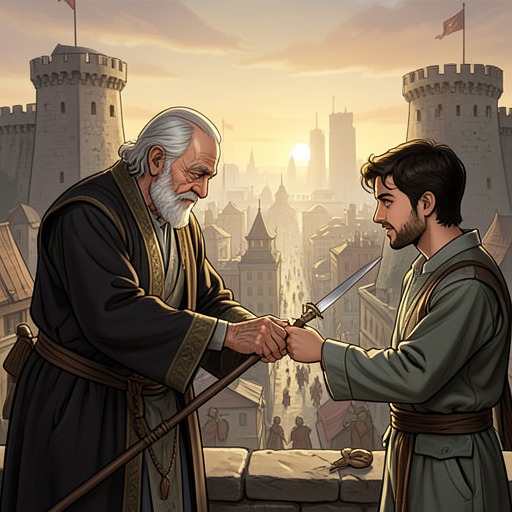
Minos
Metamorphoses (Ovid Edition)Minos is the neighboring monarch whose power turns a political grievance into war and whose authority ultimately produces the Labyrinth, the defining prison of the Cretan narrative. In his brief but consequential appearances, he is not developed through private reflection so much as through actions that organize kingdoms, compel ritual, and transform architecture into an instrument of concealment and control.
Identity and Political Power
Minos appears as the ruler of Crete and the neighbor of Aegeus, whose kingdom is weak both on land and at sea. That weakness does not prevent conflict: Minos threatens war because his resentment is deep, making grievance itself a source of power. The contrast establishes him as a monarch whose strength lies not merely in armies or fleets but in the intensity and persistence of his claim against Athens.
His campaign is shown in movement rather than in deliberation. While the Athenian king and his subjects prepare costly feasts, Minos displays his martial skill on the Attic shore and lays waste to the land. The image makes his authority materially visible: Minos is the force that brings war into another kingdom’s territory, converting a neighboring relationship into open devastation.
War, Victory, and Sacred Obligation
After his operations in Attica, Minos reaches the Cretan shore and performs vows to Jupiter, his protecting power. His victory or renewed security is therefore framed through both military and religious action. The monarch does not simply return from war; he returns to fulfill obligations before a god, linking the success of his rule to ritual acknowledgment.
The scale of the offering reinforces his royal status. Minos sacrifices one hundred of the largest bullocks, a lavish act that measures prosperity, power, and gratitude at once. The scene places him within a political order in which warfare, kingship, and divine favor are inseparable: the king conquers or survives through force, then confirms that position through conspicuous devotion.
The Labyrinth and the Politics of Concealment
Minos resolves to provide a dark enclosure in which the two-formed creature can be hidden far from sight. His decision gives architectural form to secrecy. The creature is not merely guarded; it is removed from ordinary visibility and placed within a designed space whose purpose is exclusion, concealment, and control.
Daedalus of Athens is commissioned to execute the plan. The architect makes the design and constructs a marvel in which rooms encircle one another, producing an interior that defeats ordinary orientation. Minos therefore exercises power indirectly through another man’s intelligence: Daedalus supplies the craft, but Minos supplies the political demand and the purpose for which that craft is used.
The Labyrinth turns Minos’s authority into a spatial system. Its rooms fold inward, separating the hidden creature from the outside world and making access itself a problem. In this setting, kingship is expressed not only through armies and tribute but through the ability to define who may enter, what must remain unseen, and how knowledge can be obstructed by physical design.
Narrative Role and Significance
Minos functions as a hinge between public conflict and enclosed marvel. His war against Athens expands the story from a dispute between rulers into a crisis affecting an entire territory; his return to Crete and sacrifice to Jupiter restore the language of legitimate kingship; his commission to Daedalus then redirects that power into the creation of the Labyrinth.
The character is consequently less a psychologically elaborated protagonist than a concentrated figure of sovereignty. Military violence, sacred duty, and architectural confinement belong to the same pattern in his portrayal. Minos commands the land, honors Jupiter, and orders the construction of a space where ordinary human access and understanding fail. His importance lies in this chain of consequences: political power produces ritual display, ritualized kingship produces the hidden enclosure, and the enclosure becomes one of the poem’s most enduring images of authority made solid in stone.