Nereids
Metamorphoses (Ovid Edition)The Nereids are a collective of sea nymphs who inhabit the poem’s mythic maritime world. They appear not as a single protagonist with an individual biography, but as a responsive community whose presence marks the boundary between human society and the wider life of the sea. Their recurring interventions make them witnesses, attendants, mourners, and custodians of transformation: they can surround a sacred crisis, carry living branches, and accompany divine or heroic figures in spaces where ordinary nature becomes miraculous.
Nature and Setting
The Nereids belong to the sea and are repeatedly associated with coastal or watery places. Their identity is defined collectively rather than through one fixed personal narrative. They share the poem’s larger system of metamorphosis, in which distinctions between human, divine, animal, plant, and landscape remain permeable. The Nereids therefore function as a marine counterpart to other supernatural communities, including the Naiads and Dryads, while retaining a specifically maritime relation to movement, shorelines, and the changing forms of nature.
Their appearances often occur at thresholds. They are connected with shores, retreats, streams, and scenes in which the sea enters or transforms the human world. In the account of the devastated cities, creatures of the deep replace the former signs of settled cultivation: where children once cropped the grass, marine monsters now occupy the space, insulting Nereids ride upon the cities, and dolphins glide above palaces. This image reverses the normal relation between land and sea. The Nereids are not merely decorative inhabitants of the water; their presence helps reveal a world in which the distinction between civic architecture and oceanic life has collapsed.
Collective Actions and Appearances
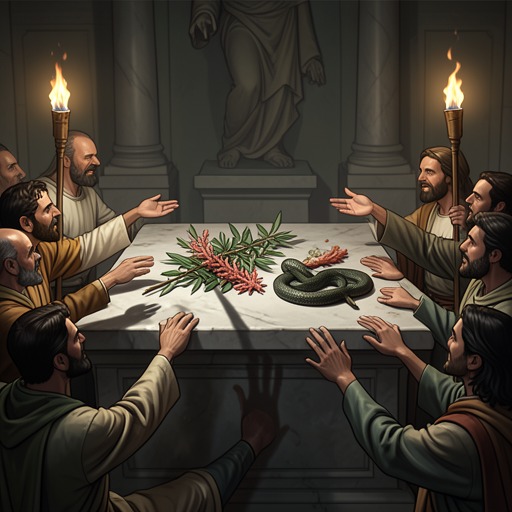
The Nereids are shown as active participants in scenes of supernatural change. When a petrifying force spreads through living vegetation, they bring fresh, juicy twigs, only to find that the same contagion seizes those branches as well. Their action establishes both their concern for threatened life and the contagious reach of transformation. They attempt to preserve living material, but the attempt also demonstrates that no natural category is secure once metamorphic power has been released. The Nereids retain the petrifying seeds, making them not only observers of the change but also bearers of its continuing material trace.
They are also associated with divine and heroic maritime spaces. A bridled dolphin is described as having carried Thetis to her beloved retreat, a favored shore connected with her hidden life. In this setting, the Nereids belong to the ceremonial and intimate environment surrounding a sea divinity. Their world is one in which dolphins serve as mounts, shores become privileged retreats, and the sea provides both concealment and access to divine power. Their collective presence reinforces the sense that marine nature possesses its own social and sacred order.
The Nereids’ relation to ritual is likewise visible in the wider pattern of the poem. They occupy the same mythic universe in which mourners invoke the gods, seek relief from sacred oracles, and pursue divine explanations for catastrophe. Although the cited scenes do not assign them a separate oracle or formal priesthood, their appearances place them close to the poem’s sacred mechanisms: they inhabit spaces where grief, prayer, prophecy, and transformation meet. Their collective identity gives such scenes a communal rather than purely individual scale.
Relations with Gods, Heroes, and Nature
The Nereids are connected with divine figures, especially through the maritime sphere surrounding Thetis. Their association with her favored shore presents them as members or attendants of a sea-centered divine environment, one that can receive heroic figures and conceal significant encounters. The sea is not an empty setting behind the action; through the Nereids, it becomes a populated realm with its own beings, loyalties, and forms of movement.
Their relation to metamorphosis is especially important. The poem repeatedly presents change as a force that can punish transgression, preserve memory, or reorganize the boundary between species. The Nereids’ response to the petrifying contagion places them on the side of threatened continuity: they bring fresh branches and attempt to sustain living growth. Yet the branches harden under the same influence, and the nymphs themselves keep the petrifying seeds. Their role consequently contains a tension between guardianship and transmission. They resist transformation while also becoming the agents through which its evidence survives.
The collective is also implicated in the poem’s contrast between culture and nature. The image of Nereids riding upon cities and dolphins passing over palaces turns the aftermath of devastation into a marine invasion of human space. By contrast, the Nereids’ work with branches shows them operating within living nature rather than against it. Across these episodes, they mediate between orderly human construction, wild or supernatural natural forces, and the possibility that one realm may overtake another.
Narrative Function and Significance
Because the Nereids recur in different myths, they help unify a work built from numerous transformations. Their appearances establish continuity across otherwise separate stories. A scene involving sea nymphs can echo the poem’s broader patterns of divine intervention, environmental reversal, bodily change, and the persistence of material remains after catastrophe. They are thus a connective presence within the poem’s mythological structure rather than a narrowly bounded cast of characters.
Their collective form is itself meaningful. Individual figures in the poem often undergo singular transformations, but the Nereids appear as a group, emphasizing shared witness and communal response. They can express the scale of a crisis more effectively than one isolated observer: when cities are overrun by the sea, their presence measures the displacement of human order; when branches become stone, their collective handling of the twigs records the spread of the supernatural through the natural world.
The Nereids ultimately embody the poem’s principle that nothing remains confined to one form or realm. Sea life enters cities, dolphins serve divine purposes, living branches become stone, and sacred or heroic stories unfold along shores and retreats. The Nereids make these transitions legible because they inhabit the unstable border between water and land, nature and culture, and ordinary life and divine transformation. Their importance lies less in a completed personal arc than in their recurring capacity to witness, carry, and preserve the poem’s changing world.