Orpheus
Metamorphoses (Ovid Edition)Orpheus is the defining figure of artistic grief in the poem: a singer whose music gives emotional form to bereavement and carries him across the boundary between life and death. His importance lies not in defeating the underworld by force, but in persuading its rulers through song. Yet the same love that sends him into the realm of the dead also produces the anxious backward glance that destroys his rescue. His story therefore joins artistic power to human limitation, making failed recovery—not triumphant return—the final measure of his devotion.
Identity and the Call of Grief
Orpheus enters the narrative as a Thracian overwhelmed by the death of Eurydice. A venomous viper bites her as she passes, and she dies instantly. Orpheus does not accept the ordinary finality of that death. After mourning her for a long time and finding no restoration from the superior powers, he is inflamed by love and driven by profound despair to seek Persephone and the ruler who governs ghosts and the uncomfortable plains of Hell.
His journey begins in grief but takes the form of a deliberate descent. He moves from the human world into a sacred and perilous region where ordinary boundaries no longer hold: the living singer stands before the king and queen of shadows, carrying only his voice and the strings of his instrument. The movement makes mourning spatial. What cannot be repaired in the world above is pursued below, through darkness, vapour, and the difficult steep path toward the margin of light.
Song Before the Rulers of the Dead
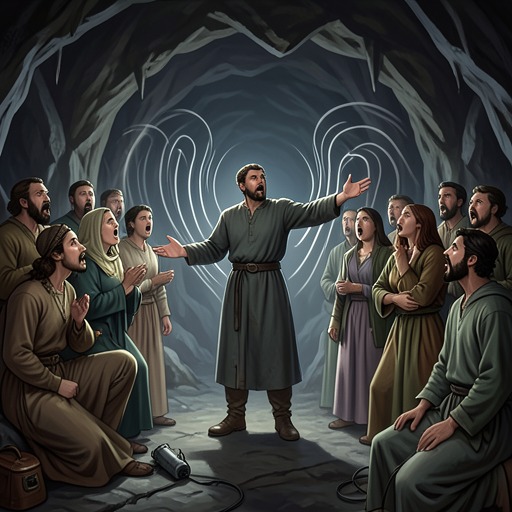
When Orpheus arrives, he tunes the strings of his instrument to his voice and sings before the powers beneath the earth. His appeal transforms the underworld court from a place of irreversible judgment into a scene of listening. The dead, the ruler, and the queen become an audience, while the singer’s personal loss is translated into a plea capable of reaching beyond human law.
The power of Orpheus is thus persuasive rather than coercive. He does not break the gates of Hell or challenge its authority in battle. His art makes the rulers of the dead confront the intensity of mortal attachment, and the journey becomes a test of whether song can mediate the opposition between life and death. The poem grants him access to a realm normally closed to the living, but it does not abolish the conditions governing that realm.
Eurydice and the Fatal Reversal
Orpheus succeeds in winning the opportunity to lead Eurydice back toward the light, but the terms of the recovery remain severe. The path is dark, difficult, steep, and thick with vapours from the smoky deep. The pair have nearly passed beyond the bounds of night and are approaching the margin of light when Orpheus begins to distrust the journey. He fears that Eurydice’s steps may stray, and that fear overcomes the restraint required of him.
He turns to look back before the rescue is complete. The glance is a small physical act with an absolute consequence: the return that song had almost achieved is revoked, and Eurydice is lost again. The episode’s reversal lies precisely in this contrast between immense achievement and fragile failure. Orpheus has crossed into Hell, persuaded its sovereign powers, and brought the dead woman almost to daylight; nevertheless, his anxiety at the threshold converts deliverance into a second separation.
Love, Death, and the Limits of Art
Orpheus’s story repeatedly places love against the boundary that separates mortals from the dead. Eurydice’s death is sudden and arbitrary, while Orpheus’s response is expansive: he turns private sorrow into ritual action, descends into a sacred realm, and makes music serve as an instrument of negotiation. His art can open a passage that force could not create, but it cannot make him entirely free of mortal fear.
The failed rescue gives the myth its structural tension. Life and death are not simply opposed without contact; they are briefly mediated by song, memory, and the journey toward light. Yet the mediation remains incomplete. Orpheus can approach the dead and momentarily alter the conditions of the underworld, but he cannot sustain faith at the exact point where the worlds meet. The threshold is therefore both the site of hope and the place where hope collapses.
Narrative Role and Legacy
Orpheus functions as the poem’s emblem of poetic power under pressure. His music is strong enough to be heard by the rulers of shadows, but his judgment is not strong enough to endure uncertainty. That contrast prevents the tale from becoming a simple celebration of art. Song achieves the impossible only provisionally; the artist’s access to the supernatural does not exempt him from ordinary human weakness.
His narrative also establishes a pattern that recurs throughout the poem: death is often followed by transformation, memorial, or altered identity, but not every loss is repaired. In Orpheus’s case, mourning does not become a successful return. It becomes an enduring song shaped by the knowledge that the beloved was once within reach and then vanished again. His descent and failure preserve Eurydice in poetic memory while confirming that the deepest boundary in the story is not the distance to Hell, but the inability of the living to possess the dead securely.