Palladium
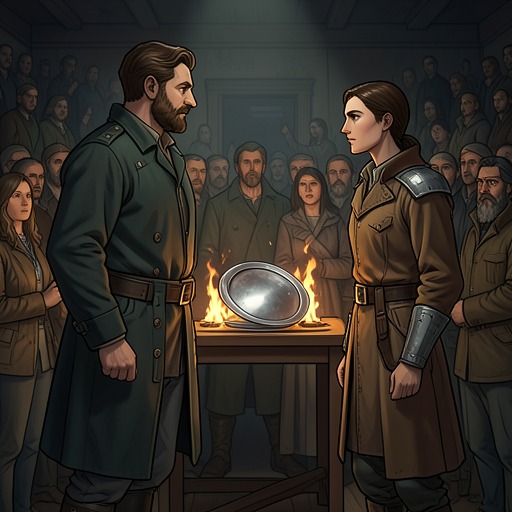
Metamorphoses (Ovid Edition)Palladium is the guardian image of Troy and one of the poem’s clearest examples of an object whose power lies in its location. While it remains within the city, Troy is defended; once it is carried away, the protection that has made the city secure is broken. Its removal is therefore not a decorative episode but a strategic and sacred act, accomplished by Ulysses and remembered as one of the essential works that enabled the Greek victory.
Identity and Sacred Function
Palladium is identified as the image of Pallas, the goddess whose presence gives the object its authority. The text does not treat it as an ordinary statue or portable treasure. Its power is bound to Troy itself: Pallas may be friendly to the Greeks, yet, while her image remains in Troy, she continues to defend the city. The object thus occupies an unstable middle ground between divine protection and material possession. It can be seen, taken, and transported, but its significance exceeds its physical form.
The Palladium also belongs to the poem’s larger world of transformations and sacred interventions. The work begins with a song of bodies changed into various forms and repeatedly shows divine force entering the material world through bodies, landscapes, images, and relics. Within that structure, the Palladium reverses the usual direction of metamorphosis. It is not a person changed into another being; it is a divine presence embodied in an object whose position changes the fate of an entire city.
Ulysses and the Removal from Troy
Ulysses claims responsibility for conveying the fatal image out of Troy. His statement presents the theft as a deliberate achievement rather than an incidental prize of war. He says that he secured the image and brought it away from the city, making the act part of his larger record of service to the Greek cause.
The decisive logic is explicit: while Palladium was in Troy, Troy was defended. Once Ulysses had removed it, the city no longer possessed the guardian presence that sustained its resistance. The object therefore functions as a strategic key. Its capture does not merely weaken Troy in a general sense; it removes the particular protection on which the city’s safety depends.
The episode also establishes a contrast between Ulysses and Ajax. Ulysses invokes the Palladium as proof of effective action, while Ajax is dismissed as producing only noise and empty display. In this opposition, the sacred image becomes evidence in a contest over heroic worth. The man who obtains it is associated with secrecy, purpose, and results; the man who boasts without comparable accomplishment is reduced to an unsuccessful claimant to glory.
Troy’s Vulnerability and the Logic of War
Palladium makes the fall of Troy intelligible as more than the outcome of brute force. The city’s destruction depends on a breach in the relation between sacred protection and civic survival. The object’s removal creates the condition under which the city can be taken, so the war’s apparent scale is concentrated in a single act involving one image.
Its importance also exposes the dependence of political power on material signs. Troy’s defense is represented through a thing that can be guarded, hidden, and stolen. The sacred and the military are consequently inseparable: divine favor is not an invisible abstraction but something attached to a concrete image, and military success requires access to that image. The Palladium’s displacement turns a protected city into a conquerable one.
Because the poem presents the object through Ulysses’ retrospective self-defense, its meaning is also bound to narrative authority. The image is not shown in an extended independent scene; its importance is established through the account of the man who claims to have removed it. Palladium therefore operates both within the mythic plot and within the rhetoric of heroic reputation. Possession of the story of its capture is nearly as important to Ulysses as possession of the object itself.
Memory, Possession, and Significance
Palladium is a compact emblem of the poem’s recurring conviction that bodies and things do not remain fixed in meaning. A statue can be treated as an image, a guardian, a city’s defense, and a trophy depending on where it stands and who controls it. Its material form appears stable, but its political and sacred function changes radically when it crosses the boundary between Troy and the Greek camp.
The object’s significance also extends beyond the immediate episode. The poem repeatedly links remembrance to physical forms: the dead may become trees, ashes may be confined in a single urn, and recurring birds may preserve the name of a fallen champion. Palladium belongs to the same memorial economy, though in a harsher register. It preserves Troy’s dependence on divine protection while also recording the moment that protection was severed. Its removal becomes part of the enduring account of how Troy was overcome.
In the poem’s final movement, the work itself is declared secure against tempest, fire, war, and wasting age. That claim gives the Palladium an illuminating literary counterpart. Troy’s guardian image can be displaced and its city destroyed, whereas the poem converts vulnerable events and objects into lasting cultural memory. Palladium is consequently both a weapon in the destruction of a city and a surviving sign within the poem that preserves the logic of that destruction.