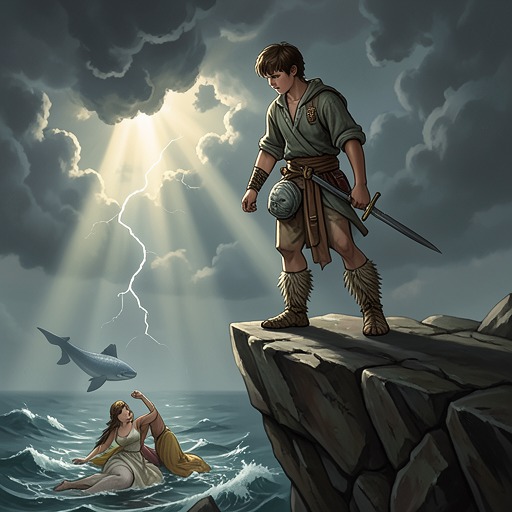
Perseus and Andromeda
Metamorphoses (Ovid Edition)Perseus and Andromeda presents rescue as a sudden interruption of sacrificial violence. Andromeda has been condemned to atone for a fault that is not her own, while Perseus arrives at the Ethiopian shore and finds her chained to a rock. His intervention changes the scene from helpless mourning to heroic action: the sea monster rises, Perseus descends upon it, and the endangered maiden is saved before the gathered royal household can do more than grieve.
Causes and Background
Andromeda’s punishment is rooted in a divine decree described as unjust. She is made to suffer for her mother’s pride, because her mother had once competed in beauty with the Nereids. The episode therefore separates guilt from punishment: Andromeda is the victim of a transgression attributed to another, and her exposure to the monster is presented as a wrong imposed by divine power rather than as a consequence she has personally earned.
The landscape is prepared as a place of exceptional danger. Perseus has crossed various seas and lands before the Ethiopian shore appears, and the winds have been restrained by Aeolus in strong chains, imprisoning every blustering wind. This stillness does not remove the threat; it makes the approach of the sea monster more stark. The shore becomes a boundary between Perseus’s airborne journey and Andromeda’s fixed, public vulnerability.
The Sacrifice at the Shore
Andromeda stands chained to the rock, unable to escape, while Perseus halts his rapid flight to look upon her. Her beauty is emphasized at the very moment when her life is treated as payment, creating a sharp contrast between the delicacy of the captive and the brutality of the sentence. Her parents and attendants weep and cling to her, but their tears offer no practical aid. The emotional force of the scene lies in this failure of ordinary protection: the family can witness the sacrifice but cannot prevent it.
The sea then announces the approach of the danger. The waters roar, mounting billows tumble toward the shore, and the monster raises its head above the waves. The threat is not merely anticipated but made physically present, turning Andromeda’s suspension into a race against time. Perseus rebukes the prolonging of sorrow and insists that the hour is short and aid must be swift. He identifies himself as the son of Jupiter, presenting divine lineage not as a distant claim but as the authority with which he enters the crisis.
Perseus’s Combat and the Rescue
Perseus fights from the air rather than from the monster’s level. The winged hero repeatedly descends and rises, using movement and height to strike at the creature. At his pleasure he gores the vast body, converting the gift of flight into a tactical advantage. The monster’s scale and armor make the battle difficult: its imperial talons pierce deeply into the scales, and its twisting neck resists the effort to restrain it.
The combat proceeds through repeated aerial assaults until Perseus delivers the decisive home-thrusts. The expiring monster finally acknowledges the force of the attack, and the danger that had seemed to belong entirely to the sea is brought to an end by the hero’s controlled violence. The value of the scene shifts from death to survival, but the change is not private. It is witnessed and answered by a collective sound: glad applause rises in deafening shouts and echoes through the sky.
Recognition and Aftermath
The royal pair recognize Perseus as their savior. Their recognition completes the rescue’s public dimension, because the hero is not merely the person who happened to defeat the monster; he becomes the acknowledged agent who has restored their daughter and interrupted the decree’s apparent inevitability. Andromeda’s rescue thus establishes a new relation between the foreign traveler and the endangered royal household, founded on an accomplished act rather than on promise alone.
The episode also gives Perseus a form of heroic arrival. He comes from elsewhere, having crossed seas and lands, and his flight brings him directly into a scene where conventional authority has failed. The chained maiden, the powerless mourners, and the rising monster form the crisis; the aerial battle supplies the reversal; the applause and royal acknowledgment provide its visible resolution. The narrative moves rapidly from spectacle to action, then from action to recognition.
Narrative Significance
As a rescue plot, Perseus and Andromeda joins adventure, pursuit of danger, and the defense of an innocent victim. Its central contrast is between imposed immobility and chosen motion: Andromeda is fixed to the rock, the mourners are immobilized by grief, and the monster advances through the waves, while Perseus remains in motion above them all. Flight is therefore more than a marvelous attribute; it is the form taken by effective agency.
The story also places unjust sacrifice beside heroic intervention. Andromeda’s suffering is explicitly detached from personal guilt, so the rescue does not simply reward virtue or correct a mistake. It exposes the violence of a world in which divine decrees can condemn the innocent, then imagines justice arriving through a mortal-seeming champion who carries divine descent and acts before lamentation becomes surrender. The monster’s death does not erase the injustice of the original sentence, but it prevents that injustice from becoming the final meaning of Andromeda’s story.