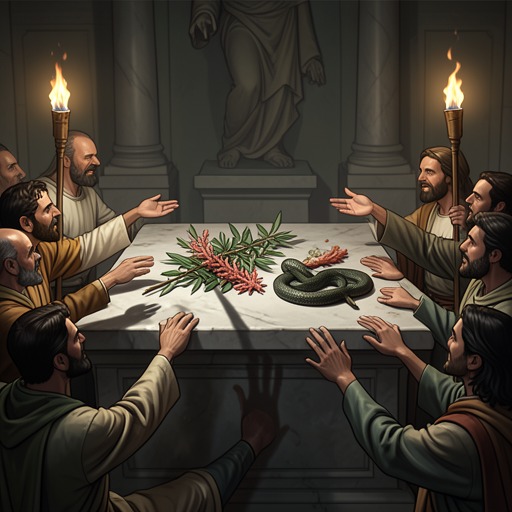
Petrification
Metamorphoses (Ovid Edition)Petrification is the transformation of a living being into stone, a state in which bodily motion, speech, and ordinary human agency are arrested while the transformed figure remains materially present. In the myths, it is never merely disappearance: the body becomes an object that preserves an encounter and makes its consequences permanently visible. Petrification therefore joins metamorphosis to memory, turning a person, a god’s victim, or an adversary into a monument shaped by the force that overcame them.
Definition and Metamorphic Logic
Petrification marks the most severe possible interruption of bodily change. A living figure does not simply die or leave the narrative; limbs, features, and posture are reorganized into mineral form. The transformation of Daphne into a Lawrel shows a related but distinct logic of metamorphosis: the beloved becomes a tree, and the new substance retains a recognizable relation to the former body. Petrification intensifies that process by replacing vulnerable life with immobility. What was once capable of resistance is made fixed, weighty, and unable to escape the gaze of others.
The state also belongs to a larger world in which physical conditions are unstable and repeatedly redefined. The account of the first human settlement contrasts an earlier condition in which land was common with the later marking out of individual rights. Against that social division, petrification presents another kind of material boundary: the body itself becomes a fixed limit. A person who could move through a shared world is converted into a singular, immovable thing, and the change exposes how completely divine power can rewrite the relation between person and environment.
Divine Power and Bodily Arrest
The story of Aglauros makes petrification a punishment for obstructing divine desire. Aglauros discovers Mercury crossing her chamber and demands to know his name, business, and origin. Mercury answers that he has come from Heaven to woo her sister and make Aglauros an aunt. When Aglauros refuses to yield her place, the god commands her to keep her seat forever and touches the door with his rod. She wishes to rise and stop him, but her trunk has become too heavy to leave the ground; her joints are benumbed, and her hands turn pale. The scene gives the transformation a precise physical progression. Resistance first becomes heaviness, then loss of mobility, and finally the irreversible conversion of a living body into an obstruction that can no longer intervene.
This episode shows that petrification is not an abstract curse detached from action. It begins in a contested threshold, with Aglauros occupying a chamber and Mercury trying to pass through it. The transformed body consequently retains the logic of the quarrel: the woman who blocks passage is made permanently unable to move, while the god’s will proceeds unhindered. The punishment converts social and spatial opposition into material permanence. Her body becomes the lasting shape of refusal overcome by superior divine force.
The Petrifying Gaze
Petrification is also produced through sight. When Perseus reveals Medusa’s head to Atlas, the high Atlas immediately becomes a high mountain. His locks and beard become leafy wood, while his hands and shoulders extend into ridges. The transformation enlarges the victim rather than reducing him: the individual body becomes an entire mountain mass. Yet the details of hair, beard, hands, and shoulders preserve the human outline within the landscape, allowing the mountain to function as both natural feature and petrified person.
The same mechanism governs the confrontation with Medusa’s head during Perseus’s battle against Phineus and his allies. Thescelus sees the Gorgon and, in defiance, declares that he regards both Perseus and the monster with scorn. He raises his arm to strike, but before the blow can be thrown, the head’s power arrests him. Phineus attempts to avoid looking at the shield, but Perseus turns the staring head directly toward his face. The threat therefore depends on a conflict between seeing and refusing to see. The shield offers a controlled mediation of the dangerous image, while the unveiled head makes vision itself lethal.
Phineus’s petrification carries a further consequence because he is linked to Andromeda. After the transformation, the narrative states that his betrothed will still behold her spouse and find his image in her father’s house. Stone thus preserves a relationship even as it destroys the man’s freedom. The petrified figure becomes an image to be looked upon, a substitute presence that remains after agency has vanished. Petrification is consequently both annihilation and preservation: it ends action but leaves an enduring likeness.
Landscape, Memory, and Repeated Transformation
The recurring pattern across these myths is a movement from unstable life to fixed testimony. Daphne’s transformation into a Lawrel preserves the trace of desire and pursuit; Aglauros’s hardening records her obstruction of Mercury; Atlas’s mountain body records the revelation of Medusa’s head; and the victims of that head preserve the instant in which defiance or attempted violence failed. Each transformation changes the scale at which a life can be remembered. A private encounter may become a tree, a household barrier, a mountain range, or a statue-like human image.
Other metamorphic stories reinforce this broader system without making petrification their central outcome. The transformation of Io into a Heyfer relocates identity into an altered animal body, while Salmacis and Hermaphroditus produce a fused body through water that softens and unnerves the limbs. These changes demonstrate that metamorphosis can operate through vegetal, animal, aquatic, or mineral matter. Petrification is the most radically immobilizing form among them: where other transformations redirect movement or combine bodies, stone abolishes ordinary motion and makes the transformed figure part of the world’s permanent surface.
Narrative and Thematic Significance
As a narrative device, petrification produces an unmistakable value shift. A character begins with the capacity to act, resist, desire, or attack; the scene ends with that capacity extinguished, and the body itself becomes evidence of the encounter. The reversal is especially stark in the stories involving Medusa’s head. Boldness does not secure victory for Thescelus, and avoidance cannot save Phineus once the petrifying image is directed toward him. The power of the transformation lies in the speed with which confidence, movement, and future possibility collapse into stillness.
The state also mediates a fundamental opposition between life and matter. Stone is apparently inert, yet it continues to carry recognizable signs of the former person: Atlas’s leafy locks, his beard, and his transformed hands and shoulders; Aglauros’s heavy trunk and benumbed joints; Phineus’s preserved image in the house of Andromeda’s father. The material world is therefore not empty after metamorphosis. It becomes an archive of divine judgment and human conflict. Petrification makes memory durable by sacrificing freedom, preserving the outline of a life precisely when that life can no longer continue on its own terms.