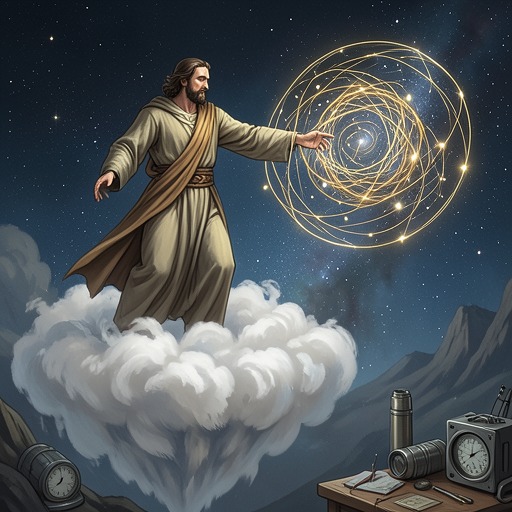
Phaethon
Metamorphoses (Ovid Edition)Phaethon is the youthful figure whose claim to solar ancestry becomes one of the book’s clearest tragedies of desire, proof, and punishment. Equal in age and reputation to Epaphus, he boasts that the Sun is his father and seeks not merely honor but visible confirmation of that identity. His story moves from rivalry and wounded pride to a request that even his divine father cannot safely grant: the right to guide the Sun’s bright chariot for a single day.
Identity and Rivalry
Phaethon is introduced as a young man who stands beside Epaphus as an equal in years and a rival in renown. His distinction rests on the claim that the Sun is his father, a claim presented as a source of honor and public status rather than as a private family matter. The rivalry gives his identity a precarious structure: Phaethon possesses reputation, but he still feels compelled to establish the paternal connection on which that reputation depends.
The episode therefore begins with recognition withheld. Phaethon’s boast does not settle his lineage; it exposes his need to have it acknowledged. His public identity is tied to a divine father whose authority he invokes before he has personally received decisive proof from him. The challenge from Epaphus turns that uncertainty into an urgent demand for demonstration.
The Demand for Proof
Phaethon goes to the Sun and asks to guide the solar chariot for a day. The request is immediate and daring, as though the opportunity to prove himself must be seized before doubt can return. The chariot is not an ordinary emblem of rank: it carries the Sun’s daily course, so Phaethon asks to assume a task whose scale exceeds ordinary human capacity.
The Sun recognizes the danger and regrets the oath he has already taken. Yet he has sworn by the Styx, whose hidden waves move beyond his penetrating sight, and the sacred oath binds him to fulfill whatever promise he made. Phaethon’s success in obtaining the vow thus becomes the mechanism of his ruin. The father’s affection and the son’s demand meet within a legal and divine order that neither can simply evade.
The Fatal Trial
Phaethon’s defining action is his attempt to drive the Sun’s chariot. The narrative gives the request the shape of an ascent into forbidden power: he is permitted to occupy the position of the Sun, but permission does not make him capable of sustaining it. The episode’s tragic force comes from the widening gap between the symbolic authority Phaethon desires and the overwhelming responsibility represented by the chariot.
The trial turns ambition into catastrophe. What Phaethon seeks as proof of identity becomes evidence of his mortality and lack of control. His story is consequently not a successful heroic quest with a return and a reward; it is an inverted journey in which the threshold is crossed, the test cannot be mastered, and no restorative return is possible.
Death and Narrative Consequence
The crisis ends when Jupiter raises his hand and hurls the forked thunderbolt directly at Phaethon’s head amid dreadful thunder. The punishment is sudden and absolute. Phaethon’s death stops the dangerous course he has undertaken, but it also confirms the cost of allowing a mortal youth to handle a divine vehicle. His boast is neither vindicated nor quietly disproved; it is answered through destruction.
The surrounding narrative preserves the aftermath through mourning and the recognition that Phaethon did not deserve so severe a fate. That response complicates the judgment against him. He is responsible for seeking the dangerous proof, yet the severity of the punishment exceeds a simple moral correction. The episode thus balances condemnation of reckless ambition with pity for a son trapped by an oath his father could not break.
Thematic Significance
Phaethon embodies a recurring metamorphic pattern in which an identity claim produces an irreversible transformation in the claimant’s situation. His story passes through rivalry, proof, transgression, and punishment rather than through literal bodily metamorphosis alone. The desired change is social and symbolic—becoming unquestionably the Sun’s son—but the achieved change is tragic: the aspirant is removed from the human sphere by divine force.
His fate also sharpens the book’s interest in the unstable boundary between human and divine capacities. Phaethon can invoke a god’s lineage, but lineage does not transfer command of the cosmic order. The solar chariot makes that distinction visible. It is at once a vehicle, a sign of sovereignty, and a test that exposes the difference between possessing divine ancestry and possessing divine mastery. Phaethon’s brief elevation therefore ends as a warning: the demand to prove one’s identity may itself become the instrument of annihilation.