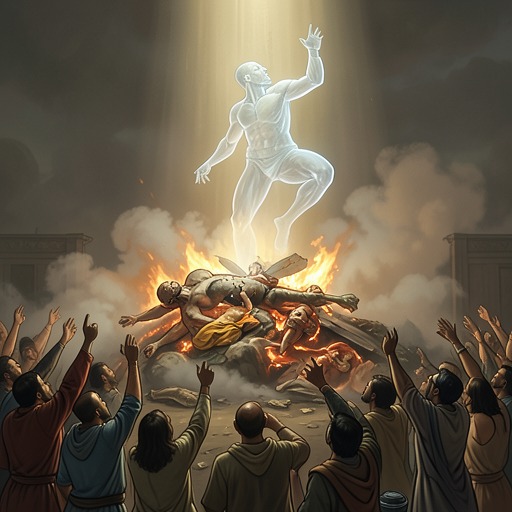
Pyrrha
Metamorphoses (Ovid Edition)Pyrrha is the sole surviving woman after the Flood, Deucalion’s wife, and one half of the pair from whom human life is restored. Her decisive importance lies not in solitary conquest but in her response to catastrophe: amid a world emptied of humanity, she interprets a cryptic command, refuses to perform it blindly, and helps transform mourning into a new beginning.
Identity and Survival
Pyrrha remains alive with Deucalion when the waters subside. Their small boat comes to rest high on the summit of a doubtful, isolated mountain, and the poem stresses the extremity of their condition: they alone are left from perished humankind, and together they constitute what remains of the human race. Her identity is therefore bound to both loss and continuance. She is not merely a survivor who escapes the disaster; she is the surviving woman through whom the possibility of future generations is preserved.
The aftermath offers no consoling abundance. Deucalion and Pyrrha look upon a desolate waste, a silent landscape from which human society has vanished. Their survival creates a paradoxical inheritance: they possess the world, yet have no people with whom to share it. Pyrrha’s presence gives the catastrophe a specifically relational form, because the future of humanity depends on the bond between two isolated individuals rather than on the recovery of any existing community.
Grief and the Oracle
When Pyrrha sees the ruined world, Deucalion turns to her in pity and addresses her as wife, sister, and the best of all her kind, emphasizing both marital intimacy and the fact that she is the last woman left behind. His appeal places Pyrrha at the emotional center of the post-Flood scene. The renewal of the race begins not with triumph but with shared bereavement, and her status as the final representative of womankind makes the loss visible through a single surviving body.
The pair then receive a command associated with Themis: they are to throw behind them the bones of their great mother. The instruction is deliberately obscure, since the “bones” of the earth can be understood only through interpretation. Pyrrha is amazed and stands mute with Deucalion before the command. Her silence records the gap between divine authority and human comprehension; survival has not made the survivors omniscient, and the new world must still be read.
Refusal and Judgment
Pyrrha is the first to reject the command. She fears that obeying it would require tearing bones from the earth, an act presented as impious and violent. Her refusal is not simple disobedience. It establishes an ethical boundary against destructive literalism and shows that the rebuilding of humanity requires discernment as well as faith. The divine order acquires meaning only when Pyrrha tests it against the demands of reverence.
This moment gives her an active interpretive role. Deucalion may participate in the recovery of the oracle’s meaning, but Pyrrha’s hesitation prevents the command from becoming an unexamined act of desecration. The poem thus makes the woman survivor a guardian of judgment at the threshold of the new human world: she does not abandon the hope of restoration, but she refuses to purchase it through an action she understands as morally forbidden.
Restoration and Narrative Role
Pyrrha’s story belongs to a broader pattern in which destruction is followed by transformation rather than absolute extinction. The Flood is chosen when fire is rejected as the means of punishment: what could not be burned is resolved to be drowned. Against that annihilating decision, Pyrrha’s survival represents continuity in its most fragile form. The new order depends on preserving a remnant capable of recognizing what the old order has lost.
Her significance is therefore both practical and symbolic. As Deucalion’s companion, she is necessary to the physical continuation of humankind; as the woman who questions the oracle, she is necessary to its intelligible fulfillment. The episode joins catastrophe, marriage, interpretation, and rebirth in a single structure. Pyrrha does not erase the Flood’s desolation. Instead, she helps make restoration possible without denying the grief and danger that precede it.
The contrast between Pyrrha’s caution and the violence of the surrounding disasters sharpens her characterization. Elsewhere, divine anger brings plague, hunger corrodes the body, sacred groves are violated, and wars stain the fields with blood. Pyrrha’s crisis is quieter but foundational: she must decide whether an obscure sacred instruction can be obeyed without violating the source of life itself. Her refusal and subsequent participation in renewal make her an emblem of survival governed by conscience rather than mere endurance.