Rod of Asclepius
Metamorphoses (Ovid Edition)The Rod of Asclepius is the distinctive staff associated with Asclepius, the health-giving god who appears to a Roman in a dream and identifies the serpent winding around it as a sign of his divine presence. It is not merely a prop or ornament: the staff concentrates the god’s healing identity, marks his promised arrival, and accompanies the transfer of his protection from his original shrine to Rome.
Appearance and Divine Identity
The rod appears in a nocturnal vision after mortal eyes have closed and darkness has overtaken the scene. Asclepius presents himself with a rural staff in his left hand while his right hand strokes his beard, an image that joins an unadorned, pastoral object to unmistakable divine dignity. The staff therefore carries a double character: it is simple enough to belong to a traveler or healer, yet it is held by a celestial figure whose appearance promises supernatural intervention.
The serpent is the rod’s defining feature. Asclepius directs the dreamer to observe the creature playing ambitiously around the staff and explains that he will assume a form larger and nobler than the serpent’s present one. The image makes transformation part of the object’s meaning: the serpent is at once a living sign, a visible companion of the god, and a form that can be exceeded when divine power reveals itself more fully.
The Dream and the Promise of Healing
Asclepius’s appearance is an answer to fear and uncertainty. He tells the Roman to dismiss those fears because he is coming and is leaving his shrine. The rod thus functions within a message of reassurance rather than within a battle or a punishment. Its visibility gives the dreamer a concrete token by which the god can be recognized, while the serpent’s coiling movement supplies the sign with vitality and agency.
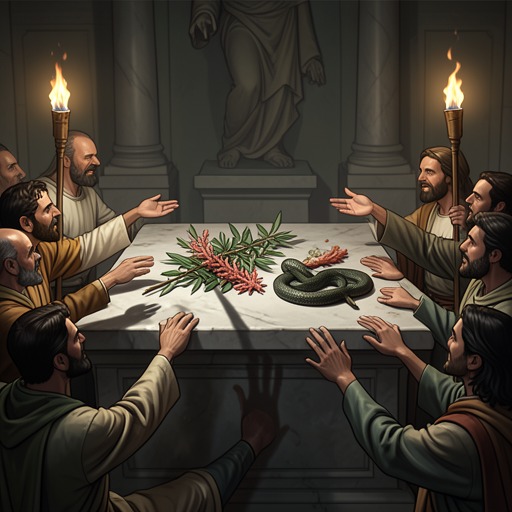
The vision also establishes a connection between the staff and the god’s choice of a new seat. The Roman authorities and worshippers pray for a genuine sign indicating which place Asclepius will favor. Their prayers have scarcely risen to the sky when the serpentine god appears upright, announcing his approach through hissing before his arrival is fully seen. The rod belongs to this process of discernment: it is the object around which the serpent is displayed, and therefore the emblem through which divine intention becomes legible.
Arrival in Rome
The rod’s significance expands when Asclepius’s serpent leaves the Latian pine. The god’s movement is not an isolated apparition but the beginning of a religious relocation. The serpent travels from the god’s shrine toward the Roman world, carrying with it the authority represented by the staff. When it has departed from the pine, it resumes its divine form, showing that the animal appearance was a mode of arrival rather than a permanent reduction of the god’s identity.
The transfer has a civic consequence. After the salutary serpent reaches its new destination, the drooping city no longer mourns. The staff’s emblematic power is therefore tied to public health and collective restoration, not only to the cure of an unnamed individual. The rod accompanies the passage from divine distance to Roman protection, making the god’s healing presence available to a city afflicted by distress.
Symbolic and Narrative Function
Within the wider poem, which sings of bodies changed into various forms, the Rod of Asclepius offers a particularly concentrated image of continuity through change. The serpent changes scale and form; the god changes the place from which he acts; and a sign once connected with a shrine becomes recognizable as a Roman emblem. Yet these alterations do not destroy identity. They preserve and extend the same healing power across different bodies, places, and modes of appearance.
The staff also contrasts with the poem’s more violent transformations. Elsewhere, bodies are bound, dragged, broken, or forcibly remade, while other figures undergo changes that reveal loss, punishment, or irreversible separation. Here the serpent’s transformation is purposeful and restorative. The rod provides a stable axis around which change can occur: the creature coils around it, the god uses it to identify himself, and the symbol survives the movement from vision to civic cult.
The object’s final force lies in its ability to make healing visible. The serpent, the staff, the dream, the prayers, and the god’s departure from his shrine form a chain of signs that culminates in Rome’s relief. Asclepius’s Rod thus condenses the poem’s larger interest in metamorphosis into a hopeful pattern: altered form becomes a vehicle for renewed presence, and divine power reaches the human community without losing its identity.