Rome
Metamorphoses (Ovid Edition)Rome is presented as the culminating political space of Metamorphoses, a city whose rise gathers together foundation myth, warfare, healing, dynastic legitimacy, and divine authority. It begins as a community that Romulus must people and govern, but ends as the world’s great mistress, aligned with Augustus’s earthly sovereignty and the poem’s movement from mythic transformation toward Roman imperial destiny.
Foundation and Early Expansion
Rome first appears as a growing state requiring deliberate population and political organization. Romulus contrives to people the city, and during the festival of Pales he gives the signal for the seizure of the Sabine women. The episode makes Rome’s foundation inseparable from coercion: demographic survival and military power arise through an act that joins marriage, abduction, and the creation of future civic bonds.
The city’s early history remains marked by conflict even after its first expansion. Romulus reigns for a long period, while the neighboring ruler Tatius is killed through Lavinian fury. Rome therefore develops not through an unbroken ideal of peaceful foundation, but through a sequence in which violence, rivalry, succession, and consolidation gradually produce political continuity.
Rome as a Warrior State
The city’s political identity is reinforced through the figure of Mars, who puts on his burnished helmet and addresses Heaven’s imperial throne. His intervention places Rome’s earthly development within a larger divine order and presents Roman rule as a matter of cosmic as well as military significance. The warrior god’s presence gives the city an elevated pedigree, while also exposing the force that sustains its expansion: Rome’s authority is associated with arms before it is associated with healing, law, or cultural achievement.
This martial foundation is not treated as an isolated beginning. Rome’s later grandeur depends on the continued conversion of force into legitimacy. The city’s rise is repeatedly framed through rulers, divine ancestry, and the language of imperial command, so that conquest and sovereignty become parts of a sacred historical sequence rather than merely human accidents.
Foreign Power and Civic Renewal
In the fifteenth book, Rome receives Aesculapius, described as a foreign power. His arrival introduces a different kind of strength into the city. Whereas Rome’s foundation is linked with seizure and war, Aesculapius brings restoration: the drooping city no longer mourns, joy returns, and health is restored. The episode expands Rome’s identity beyond military domination by making the city a recipient and adopter of healing power from outside itself.
Aesculapius’s foreign origin is crucial to this transformation. Rome’s greatness does not arise from isolation or ethnic purity; it grows by absorbing external powers and converting them into civic benefit. The reception of Aesculapius thus parallels the poem’s wider movement across regions and traditions, in which divine figures, cults, stories, and forms of authority are relocated and given new significance within Roman space.
From Dardan Rome to Imperial Rome
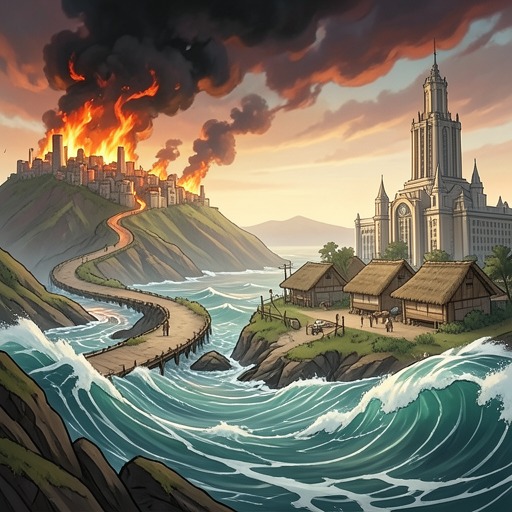
The poem contrasts the fragile ruins of older cities with Rome’s emerging power. Mycenae, Sparta, and Thebes, once celebrated for their fame, have vanished from substance into name, while Dardan Rome is only beginning to rise. Rome is consequently defined through historical contrast: cities that once seemed permanent become memories, whereas Rome appears as the successor capable of converting mortality into political endurance.
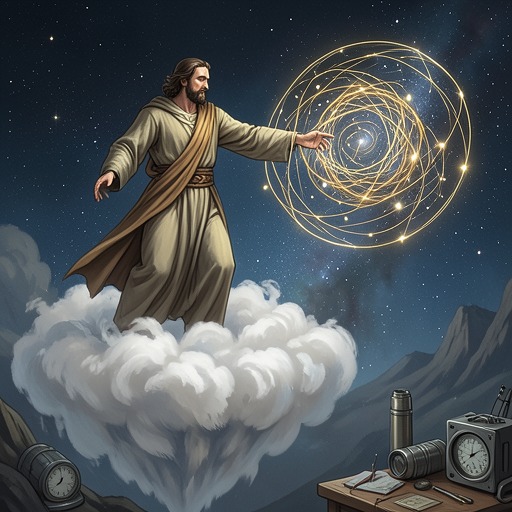
Its culmination is expressed in imperial language. Rome receives Aesculapius as the world’s great mistress, and the final theological pattern places Jupiter over Heaven while Augustus rules Earth. Each possesses both a monarch’s authority and a father’s praise. Rome therefore functions as the earthly counterpart to the divine order: its political center is not merely a location of human settlement but the stage on which sovereignty is translated into a quasi-cosmic structure.
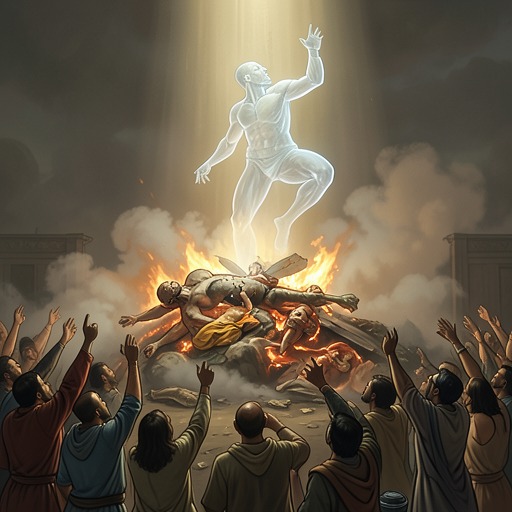
The city’s destiny is also connected to the elevation of Julius Caesar. His fleeting spirit is to be carried from his wounds and changed into a star, allowing Julius to assume divine rites. Through this apotheosis, Roman history enters the same transformative register that governs the myths of the gods. Political death becomes celestial permanence, and the city’s ruling lineage is presented as capable of crossing the boundary between mortal history and divine status.
Narrative Significance
Rome gathers the poem’s central concern with change into a political form. Bodies become other bodies, cities disappear, heroes become stars, and foreign powers are received into new civic settings; Rome is the large-scale institution that survives by incorporating these transformations. Its history is not static preservation but continual conversion—of violence into rule, foreign divinity into public health, ancestry into legitimacy, and mortality into imperial memory.
At the same time, the city’s glory carries the cost of the means by which it is made. The seizure of the Sabine women and the prominence of Mars prevent Rome from appearing as an innocent or purely rational foundation. Its sacred political genealogy does not erase violence; it redescribes violence as the beginning of order. By the close of the poem, that process reaches its most complete form in the pairing of Rome with Augustus, when earthly empire is made to resemble heavenly sovereignty and the city becomes the final political horizon of the poem’s transformations.