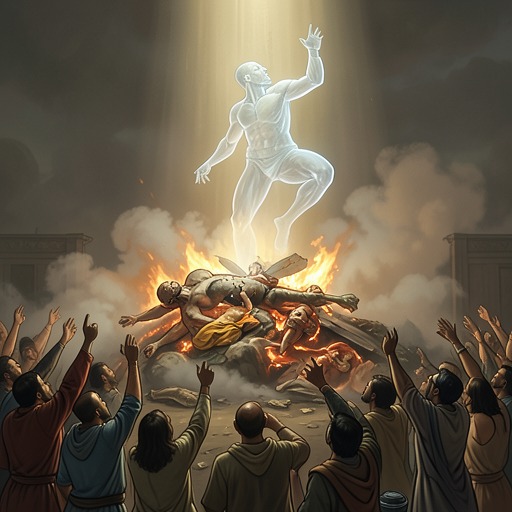
The Flood
Metamorphoses (Ovid Edition)The Flood is the decisive act of divine destruction in which Jupiter replaces a proposed fiery annihilation with a universal deluge. It is not merely a natural disaster but a judgment imposed from above: the old human order is condemned, the landscape loses its familiar divisions, and almost all mortal life disappears. At the same time, the disaster becomes the necessary threshold for renewal, making destruction and re-creation inseparable.
Causes and Divine Decision
Jupiter first considers a punishment by fire. His artillery is ready, and such a conflagration would consume the blazing worlds above and reduce the lower globe to ashes. He rejects that danger because the flames might spread beyond the intended target and threaten the structure of the universe itself. The safer punishment is water: what cannot be burned, he resolves to drown. The change from fire to flood therefore reflects both overwhelming power and a concern to preserve the larger cosmic order.
The Flood follows an earlier divine judgment against a human world understood as unworthy of continued existence. Jupiter tells the assembled gods that the guilty offender has already paid his debt to justice and to Jupiter himself, but the exact crimes and judgments are left to the surrounding narrative rather than fully restated at this moment. The gods’ reverence for Jupiter’s superior state establishes the decision as authoritative, while his promise to provide new people answers the fear that neglected altars will remain without worshippers. Destruction is thus presented as a controlled interruption of divine-human relations, not as their final end.
Course of the Deluge
The flood begins when the waters gather across the plains. They float over the fields, overtop the grain, and advance with a sweeping force that erases the ordinary shape of cultivated land. The agricultural details make the disaster concrete: grain, fields, and the laboring landscape are among the first structures of human life to vanish beneath the water. Nature is no longer divided into useful plots and recognizable boundaries; it becomes one continuous inundated surface.
As the waters rise, hills and valleys lose their distinction, and levelled nature lies oppressed below. The transformation is geographical as well as human. Places that once organized movement, settlement, labor, and memory are reduced to a single hostile element. The Flood therefore destroys not only bodies but the environmental coordinates through which a society knows where it is.
The event is set against a wider pattern of collective catastrophe. Elsewhere in the poem, Juno’s plague punishes a land associated with her rival, Famine attacks the body through pinching want and relentless hunger, and war stains the fields with Phrygian blood. The Flood differs in scale and mechanism, but it belongs to the same recurrent system in which divine conflict or human transgression becomes a material disaster borne by populations, landscapes, crops, and animals.
Human Loss and Survival
Most mortals perish in the Flood. Those who are not immediately taken by the water die afterward from lack of food, so survival is narrowed by a second crisis of resources. The distinction matters: the disaster is not exhausted by the initial inundation. Once fields and grain have disappeared, hunger completes what the rising waters began. Death proceeds through both direct force and the collapse of subsistence.
This sequence also exposes the social dimension of catastrophe. The Flood overwhelms the infrastructure that sustains ordinary life, while the remaining mortals are left without the food needed to endure. The poem’s image of drowned fields followed by starvation presents environmental destruction and resource failure as linked stages of one event. Divine punishment may supply the explanation, but mortal bodies bear its practical consequences.
Aftermath and Renewal
Despite its near-total destruction, the Flood does not end the human story. Jupiter’s assurance that new people will be provided gives the catastrophe a deliberate future orientation. The old population is removed, but the possibility of worship, community, and renewed human presence remains. The event consequently functions as both an ending and a beginning: it closes one moral and physical order while making room for another.
The poem repeatedly turns loss into altered continuation. The nymphs gather around Phaethon’s thunderstruck body before his sisters become trees; Pyramus and Thisbe ask that their ashes be confined in one urn; and later changes of land show that what was once sea may become solid earth, while the coastline itself retreats. These transformations do not cancel death. They convert its objects into new forms, preserving a trace while changing the conditions of existence. The Flood is the largest instance of this principle, because an emptied world becomes the ground for repopulation.
Narrative and Thematic Significance
The Flood gives physical form to the poem’s central claim that the world is governed by continual alteration. It is an extreme reversal in which fertile fields become water, hills and valleys become indistinguishable, and a populous earth becomes nearly vacant. Yet the catastrophe also demonstrates that destruction is never the same as absolute nonbeing: Jupiter destroys one human arrangement in order to make another possible.
Its scale makes the event a test of divine governance. Jupiter’s power is immense, but his choice of water rather than fire acknowledges that punishment must be bounded lest it damage the universe itself. The result is a paradoxical image of rule: the sovereign god preserves the cosmos by devastating the earth within it. The Flood therefore joins moral judgment to ecological upheaval and leaves the reader with a world whose apparent permanence has been exposed as fragile, provisional, and transformable.