Troy
Metamorphoses (Ovid Edition)Troy is presented as both a magnificent royal city and a historical ruin, a place whose destruction becomes the condition of a new beginning. In the poem’s late sequence, its fate links the heroic age of Priam and Achilles with the divinely sanctioned voyage of Aeneas and the emergence of Rome. Troy therefore matters less as a surviving location than as a city transformed by catastrophe into memory, lineage, and political future.
Setting and Royal Splendor
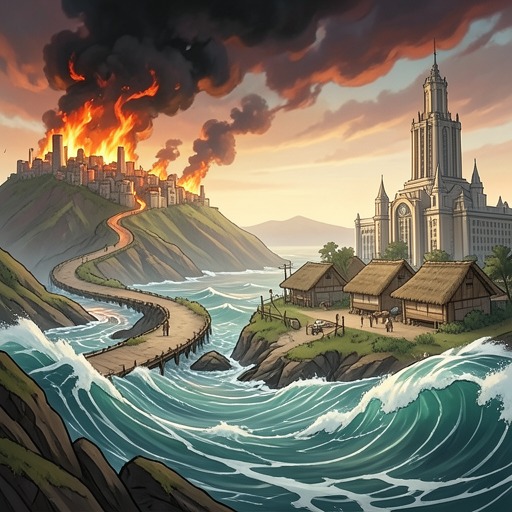
Near the Hellespont, Troy stands on the plains ruled by Laomedon, whose city is built between two projecting shores. The setting places Troy at a strategic meeting point between land and sea, while its association with Laomedon gives it an explicitly royal identity. It is not introduced as an anonymous settlement but as a fortified kingdom with a monarch, a remembered dynasty, and a geographical presence strong enough to organize the surrounding narrative.
The poem’s broader world also situates Troy within a network of divine and heroic movement. Apollo reaches the plains near the Hellespont after flying from Mount Tmolus, bringing the city into the orbit of divine action before the Trojan war is fully recalled. Troy thus functions as a stage where the mortal history of kings and warriors intersects with the interventions and designs of the gods.
The City’s Destruction
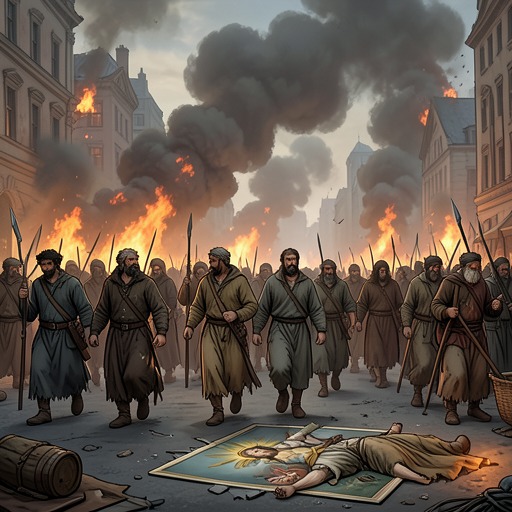
The account of Troy’s later history turns on its destruction. The city is overthrown, and the catastrophe threatens to erase not only its buildings but the hopes attached to the Trojan state. The fall is therefore a reversal from royal substance to ruin: a place that embodied political continuity becomes evidence of its collapse. The poem treats this destruction as decisive, yet it does not allow the disaster to have the final word.
Priam responds to the death of his transformed son by mourning him as though the story were unknown. A cenotaph preserves the son’s name and title, creating a memorial structure for someone whose bodily fate has already been altered. Within this Trojan context, remembrance survives through names, tombs, and monuments even when ordinary political and familial order has failed. The city’s history is repeatedly refracted through such acts of mourning, in which loss is acknowledged but not allowed to disappear without a trace.
Aeneas and the Trojan Survivors
After Troy has been destroyed, Fate denies that Trojan hopes should perish with the state. This distinction between the city and its people makes the Trojan aftermath a narrative of separation and survival. Troy itself is lost, but its future remains active in the survivors who carry its bloodline, memory, and claims beyond the ruined homeland. The departure of Aeneas is consequently not a retreat without purpose; it is the movement by which a defeated people becomes the bearer of a larger destiny.
The Trojans set sail for Crete while remembering that they descend from Teucer’s blood. Their voyage shows how identity is preserved through genealogy even when territory can no longer provide a home. Yet the journey is not governed by human choice alone. Heaven forbids the attempted settlement, and pestilential divine force drives the Trojans onward. The failed arrival in Crete makes exile itself part of Troy’s inheritance: the survivors must continue moving because the destiny attached to them has not yet reached its appointed land.
Ruin, Memory, and Rome
Troy’s destruction becomes the necessary prehistory of Rome. The voyage of Aeneas carries the remnants of the fallen city into a sequence of migrations through which Trojan lineage is not extinguished but relocated. The city’s political defeat is thus converted into a dynastic and imperial beginning. What disappears in place persists in descent, narrative, and future foundation.
Near the end of the poem, the contrast between Troy and Rome is made especially sharp. Mycenae, Sparta, and Thebes, once celebrated for their fame, have vanished from substance into name, while Dardan Rome is only beginning to rise. Troy belongs to the same pattern of historical change: its material greatness has passed, but its name and blood continue into a city that will possess a later and more durable prominence. The ruined city is therefore both warning and origin, an emblem of the instability of earthly power and a source of continuity beneath that instability.
Narrative Significance
Troy gathers several of the poem’s central transformations into one location. It changes from a living kingdom into a destroyed city, from homeland into remembered ancestry, and from the endpoint of one heroic tradition into the starting point of another. Its story also extends the poem’s interest in alteration beyond individual bodies: states, cities, dynasties, and civilizations are subject to the same pressure of change.
The city’s importance lies in the tension between extinction and survival. Troy cannot be restored as the city it was, and its fall remains a genuine historical and emotional loss. Nevertheless, the Trojan future survives through Aeneas’s voyage and the continuing force of Trojan descent. In that sense, Troy is the poem’s great image of displaced continuity: a vanished place whose destruction makes possible the rise of something new.