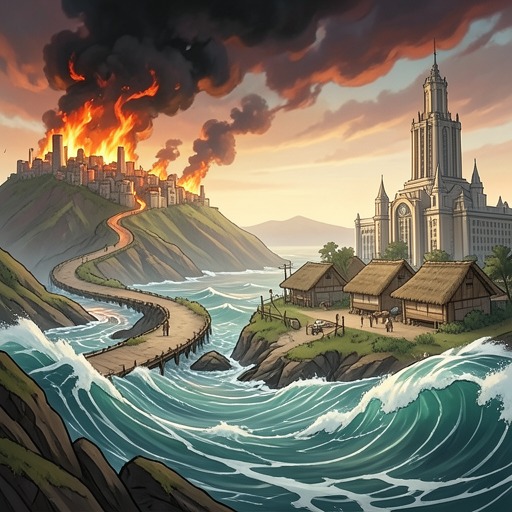
Aeneas
Metamorphoses (Ovid Edition)Aeneas is the Trojan survivor through whom the poem turns the destruction of Troy into the beginning of a new historical order. His decisive significance lies not in a single transformation, but in his preservation: although Troy falls, Fate does not permit the hopes associated with Troy to perish with the city. Aeneas therefore embodies survival as continuity, carrying a defeated people’s future beyond the ruins of their homeland and toward Latium, Rome, and the divine ancestry later claimed by Roman power.
Identity and Historical Function
Aeneas enters the poem as a figure defined by the tension between loss and continuation. The fall of Troy is presented as a catastrophe severe enough to destroy the city, yet insufficient to extinguish its destiny. Fate denies that Troy’s hopes should perish with the state, and Aeneas becomes the surviving bearer of that interrupted promise. His identity is consequently both heroic and genealogical: he is an individual who escapes destruction, but also the vessel through which Trojan memory is transferred into the future.
This role places Aeneas within the poem’s larger architecture of change. The work begins by singing of bodies changed into various forms, but its later books extend transformation from individuals to peoples, cities, and political worlds. Aeneas does not need to undergo a bodily metamorphosis to be transformed by the narrative. Troy’s defeated prince becomes the founder-ancestor of a new order, and the movement from Trojan ruin to Roman prestige gives his voyage the character of a political and mythic metamorphosis.
Voyage from Troy
After Troy is destroyed, Aeneas is compelled to continue rather than remain with the fallen city. His voyage is governed by a destiny that outlasts Saturnia’s hatred. The poem describes him as surviving the period of that hostility according to an irrevocable decree, making his escape an outcome of cosmic determination rather than mere luck or private skill. His endurance is therefore measured against the persistence of divine opposition: the journey succeeds because Fate ultimately proves stronger than the anger directed against him.
The hazards of the sea sharpen the contrast between Aeneas and other voyagers. At the place where Scylla has been changed into rocks, destruction waits for ships that beat against the waters. The pride of Ulysses’ famous fleet bulges there, while good Aeneas escapes the fate that overtakes it. The juxtaposition makes survival morally and narratively legible. Aeneas is not simply one more sailor exposed to maritime danger; he is the voyager whose mission remains protected when another celebrated expedition is broken by the transformed landscape.
His destination is the Latian shore. That arrival gives geographical direction to the poem’s movement from the eastern ruins of Troy toward the Italian future. The shore is more than a place of refuge: it is the threshold at which exile becomes foundation, and at which a survivor’s flight begins to acquire the meaning of national origins. Aeneas’s voyage thus joins danger, preservation, and settlement in a single historical trajectory.
Relations, Lineage, and Divine Descent
Aeneas’s importance is also secured through descent from Venus, the beautiful goddess who bore him. In the poem’s closing political theology, the goddess is invoked to establish that a great ruler should not appear to rise from a merely mortal stock. Her relation to Aeneas supplies the divine elevation of the Roman line: what begins with a Trojan hero is retrospectively connected to celestial ancestry and then to the authority of Rome’s rulers.
This genealogy makes Aeneas a mediating figure between the mortal and divine spheres. His own life belongs to exile, warfare, shipwreck, and threatened survival, yet his bloodline permits later Roman history to be read as more than an accidental succession of human events. Through Venus and Aeneas, political legitimacy is translated into sacred inheritance. The lineage does not erase the violence and displacement from which it emerges, but it places those experiences within a providential account of Roman continuity.
The poem’s treatment of Aeneas therefore prepares the later claims made for Julius Caesar and Augustus. The Roman future is represented as descending from a Trojan survivor whose destiny endured the destruction of his city, while divine ancestry gives that future a status reaching beyond ordinary mortality. Aeneas is the crucial link in this chain: Troy’s remnant passes through him into the Roman present, and the Roman present can then imagine itself as rooted in both heroic endurance and heavenly favor.
Narrative Role and Political Significance
Aeneas belongs to the poem’s final shift from mythic episodes of bodily change toward the continuity of Roman history. The fifteenth book announces a movement through Numa, the doctrines of Pythagoras, Hippolytus, Asclepius, Julius Caesar, and the epilogue. Within that sequence, Aeneas is not an isolated character but part of the bridge by which myth becomes civic memory. His voyage supplies the origin story necessary for later accounts of Rome’s rulers and divine patrons.
The contrast between Aeneas and the ruined fleet of Ulysses also reveals the poem’s preference for destiny that produces continuation over adventure that ends in spectacle or loss. Ulysses’ fame cannot protect his ships from the transformed Scylla, whereas Aeneas’s mission carries him onward. The difference is not simply between two heroes; it is between two narrative economies. One journey is remembered through destruction, the other through survival and the future it makes possible.
The closing praise of Roman power ultimately amplifies Aeneas’s significance. Julius Caesar is presented as a figure whose greatness in arms and arts demands divine elevation, and his spirit is imagined as being changed into a star so that he may assume divine rites. Augustus, in turn, is associated with the sovereign rule that blesses the human race. These later apotheoses depend on a lineage whose mythic foundation lies in Venus’s son, the Trojan who escaped when Troy itself could not. Aeneas’s story thus gives imperial theology a narrative beginning: the road to celestial Rome runs through the survival of one displaced hero.