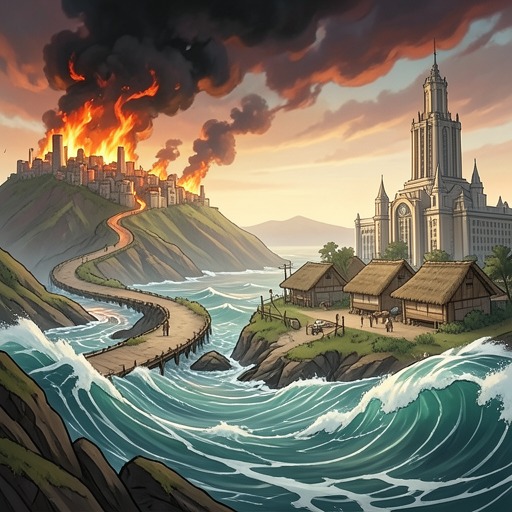
Aeneas's voyage route
Metamorphoses (Ovid Edition)Aeneas's voyage route traces the movement of Trojan survival through a hostile and providential world. It begins after Troy has been destroyed but not wholly erased by Fate, and ends when Aeneas reaches the Latian shore, where marriage, kingship, and the future of Rome become possible. The route is therefore more than a sequence of sea passages: it is the narrative corridor through which a vanished city gives way to a rising people.
Definition and Narrative Function
The route belongs to the larger geography of Ovid's Metamorphoses, a poem devoted to bodies changed into different forms and to the divine powers that bring those transformations about. Within that expansive design, Aeneas's journey supplies a political and historical continuation after the fall of Troy. Troy's destruction does not conclude the Trojan story, because Fate denies that its hopes should perish with the city itself. The voyage relocates Trojan identity rather than abolishing it, carrying its lineage, memory, and future across shifting waters.
The route also connects distant cultural and political spaces. The surviving Trojans remember that they sprang from Teucer's blood when they set sail for Crete, while the final destination is the Latian shore and the country nourished by the Tiber. Between those points, the journey passes through a world in which divine prohibitions, pestilence, storms, and dangerous waters repeatedly interrupt human plans. Its geography is consequently governed by a tension between movement and restriction: Aeneas must continue, but he cannot simply choose the course.
From Troy to Crete
The first decisive condition of the route is the destruction of Troy. The city has been reduced to ruin, yet the poem presents this catastrophe as a beginning as well as an ending. Aeneas escapes the fate that overtakes the fleet associated with Ulysses, preserving a Trojan line when the old city and other heroic enterprises have been broken. His survival gives the voyage its central stake: he is not merely seeking a harbor, but carrying forward what the fall of Troy appeared to have destroyed.
The Trojans initially steer toward Crete, confident in the memory of their descent from Teucer. Their confidence is checked by Heaven, which forbids the settlement they appear to have chosen; pestilence follows, and the intended destination becomes a place of divine rejection rather than fulfilment. This episode establishes a recurring principle of the route. Human ancestry may suggest a destination, and human effort may carry the ships there, but neither inheritance nor navigation can overrule the gods' larger design.
Perils of the Sea
Aeneas's passage unfolds amid the unstable forces that dominate the poem's natural world. The winds are personified agents of damage: Eurus is sent toward the rising morning and the eastern regions, while the South Wind brings night and horror, shaking fog from his wings and pouring streams from his divided beard. Such imagery makes the sea route an arena in which weather becomes an expression of divine or elemental power. The travelers are exposed not to an empty landscape but to competing forces capable of scattering fleets and altering the terms of survival.
The route reaches one of its most dangerous points when Aeneas weathers Charybdis. The passage is framed by the wrecking of Ulysses' fleet, whose pride is said to have been swollen by the perilous waters, while Aeneas escapes the fate encountered by the other hero. This contrast gives Aeneas's movement a distinctly providential character. Seamanship matters, but survival is also a sign that his journey has not yet completed its appointed work.
Arrival in Latium
The voyage ultimately brings Aeneas to the Latian shore, where he cuts through the foaming flood with well-timed oars. The sea journey ends in a landscape defined by the Tiber, which rolls majestically toward the sea and enriches the surrounding countryside as it runs. The river is not merely a geographical marker. It signals the conversion of wandering into settlement, and of maritime uncertainty into the fertile political ground from which a new order can grow.
Aeneas's wishes are crowned by his kindred gods through Lavinia and the throne of Latinus, but the promised reward is not granted without war. Arrival therefore does not mean peace or effortless possession. The route delivers Aeneas to the threshold of power, yet conflict remains the price of establishing himself there. The voyage's endpoint is consequently both homecoming and another beginning: the sea has been crossed, but the struggle to make a future in Latium has only assumed a new form.
Historical and Thematic Significance
The route gives physical shape to the poem's larger argument that nothing remains fixed. Troy vanishes from substance into name, as do Mycenae, Sparta, and Thebes, yet the Trojan future survives through displacement. Cities perish, peoples move, and political centers change; continuity is found not in unchanged buildings or territories but in the transmission of lineage and destiny through altered forms.
The voyage also binds mythic transformation to Roman historical memory. Its movement from Troy toward the Tiber prepares the rise of Rome, a city described as only beginning to rise while older places have already become names of vanished greatness. Aeneas's route thus works as a bridge between heroic loss and imperial emergence. It preserves the past by refusing to leave it where it fell, carrying Trojan identity through storms, forbidden settlements, pestilence, and treacherous waters until exile becomes the first stage of Rome's future.