Ages of Man
Metamorphoses (Ovid Edition)Ages of Man is the poem’s great chronology of human deterioration, arranging history as a sequence of material and moral transformations. It begins with the Golden Age, when newly created humanity lived without coercive law because uncorrupted reason was sufficient, and descends through Silver, Bronze, and Iron into a world marked by labor, violence, possession, and ingenuity directed toward destruction. The scheme is not merely a lost-age myth: it establishes the poem’s governing logic that change may be degradation, while still belonging to the larger continuity of metamorphosis.
The Golden Age and Its Natural Abundance
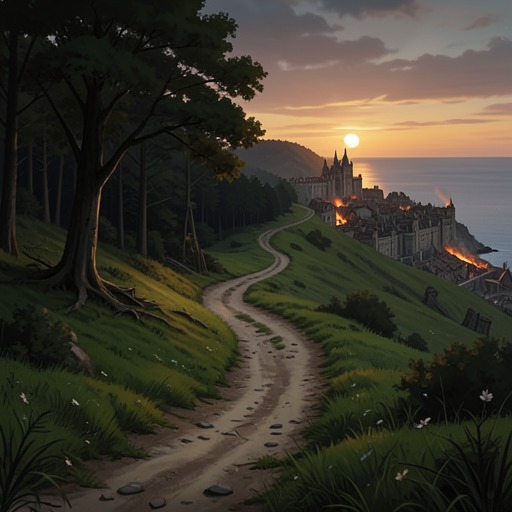
The Golden Age comes first, when humanity was still new and needed no ruler or written law. Uncorrupted reason served as its only rule, so justice did not depend on punishment, institutions, or force. The absence of conflict was expressed through the absence of weapons: there were no armies, fortified cities, or defensive walls because no community yet required protection from another.
The age’s abundance was spontaneous rather than produced by labor. The earth yielded food without ploughing, cultivation, or seasonal anxiety. Rivers were imagined as sources from which milk and nectar flowed, while honey seeped through the pores of oak trees. Nature therefore functioned as both landscape and provision, supplying human need directly instead of demanding work, ownership, or technical control. The Golden Age represents a complete correspondence between human appetite and the world that nourishes it.
Saturn, Jupiter, and the First Historical Break
The transition to the Silver Age is connected with the displacement of Saturn and the rule of Jupiter. When Saturn was banished from the upper realm and driven to the underworld, the world came under Jupiter’s authority. The change in divine sovereignty accompanies a change in human experience: the effortless, timeless abundance of the first age gives way to a more differentiated and demanding order.
The Silver Age is marked by the division of the year into seasons. Humanity must now endure spring, summer, autumn, and winter rather than inhabiting a perpetual climate of ease. Shelter becomes necessary, with houses replacing open dwelling; the earth must be worked, and the ox is first placed beneath the yoke to break fruitful furrows for seed. Agriculture introduces both dependence and discipline. Food remains possible, but it is no longer simply offered: it must be secured through labor, tools, animals, and a recognition of time’s recurring pressures.
The Bronze and Iron Ages
The Bronze Age follows as a more warlike generation, described as quick to bloody rage though not yet wholly impious. Its defining metal gives the age a harder and more martial character. Violence has become a central human possibility, but the moral collapse is still incomplete; the bronze people retain a remnant of religious restraint even as their temper grows aggressive.
The Iron Age completes the descent. Hard steel succeeds bronze, and the people become stubborn like the metal itself. The social and moral consequences appear in the spread of violence, greed, and hostile ingenuity. Trust gives way to suspicion, and the world is no longer organized around common abundance. Human beings seek wealth from the earth, treat land as something to possess, and turn their technical intelligence toward weapons, traps, and methods of killing.
This final age does not merely make people poorer or more warlike. It changes the relation between humanity and nature. The earth is forced to surrender metals, and the sea is crossed by ships in pursuit of gain; boundaries that once protected communities are violated by exploration motivated by acquisition. War follows, along with the breaking of hospitality, the betrayal of kinship, and the normalization of bloodshed. The Iron Age is therefore a condition in which physical hardness and moral hardness mirror one another.
The Age Scheme and the Poem’s Transformations
Ages of Man supplies a structural model for the wider poem. Later stories repeatedly show bodies, landscapes, animals, and divine figures changing form, but the age sequence gives those local metamorphoses a historical direction. Daphne becomes a laurel, Io becomes a heifer, and other figures pass from human or divine identity into new natural shapes; the age myth places such changes within a world where nothing remains permanently in the figure with which it began.
The recurrence of decline also creates contrasts among individual narratives. Divine punishments can turn a person into an animal, plant, stone, or other altered being, while rescue or remembrance may give that new form a lasting place in the world. The stories of Calisto, the birth of Bacchus, Salmacis and Hermaphroditus, and Venus and Adonis all belong to a poetic universe in which identity survives through transformation rather than through unchanging substance. The historical ages thus function as a collective metamorphosis: humanity changes as decisively as any individual character.
The poem later returns to the sequence in its meditation on change, recalling that gold was debased into silver, silver into copper, and copper into the final metal. The image makes historical deterioration part of a wider natural process. Places and their forms decay, just as bodies and institutions alter, but alteration is not identical with annihilation. The ages are therefore both a moral history and an argument about form: the world loses one condition and enters another.
Ethical Memory and the Possibility of Restraint
The Iron Age’s violence becomes especially significant when set against later teachings about how life should be sustained. In a moral appeal to spare animals, goats are allowed to provide milk and sheep to offer protection against winter cold, but nets, snares, and other devices of destruction are rejected. The contrast recalls the age myth’s distinction between useful cultivation and destructive ingenuity. Labor itself is not condemned; what is condemned is the conversion of intelligence into an instrument for killing.
These precepts are attributed to the Samian sage and are said to have been brought by Numa to the Sabines and then transferred to Rome. The teaching recommends vegetable nourishment and avoidance of the sacrilegious taste of blood. In this context, the memory of the Golden Age is not only elegiac. It becomes an ethical standard against which later human conduct can be judged, preserving the possibility that a degraded age may recover some discipline, reverence, and restraint even if it cannot simply return to the world that preceded it.