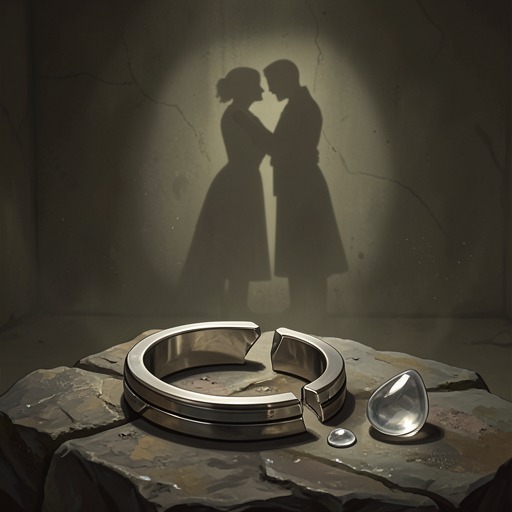
Ceyx and Alcyone
Metamorphoses (Ovid Edition)Ceyx and Alcyone form one of the most sustained marital relationships in the poem: their love is tested not by infidelity or rivalry, but by distance, foreboding, death, and the limits of human knowledge. Ceyx leaves despite Alcyone’s fear of the sea; after his ship is destroyed, a dream reveals his fate, and her recognition of his corpse completes the movement from anxious separation to unbearable certainty. The gods finally transform both spouses into winter birds, preserving their conjugal affection while also binding them to the fate that destroyed their human lives.
Marriage and the Decision to Depart
The tale is introduced through Ceyx, a pious prince troubled by prodigies and by further events that have increased his perplexity. He avoids Delphi, once his more celebrated destination, because robbers from Phlegya have made the road unsafe. Yet the danger of the land does not remove his need to travel, and he resolves to undertake the fatal voyage without concealing it from Alcyone.
Alcyone’s response establishes the emotional structure of the relationship. She does not passively accept his decision: she asks him to be warned against the watery route, describing the stormy sea as frightening and recalling the recent sight of broken planks drifting on the water. Her fear is not abstract suspicion but an interpretation of physical evidence. She would still grieve if he travelled by land, but land would lessen her fears; the sea represents a danger she cannot control or accompany him through.
Ceyx nevertheless departs. The marriage is therefore marked by a painful conflict between attachment and obligation: Alcyone seeks to preserve the shared household by preventing the journey, while Ceyx accepts separation in pursuit of the course he has chosen. The tragedy grows from the fact that neither spouse’s devotion is defective. Her warning is loving and perceptive, while his departure is not presented as a betrayal of her; the catastrophe arises because affection cannot neutralize the world beyond their home.
The Shipwreck and the Unanswered Absence
At sea, the threat Alcyone has imagined becomes reality. A tempest darkens the sky and drives the waters into violent motion. The ship spins helplessly; the storm tears away the mast and carries off the rudder. The destruction of these two instruments removes both propulsion and direction, leaving Ceyx exposed to forces that cannot be mastered by human skill.
The storm also converts marital separation into informational separation. Alcyone does not know what has happened, and Ceyx cannot return to explain it. Her anxiety therefore has no immediate object against which it can be resolved. The absent husband remains suspended between safety and death, while the wife is forced to measure time without reliable news.
The gods intensify this interval of uncertainty. Ceyx is not permitted to leave the heavens, and a cloud is drawn over his mournful eyes. Meanwhile Alcyone, still ignorant of his fate, counts the nights since his departure and watches the waning moon hour by hour. Her waiting is thus made visible through repeated calculation and observation: time continues, but it yields no reassurance. The waning moon becomes an external measure of a marriage whose expected reunion is steadily receding.
Dream, Recognition, and the Collapse of Hope
The supernatural message comes through sleep. A dark spirit, preparing for flight, glides with wings so soft that their movement is scarcely heard and travels swiftly to Trachin. The dream does not merely offer Alcyone general foreboding; it brings the absent husband’s fate into the space of her sleeping mind, where the boundary between presence and absence can briefly be crossed.
When Alcyone reaches the shore, the truth is no longer concealed. A body lies before her, and as she looks more closely her fear increases because recognition becomes unavoidable. She knows too much precisely because she knows whom she sees: it is her husband’s corpse. The scene turns knowledge itself into a wound. Before recognition, hope remains possible; after it, the emotional uncertainty created by the voyage is replaced by the finality of death.
Her response is immediate and bodily. She loudly shrieks upon recognizing Ceyx, and the relationship that had been maintained through memory, expectation, and nightly counting is confronted with physical remains. The sea has returned the husband whom it took, but only in a form that makes reunion impossible. The warning Alcyone gave before his departure is retrospectively fulfilled, while her earlier distinction between land and water becomes a measure of how completely the sea has justified her fear.
Metamorphosis and the Persistence of Marriage
The ending does not erase the tragedy. The gods translate both Ceyx and Alcyone into winter birds, and the transformation explicitly leaves them exposed to their former fate. Their new shapes are therefore not a simple escape from suffering. Metamorphosis preserves the mark of the catastrophe even as it changes the bodies that endured it.
At the same time, the transformation protects the central value of their relationship. Their conjugal affection remains tied between them after death and after the loss of human form. The marriage is not dissolved by the shipwreck, the corpse, or the metamorphosis; instead, divine power converts the bond into a new natural condition. Love survives, but it survives in a changed register, inseparable from the winter setting and from the memory of the storm.
The story consequently moves through a severe sequence of relational reversals: companionship becomes departure, departure becomes uncertainty, uncertainty becomes recognition, and recognition becomes a transformed form of togetherness. Its final miracle offers neither an ordinary happy reunion nor a complete defeat. Ceyx and Alcyone are restored to one another as birds, but their preservation is shaped by the fate that first separated them. The tale’s decisive significance lies in that doubleness: metamorphosis grants continuity to conjugal devotion while acknowledging that love cannot restore the human life the sea has destroyed.