Deucalion
Metamorphoses (Ovid Edition)Deucalion is the mortal survivor who reaches the summit of Mount Parnassus after the Flood with Pyrrha, his wife and the only other human being left alive. His decisive significance lies not in conquest but in endurance: faced with a world emptied of people and transformed into a silent waste, he turns grief into prayer and obedience to sacred instruction, becoming the human agent through whom the ruined world can begin again.
Identity and Survival
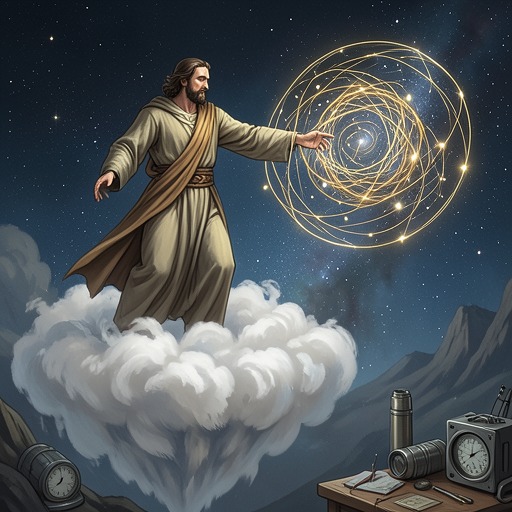
Deucalion appears at the end of the Flood as a remnant of humanity rather than as an isolated adventurer. His small boat is moored high on the summit of Mount Parnassus, whose forked height rises through the clouds. The elevated refuge marks the scale of the catastrophe: ordinary ground has disappeared beneath the waters, while survival has been reduced to a single precarious vessel and a single surviving couple.
Pyrrha is not merely his companion but his wife and the only human survivor alongside him. Their paired survival gives Deucalion’s character a communal dimension even in apparent isolation. Humanity has not been preserved as a crowd, a kingdom, or a lineage, but as a fragile marital pair capable of receiving and transmitting a future.
Grief in the Renewed World
When the waters recede, Deucalion confronts no restored homeland. Nature itself seems astonished at what it beholds: a dismal desert and a silent waste. The Flood has ended, but its consequence is an emptied world, and survival therefore becomes an encounter with loss rather than an immediate triumph.
Deucalion looks upon this desolation with pity and weeps before speaking to Pyrrha. His grief is directed both toward the vanished human race and toward the impossible burden now placed upon the two survivors. The scene defines him through recognition: he understands that remaining alive is not enough, because the world’s human order has been erased.
His address to Pyrrha also binds the survivors through several forms of kinship at once. He calls her wife and sister, emphasizing marriage, shared humanity, and the intimate closeness created by catastrophe. Their relationship becomes the emotional foundation for the restoration that follows, while his tears make the threatened future a matter of mourning before it becomes a matter of action.
Prayer and the Search for an Answer
Rather than act through force or attempt to rebuild by ordinary means, Deucalion and Pyrrha join their tears and invoke the gods with pious prayers. Their devotion eases their grief, but it does not erase the crisis; prayer becomes the means by which they seek direction when human knowledge can no longer provide a solution.
They consult sacred oracles and then pursue their way to the brook of Cephisus. The movement from the mountain refuge to the sacred source gives Deucalion’s survival a ritual structure. He leaves the place where he endured destruction and enters a landscape in which divine instruction can be received, turning private bereavement into a religious quest for the renewal of human life.
The episode presents Deucalion as a figure whose defining strength is reverence. He does not presume that survival grants him mastery over the altered world. Instead, he accepts that the restoration of humanity depends on interpreting a command beyond ordinary understanding, and he proceeds with Pyrrha despite the uncertainty of what they have been told.
Transformation and Restoration
After receiving the oracle’s instruction, Deucalion doubts his own interpretation and hesitates before the apparent meaning of the command. He and Pyrrha nevertheless resolve to make the attempt. Their uncertainty is important: the restoration of humanity does not begin with confident knowledge, but with obedience tested by bewilderment.
Descending from the mountain, they loosen their garments, veil themselves, and cast stones behind them. Deucalion therefore participates in a bodily and ceremonial act rather than a merely verbal one. The stones, ordinary objects associated with the earth, become the material through which a new human race is generated. The transformation converts the remains of the devastated world into the substance of its renewal.
His role is inseparable from Pyrrha’s. The two survivors perform the same act together, and the restoration is consequently neither Deucalion’s solitary achievement nor a simple divine replacement of the dead. It is a cooperative passage from mourning to creation, in which human piety and supernatural metamorphosis meet.
Narrative Role and Significance
Deucalion occupies a foundational place in the cycle of metamorphoses. His story moves through a clear sequence of destruction, survival, recognition, ritual appeal, doubt, and renewal. The Flood supplies the external catastrophe, but his response supplies the moral and narrative continuity: he preserves humanity first by remaining faithful to Pyrrha and the gods, then by carrying out the act that makes human return possible.
His characterization is concentrated and emblematic. Deucalion is defined by the single governing idea of faithful survival, yet the evidence gives that idea several distinct forms: he is a husband, a mourner, a supplicant, an interpreter of divine instruction, and an active participant in miraculous restoration. His tears do not mark passivity; they become the beginning of prayer, and prayer leads to the act that changes stones into the ancestors of renewed humanity.
The story also establishes a recurring pattern in which catastrophe does not end in simple destruction. The emptied landscape becomes the threshold of a new order, and Deucalion’s movement from Mount Parnassus to the waters of Cephisus traces that transition spatially as well as emotionally. He stands between the lost human past and the regenerated human future, making his endurance the hinge on which the world’s second beginning turns.