Fall of Troy
Metamorphoses (Ovid Edition)Fall of Troy is presented as both a military triumph and a human catastrophe. The Greeks’ ten-year labor finally succeeds, but victory leaves Troy burning, its royal family broken, its children killed or expelled, and its survivors forced into uncertain exile. The event closes one historical world while supplying the grief, displacement, and ancestral memory that carry the poem toward Rome.
Causes and Historical Turning Point
The fall follows the prolonged Greek struggle against Troy, whose completion is described as ten years of labor repaid by success. The city’s defeat is therefore not an isolated skirmish but the culmination of an entire war and the reversal of Troy’s former security. Its walls, towers, and dynastic order can no longer protect the people gathered within them; military conquest becomes the instrument through which a civilization is reduced to flight, enslavement, and mourning.
The destruction also carries the weight of a transition between mythic and imperial histories. Troy’s ruin does not end the poem’s movement through time. Survivors leave the smoking land, and the Trojan line continues through later wanderings toward the foundations of Rome. The catastrophe thus functions as a violent beginning as well as an ending: the old city disappears, while its displaced bloodline remains available for a new political future.
The Sack and Destruction of the City
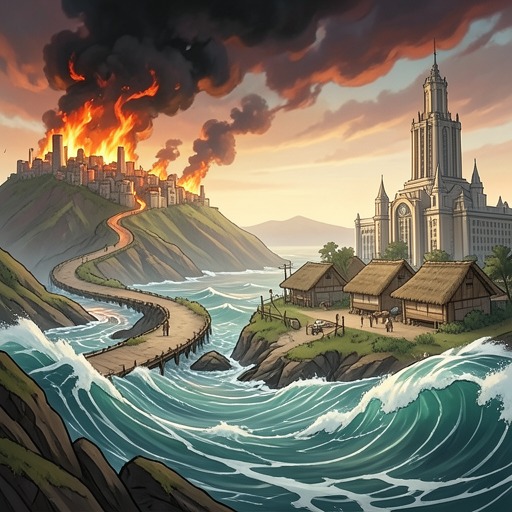
The visual center of the event is the burning of Ilium. Its flames rise in pointed columns, while the red glare is reflected in the Hellespont. Fire transforms the city from a defended home into a spectacle visible across the surrounding landscape, making destruction public and inescapable. The image joins architecture, sea, and sky in a single field of ruin: Troy is not merely conquered inside its walls but erased as a place that could continue to shelter its people.
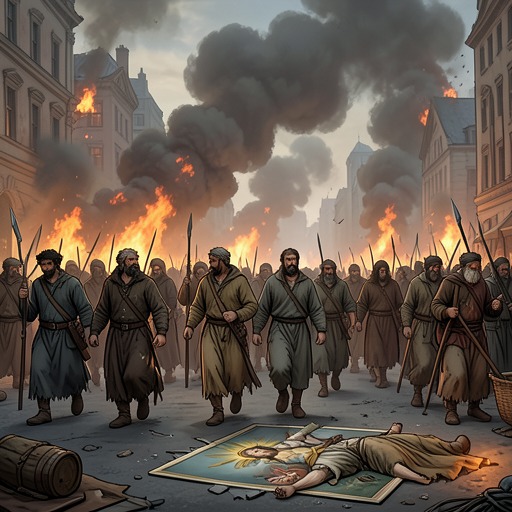
The Greeks carry away the defeated population and the spoils of victory. Trojan women cling to statues until force tears them away, a gesture that places religious devotion against military power and shows the conquerors’ triumph as dispossession rather than simple honor. The captives’ attachment to their gods and civic images cannot preserve either sanctuary or homeland. Sacred objects remain, but the society that gave them meaning has been broken.
The destruction reaches the royal household with particular brutality. Astyanax is thrown from the high towers from which he once looked down with pleasure. The contrast between his former innocent view and his fatal fall condenses the collapse of Troy’s future: the child who might have inherited the city is removed from it through violence. The fall therefore destroys not only present inhabitants and buildings but also dynastic continuity.
Hecuba and the Human Cost of Victory
Hecuba survives the immediate slaughter, but survival offers no relief. She is found weeping over the sepulchres of her children and is dragged away by Ulysses from the graves of her murdered sons. Her final appearance aboard the departing ship makes the conquered queen a figure of forced separation: she must leave the dead behind while being carried into an unknown future as part of the victor’s spoils.
Her grief culminates in transformation. With Troy fallen and her losses complete, she becomes a creature that can no longer speak with a human face; she mourns in borrowed sounds and barks terribly across the plains of Thrace. The change does not erase her sorrow but gives it a new, inhuman form. Hecuba’s altered voice makes the aftermath of war audible as a rupture in identity: a queen, mother, and human mourner is reduced to an animal presence still carrying the memory of everything destroyed.
The event’s emotional logic is consequently different from the Greeks’ military logic. For the victors, ten years of effort have reached their desired conclusion. For Hecuba and the Trojans, the same conclusion means graves, captivity, separation from sacred images, and the destruction of the city’s future. Victory and devastation occupy the same moment, but the values attached to it are reversed according to one’s position within the conflict.
Survivors, Exile, and Aftermath
The remaining Trojans eventually abandon the smoking ruins and kiss the shore before departing. This farewell is at once physical and ritual. The survivors acknowledge that the land they leave is no longer a functioning homeland, yet their gesture preserves a final relationship with it. Departure becomes the only possible form of fidelity to a city that can no longer receive them.
The aftermath extends beyond the immediate Trojan generation. The Trojans sail toward Crete, remembering that they descend from Teucer’s blood, but divine prohibition and pestilence prevent that settlement. Their first destination after the war is therefore not a secure restoration but another frustrated stage in exile. The fallen city remains a source of identity, while its descendants must repeatedly move through foreign lands and divine obstacles.
In the poem’s wider historical vision, ruined cities become names after their substance has vanished. Mycenae, Sparta, and Thebes are said to have disappeared from material existence into memory, while Dardan Rome is only beginning to rise. The contrast places Troy’s destruction within a recurring cycle of growth and disappearance: cities that seem permanent can become recollections, whereas a new power can emerge from the remnants of an older one.
Narrative and Political Significance
Fall of Troy is a tragedy of reversal in which a celebrated military achievement produces the extinction of a city and the suffering of its civilians. The event combines conquest, captivity, child-killing, dynastic collapse, exile, and metamorphosis, so its consequences cannot be contained within the battlefield. The Greeks achieve their objective, but the poem keeps attention on what that objective costs those who lose.
At the same time, the catastrophe is absorbed into a larger Roman genealogy. The Trojan survivors’ continued movement allows ruin to become ancestry, and ancestry in turn becomes a claim to future political importance. The poem’s later concern with Rome, divine favor, and the apotheosis of Julius Caesar makes the fall of Troy part of a long sequence in which violence, migration, and sacred legitimacy are connected. The city’s destruction is therefore remembered not as an isolated end, but as the dark ancestral threshold of later foundations and imperial power.