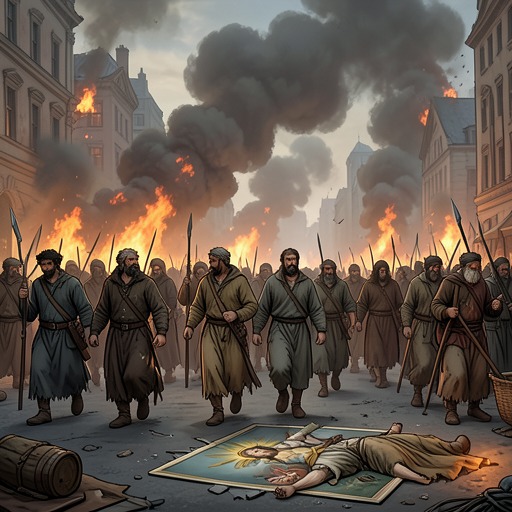
Hecuba's Transformation
Metamorphoses (Ovid Edition)Hecuba's Transformation marks the final collapse of royal identity under the pressure of grief and revenge. After the fall of Troy, Hecuba has already lost her city, status, and many of her children; the discovery that her youngest son Polydorus has been murdered on the Thracian coast converts her remaining hope into a demand for vengeance. Her transformation into a dog is therefore not an isolated marvel but the terminal consequence of war, betrayal, maternal attachment, and retaliatory violence.
Causes and Background
Hecuba's despair briefly gives way to hope when she remembers that Polydorus, her youngest son and last remaining consolation, is living on the coast. That hope is destroyed when she sees his corpse on the riverbank, his body bearing the marks of Thracian arrows. The discovery makes the political catastrophe of Troy intensely personal: even the child preserved from the war has not escaped its violence, and the foreign shore offers him no honorable burial, only a grave and a mother's tears.
The killing also reveals a betrayal within the supposed shelter of exile. Polydorus has been placed in Thrace, yet the Thracian king has murdered him rather than protected him. Hecuba responds not as a powerless captive awaiting events but as a bereaved mother who turns knowledge of the crime into an objective: she must find the murderer and make him answer for the death. The episode consequently combines the dramatic situations of the discovery of a relative's crime, blood-kin revenge, and pursuit. Its decisive reversal lies in the movement from helpless mourning to active retaliation.
Discovery and Pursuit
Hecuba's sight of Polydorus's arrow-pierced body is the scene's first irreversible turn. The matrons around her shriek, while her grief exceeds ordinary expression. Yet mourning does not end the action. Hecuba traces the ravisher by following his footprints, pursuing the king despite her age and captivity. The physical image is important: the queen's revenge begins as a literal tracking of the murderer, with the path of his body becoming the path toward judgment.
When Hecuba reaches him, she conceals her purpose beneath apparent welcome. She greets the murderer with feigned joy and listens attentively to his soothing lies. The performance is tactical rather than submissive. Her outward hospitality allows her to hold the king near while her inward response changes from controlled concealment to open fury. The contrast between his deceptive speech and her watchful silence makes the encounter a contest between verbal power and embodied knowledge: he tries to govern the story of Polydorus's death, while Hecuba has already seen the body that disproves him.
Revenge and Retaliatory Violence
Resentment finally sets her blood boiling. Hecuba springs upon the king amid the captive crowd, and the thirst for vengeance supplies the strength that age and bondage should have denied her. She tears out his eyes, pulling the rooted eyeballs from their sockets and staining her hands in the hollow orbits. The punishment answers the crime through a brutal bodily correspondence: the murderer who caused a mother's loss is deprived of sight, while Hecuba's own sight of Polydorus's corpse has supplied the knowledge that enables revenge.
The attack also overturns the expected hierarchy between captive queen and ruling king. Hecuba possesses no army, throne, or recognized tribunal, but the scene gives her grief a temporary physical force greater than her political weakness. Her revenge is nevertheless not represented as a restoration of order. It is an eruption of violence inside an already lawless world, and the king's injury does not restore Polydorus or repair the ruined house of Troy. The value at stake shifts from life and dignity to mutilation and fury: the murdered child cannot be recovered, so justice appears only as reciprocal destruction.
Transformation and Ending
The Thracians answer Hecuba's attack by firing darts and stones at her. Their assault closes the remaining space in which she might still act as a human queen. Surrounded by hostile weapons, she snarls and growls rather than speaking in a human tone; she bites impatiently at the bounding stone and extends her jaws as though trying to raise her voice. The transformation is conveyed through a progressive breakdown of human language and posture. Her anger remains, but it is now expressed through animal sound, teeth, and jaws.
The change into a dog thus joins punishment, metamorphosis, and persistence. Hecuba is deprived of human speech and social identity, yet the text does not erase the continuity between the queen and the animal. The dog retains the bodily intensity of her grief and vengeance: the transformation makes visible what the violence has already done to her humanity. She has been reduced by war to a captive, by bereavement to a mourner, and by revenge to a creature attacking with teeth; the final metamorphosis gives that degradation a nonhuman form.
Narrative Significance
The episode bends the transformation pattern toward revenge rather than renewal. Hecuba does not receive a return to family, homeland, or political power. Instead, the narrative drives her through loss, discovery, pursuit, retaliation, and exclusion from human speech. The movement resembles a quest whose object is not rescue but retribution, and its ending refuses the consoling reintegration often associated with metamorphosis.
Hecuba's animal form also unsettles the boundary between human suffering and animal existence. The Thracians call her response inhuman by attacking her amid the captive crowd, but the narration makes her altered sounds the direct continuation of a recognizable maternal rage. Her body becomes the medium through which grief survives after ordinary human institutions—family, kingship, burial, and justice—have failed. The dog is not merely an emblem placed beside the story; it is the final shape taken by a subject whom war and betrayal have pushed beyond the limits of civilized identity.