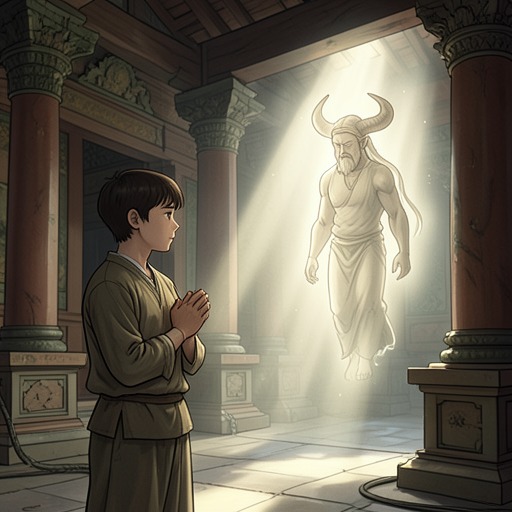
Iphis' Sex Transformation
Metamorphoses (Ovid Edition)Iphis' Sex Transformation is a metamorphosis in which a concealed female birth becomes a male body through divine intervention. The change resolves the danger created by Lygdus's demand for a son, transforms Iphis's relationship with Ianthe from an impossible attachment into a socially recognizable marriage, and makes the sacred power of Isis the force that converts fear into public legitimacy.
Family Law and Concealed Birth
The story begins in Crete, where Lygdus is described as a man of modest birth and limited wealth whose standing nevertheless earns the respect and affection of his neighbors. Before the time appointed for childbirth, he bluntly declares his wish concerning the expected child. His demand is not presented as a private preference without consequence: the child's sex determines whether the infant may safely live, and the household's poverty makes that patriarchal judgment especially severe.
Telethusa, Lygdus's wife, gives birth to a beautiful child, but the child is female. Rather than expose the infant to the fate implied by her husband's order, Telethusa conceals the birth and raises the girl as a boy. The disguise governs Iphis's entire early identity. The child receives the male name Iphis, and the household must preserve the secret while allowing the community to believe that Lygdus has obtained the son he wanted. The narrative therefore makes gender a condition imposed by family authority before it becomes a visible bodily fact.
Love and the Impossible Marriage
Iphis grows up within the male identity arranged by Telethusa, while Ianthe becomes the central object of affection. The neighboring monarchs, drawn by Ianthe's beauty, compete for the honor of marrying her, and the world seems open to her choice except for the one union that Iphis desires. That exception exposes the limits of the social order surrounding both young women: Iphis's attachment is emotionally real, but the marriage customs of the story recognize no acceptable form in which it can be fulfilled.
The approaching wedding intensifies the concealed crisis. Iphis and Ianthe are joined by affection, yet their promised marriage depends upon Iphis continuing to be taken for a man. For Iphis, the conflict is not merely between desire and prohibition. It is between an inward attachment that has developed under a name and role assigned to her, and a public ceremony that will force the household's secret into the open. The story's suspense thus turns on whether social recognition can be secured without destroying the person who has been protected by disguise.
Telethusa's Prayer to Isis
When the decisive time draws near and the fatal secret is about to be revealed, Telethusa turns to prayer. She and her daughter appear with disheveled hair before Isis, trembling with fear, and place their hopes entirely in the goddess's protection. Telethusa's appeal joins maternal desperation to religious trust: the same woman who once used concealment to save the child now asks divine power to make that concealment unnecessary.
The prayer receives a visible response. Isis nods, her altar shakes, and the temple doors move as though struck by a blast of wind. The sacred setting marks the intervention as something outside ordinary human negotiation. Lygdus's command had threatened life through domestic authority, while Telethusa's supplication invokes a higher power whose decision can overturn the bodily condition on which that command rested.
The Bodily Metamorphosis
Iphis follows Telethusa from the temple, at first not wholly afraid and not fully reassured. Then the transformation begins in observable stages. The whiteness leaves the face; the appearance gains a more imposing grace; the features and strength grow together. The change is not described as a simple alteration of clothing or social presentation. It reaches the body itself, giving physical form to the male identity that has been maintained since childhood.
The transformation proceeds through voice and bearing as well as appearance. Iphis's sparkling eyes shine with manly vigor, the voice becomes large, and the tone grows audacious. At last the previously hidden bodily parts develop, extend, and become male. The narrative culminates in an explicit reversal of status: the girl becomes a youth, and delay is no longer necessary. What had been a secret sustained by maternal fear is now an embodied condition that can pass openly through the world.
Resolution and Narrative Significance
Isis's intervention makes the marriage to Ianthe possible, but it also reveals the coercive structure that made transformation necessary. Iphis's love does not arise only after the change; the change instead answers a social and legal crisis produced by the demand for a male child and the restrictions placed on marriage. Divine metamorphosis functions as both rescue and commentary: it preserves the attachment by adapting Iphis to the available public category of husband.
The episode belongs to the recurring pattern of transformation in which an impasse is translated into a new bodily form. Unlike transformations that punish violence, vanity, or forbidden desire with animal, plant, or mineral existence, Iphis's change restores social participation. The temple, altar, prayer, and divine nod make the event a sacred crossing from danger into recognition, while the altered face, voice, strength, and hidden parts provide a detailed anatomy of that crossing. The ending does not erase the earlier fear; it shows that the household can move forward only after the body itself has been made to satisfy the rule that threatened it.