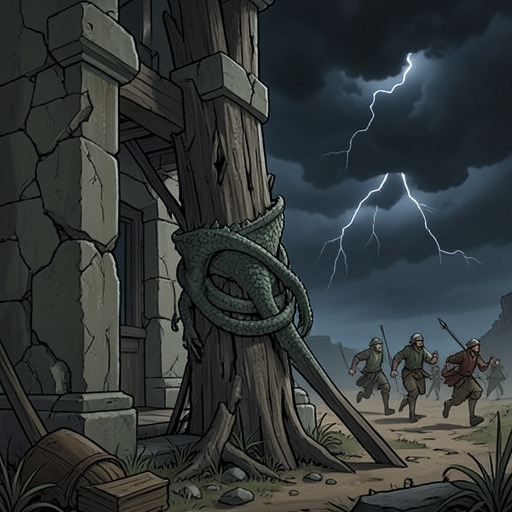
Pentheus
Metamorphoses (Ovid Edition)Pentheus is the central human antagonist in the story of the Bacchic rites at Thebes, and his significance lies in the way his opposition turns disbelief into self-destruction. He treats the worship surrounding Bacchus as irrational disorder, but the power he rejects is real, divine, and capable of overturning ordinary boundaries. His death is therefore not merely a punishment for an isolated act: it is the decisive reversal through which the narrative establishes that human authority cannot safely deny a god’s presence.
Identity and Opposition
The story introduces Pentheus as a ruler whose judgment is defined by hostility to the rites of Bacchus. The Thebans of every rank and sex join the god’s processions, mingling in the ceremonies and swelling his retinue, while Pentheus stands apart from this collective movement. The contrast is political as well as religious: the city is drawn into a new communal spectacle, but its ruler interprets that gathering as a threat to reason, discipline, and civic control.
Pentheus’s defining conflict is therefore with divine ecstasy itself. The Bacchic celebration dissolves distinctions of rank and sex into shared ritual participation, whereas Pentheus insists on judging it from the position of sovereign authority. His resistance gives the narrative a conflict between fixed identity and metamorphic power: he seeks to keep Thebes within the limits of familiar law, while Bacchus’s worship reveals a force that can transform both individuals and the social order around them.
Escalation and Fatal Error
Pentheus expresses his rage in direct address to the Thebans, asking what madness has seized their souls and challenging the meaning of hollow drums and drunken shouting. His language reduces the rites to noise and intoxication. Rather than investigating the divine claim made by the new worship, he dismisses its signs in advance, converting skepticism into contempt. This refusal is his decisive error, because it leaves no space for the possibility that what appears irrational may possess supernatural authority.
The narrative makes his anger progressively more dangerous. When an earlier response fails to restrain him, Pentheus becomes more furious and resolves to send no more messengers. The decision marks a movement from delegated inquiry to personal intervention. He no longer governs through reports or commands from a distance; his rage drives him toward the scene in which his authority will be exposed to the power he has denied.
Death and Reversal
Pentheus’s death is presented as the culmination of this unchecked fury. The heading that announces his death gives the episode its final shape: the man who sought to suppress the Bacchic movement is himself destroyed by the conflict he attempted to master. The reversal is especially stark because the rites had already drawn the whole city into their orbit. Pentheus’s isolation does not preserve him from the transformation overtaking Thebes; it makes him its most conspicuous victim.
His fate belongs to the book’s larger pattern of metamorphosis, in which bodies, identities, and social conditions are repeatedly changed by divine or extraordinary forces. Unlike figures who are transformed into another enduring form, Pentheus reaches the limit of resistance through physical destruction. His story thus supplies a dark counterpart to the book’s many survivals and conversions: where others pass from one state into another, Pentheus’s refusal ends in death.
Narrative Role and Thematic Significance
Pentheus functions as a tragic embodiment of rigid opposition. His objection is not shown as a measured examination of the rites but as an increasingly furious attempt to deny them. The story’s dramatic energy comes from the widening gap between his interpretation and the reality known to the narrative: he sees only madness, while the reader is shown the consequences of confronting a god as though divine power were merely human disorder.
The episode also contributes to the recurring tension between order and excess in the larger poem. Bacchic ritual represents collective exhilaration and the breaking of ordinary limits; Pentheus represents the individual will that believes those limits can be enforced by command. His death does not simply celebrate disorder, however. It demonstrates that the poem’s world is governed by forces larger than any one ruler’s categories, and that attempts to make the mutable universe answer to a single rigid judgment can end in catastrophic reversal.
Pentheus’s story consequently stands beside the poem’s other transformations as a warning about the cost of refusing change. The work begins by singing of bodies changed into various forms, and Pentheus’s episode gives that governing principle a political and moral shape. The ruler who cannot admit that the world contains powers beyond his understanding is not permitted to remain unchanged; his resistance becomes the instrument of his ruin.