Perseus
Metamorphoses (Ovid Edition)Perseus is presented as a deathless grandson whose existence converts ancestral suffering into enduring fame. Even when earlier figures meet a harsh and inglorious fate, each continues to live in the renown of this descendant, making Perseus a figure of hereditary memory as well as heroic action.
Identity and Inherited Renown
Perseus belongs to a line in which mortal catastrophe does not end a family’s significance. The poem contrasts the inglorious fate suffered by earlier generations with the lasting honor preserved through their grandson. His identity is therefore framed genealogically: he is not an isolated adventurer, but the living continuation of a lineage whose meaning is measured by what survives after death.
That inherited renown also gives Perseus a mediating role between mortality and permanence. The dead cannot escape their fate, yet their name is not wholly extinguished when it passes into the deeds of the descendant. Perseus embodies this transformation of loss into reputation, a recurring logic in the poem whereby bodily destruction, divine intervention, or metamorphosis produces a new form of continuity.
The Perseus Narrative
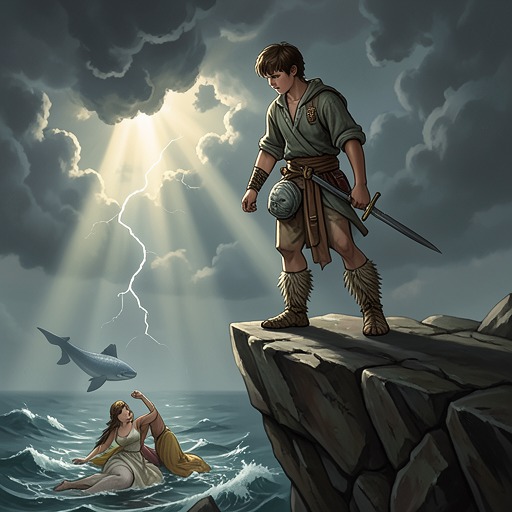
The Perseus story is introduced through the account of his rescue of Andromeda from a sea monster. The scene is set after Aeolus has confined every blustering wind in strong chains and deep imprisonment, a supernatural restraint that prepares a temporary calm for the crisis at the shore. Against that controlled elemental background, Andromeda’s danger becomes the central heroic emergency, and Perseus appears as the agent of rescue.
His heroism is defined by action rather than by detached observation. He intervenes in a situation governed by threatening natural and divine forces, placing his own strength and skill between the endangered woman and the sea monster. The episode establishes him through the rescue pattern: a vulnerable figure is exposed to destruction, a monstrous power enforces the danger, and Perseus crosses into the scene as the champion capable of reversing it.
Medusa and the Heroic Instrument
Perseus is also associated with Medusa’s head, an object whose power turns the logic of heroic combat into a weapon of transformation. When a warrior asks what arts enabled him to win Medusa’s snakes, the hero complies and explains how a valley lies beneath cold Atlas. The question draws attention away from simple victory and toward the knowledge, technique, and extraordinary setting that made the victory possible.
Medusa’s head is significant because it preserves the defeated monster’s danger after Medusa herself has been overcome. Perseus does not merely destroy a threat; he acquires and carries forward its petrifying power. His achievement therefore joins conquest with possession: the hero’s triumph depends on making the enemy’s own force serve a new purpose. In this respect, Perseus exemplifies the poem’s broader pattern in which violence is not erased but redirected into another form.
Relations, Rescue, and Legacy
The rescue of Andromeda places Perseus within a relationship structured by protection and deliverance. Her danger gives his heroism a visible human consequence, while the sea monster provides the opposing force against which his identity becomes legible. The episode also connects his personal fame with the continuation of a larger heroic genealogy, since the poem repeatedly treats descendants as vessels through which earlier lives remain publicly present.
Perseus thus stands at the intersection of several recurring mythic functions: he is a rescuer, a slayer of a monstrous threat, a bearer of a dangerous transformed object, and the descendant through whom ancestral renown becomes deathless. These functions are not separate decorations around a single character. Together they show how the poem turns the hero into a passage between catastrophe and commemoration, allowing what has been lost to persist in altered form.