Romulus
Metamorphoses (Ovid Edition)Romulus stands at the point where mythic transformation becomes Roman political memory. He emerges amid succession, violence, and contested kingship, takes command in battle, and embodies the growing state’s passage from vulnerable community to imperial power. His decisive transformation is not into an animal, plant, or natural feature, but into a god: the mortal founder is absorbed into the sacred identity of Rome as Quirinus.
Identity and Historical Setting
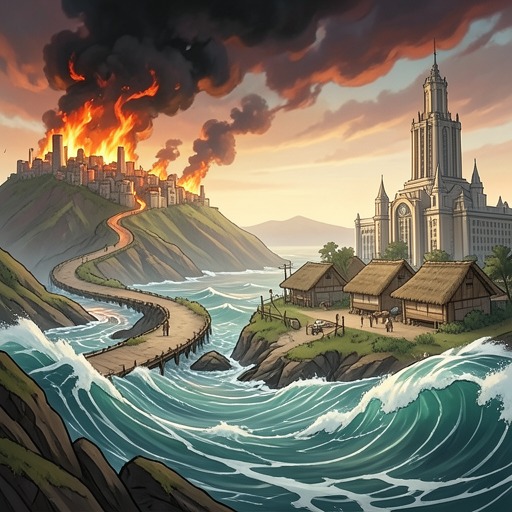
Romulus belongs to the Fifteenth Book, where the poem turns toward Numa, the foundation of Crotone, the teachings of Pythagoras, the death of Numa, Hippolytus, Asclepius, and the apotheosis of Julius Caesar. His story therefore appears within a late-book movement from legendary origins toward Roman institutions and imperial succession. The narrative places him in a dynastic crisis after Procas yields to the Fates and his son Numitor succeeds to the crown, while the false Amulius seizes power through unlawful rule.
Romulus is presented above all as a military ruler. When conflict erupts, he appears in shining armor and rouses the Roman legions to war. His identity is consequently formed through both kingship and armed protection: he is not merely the beneficiary of Rome’s foundation, but the figure who gives its emerging political order force in the field.
Rise Through Conflict
The succession crisis supplies the political background to Romulus’s rise. Procas’s submission to Fate leads to Numitor’s accession, but Amulius disrupts that sequence by exercising lawless power. The contrast establishes Romulus within a struggle between rightful succession and usurpation. His later prominence is thus connected to the restoration and defense of legitimate Roman order rather than to private ambition alone.
When Romulus enters the war, the poem emphasizes the visual authority of his arms and the effect of his presence on the legions. The battle rages across the field, and his appearance turns the Roman army toward action. The scene makes military leadership a form of political animation: Romulus warms the legions to war, giving collective strength a single commanding figure.
The conflict is not represented as an isolated victory. Tatius is eventually slain by Lavinian fury, while Romulus continues to reign for a long time. This juxtaposition separates the violent end of a rival from the durability of Romulus’s rule. His power survives the immediate battle and becomes the basis of a lasting royal order.
Kingship and Divine Sanction
Romulus’s reign is framed by the intervention of Mars, who puts on his burnished helmet and addresses Heaven’s imperial throne. The divine scene broadens the meaning of Roman kingship beyond the battlefield. Romulus’s authority is treated as part of a relationship between the lower world and the celestial realm, where the condition of the human order calls forth a divine response.
The Fifteenth Book repeatedly links Rome’s future greatness to a providential historical design. A prophecy associated with Helenus promises that, when Ilium is sinking, the fortunes of Aeneas and his line will be renewed and that the round world will eventually be contained in Rome. Romulus belongs to the later fulfillment of this trajectory. The city he rules is not portrayed as an accidental power but as the destination toward which the poem’s Trojan and Roman succession has been moving.
This framework gives Romulus a double status. Within the immediate story he is a warrior and king; within the larger architecture of the poem he is a bridge between ancestral myth and the universal claims of Rome. His reign helps turn inherited legend into political continuity.
Apotheosis as Quirinus
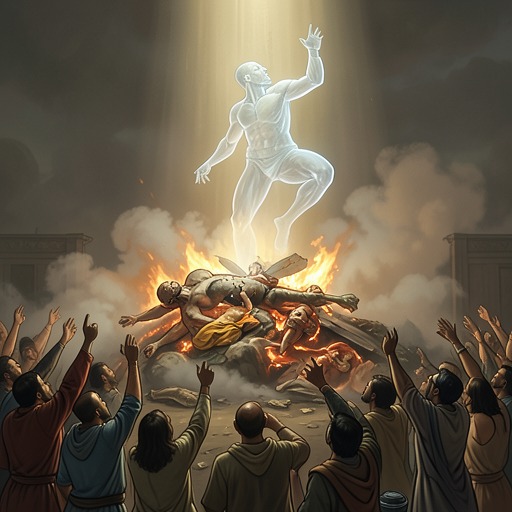
Romulus’s final change is an apotheosis. Mars asks that the hero’s fleeting spirit, still fresh from his wounds, be carried away and changed into a star. Through this celestial transformation, Julius’s later star does not stand alone: the poem establishes an earlier Roman pattern in which the founder’s mortal body and martial achievement are translated into divine presence.
The name Quirinus marks the completion of this process. Romulus does not simply disappear from history after death; he is reclassified within Rome’s sacred order. His identity as king is retained but elevated, allowing the mortal founder to remain present as a divine protector and civic ancestor. The transformation therefore preserves political memory by changing its register from human reign to heavenly status.
The image of the spirit becoming a star also extends the poem’s governing principle that bodies and forms change while significance persists. The work begins by singing of bodies changed into various forms and ends by asserting that its own achievement will survive storms, fire, war, and wasting age. Romulus’s apotheosis mirrors that larger poetic logic: mortality is not erased, but converted into a form capable of enduring beyond ordinary human time.
Narrative and Political Significance
Romulus is one of the clearest figures through whom the poem joins metamorphosis to Roman state ideology. Earlier transformations often expose desire, punishment, grief, or the violence of divine power; Romulus’s change instead authorizes a community’s political memory. War, kingship, and sacred elevation are arranged as successive stages in the consolidation of Rome.
His story also prepares the later elevation of Julius Caesar. The closing books move from Roman foundation and heroic kingship to the claim that Caesar’s spirit will become a star and that Julius will assume divine rites. Romulus and Julius therefore form a linked sequence: the founder becomes Quirinus, while the imperial ancestor becomes a god. The poem presents Rome’s rulers as figures whose earthly authority can be absorbed into the heavens.
Yet the elevation remains rooted in violence and succession. Romulus’s greatness follows a crisis of unlawful rule, a raging battle, and the death of Tatius; his celestial honor is not detached from the force that established Roman order. That combination is central to his narrative role. Romulus embodies the poem’s effort to make conquest, rule, ancestry, and divinity appear as parts of one continuous Roman history, while his transformation gives that history its most enduring emblem: a mortal founder made permanent in the stars as Quirinus.