Alcohol dependence and self-deception
Midwinter BreakAlcohol dependence and self-deception are bound together in Gerry’s drinking: whiskey offers him immediate comfort and a way to manage fear, memory, and sleep, while the language of moderation lets him avoid naming the harm. The contradiction is visible in small, repeated acts—an oversized pour kept out of Stella’s sight, a promise to take only a little followed by another drink, and bottles secretly bought, emptied, and hidden. His dependence is not presented as a single dramatic collapse but as a practice of concealment whose costs reach his body and marriage.
Ritual, quantity, and concealment
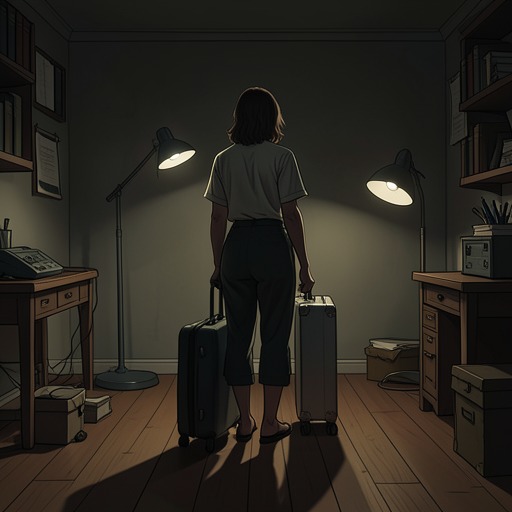
At home, Gerry waits until Stella has gone to bed before filling a Kilkenny jug and pouring whiskey into his favourite Waterford crystal tumbler. He tops the drink with water, but the dilution does not make its size modest: he fills the glass to the brim. The heavy crystal makes the drink feel more substantial to him, and he sets it on a low bookshelf where Stella would not see its volume if she came back into the room. He insists that he is not hiding his drinking, since he will openly describe having a substantial dram after she goes to bed. Yet he arranges the glass so its measure remains unseen. The distinction he draws between acknowledging a habit and concealing its scale is central to his self-deception.
The setting turns the drink into a private nightly ceremony. With the house quiet and the heating switching off at Stella’s bedtime, Gerry chooses a CD, puts on headphones, and turns the music up even when it is already loud and clear. He sips slowly and tells himself the whiskey will help him sleep and leave him ready for the next morning’s holiday. The promise of practical benefit sits beside his knowledge that he will need a couple more drinks to get through the night. Later, when Stella returns to bed, he pours another whiskey. He calls for only a small amount, then adds another small amount on top of it, making the measure larger while treating each increment as negligible. His reflection that the world recognizes only drunkenness or sobriety gives him a way to imagine a middle ground in which his repeated drinking does not yet count as a problem.
The stories he tells himself
Gerry’s descriptions of alcohol shift with what he needs from it. At one moment it smooths the roughness of life, like an iron passing over wrinkles; with more, he imagines himself rising and becoming freer, more perceptive, and more loving. He frames the effect as a spectrum of gradations rather than a straightforward increase in intoxication. The metaphor makes drinking sound like a finely controlled instrument, although the sequence he describes is one of escalating consumption. His next-day plans and the idea of a midwinter break likewise help present the night’s drinking as preparation for ordinary life rather than a threat to it.
In a bar, Stella buys Gerry a Jameson Irish whiskey and leaves the measure to the server, asking that ice be kept out and water brought separately. He mocks the small pour, and when Stella returns with her fizzy water he dilutes the whiskey himself. He compares alcohol to the rubber tyres between himself and a pier; Stella answers that it is what gets him by, and he replies by including her in what sustains him. The exchange makes drinking sound like a shared joke and a familiar accommodation between them. But the drink is still his chosen buffer, and the affectionate toast does not resolve the difference between Stella’s light drinking and his dependence on whiskey.
That dependence also shapes the stories Gerry tells about drinking cultures and national divisions. After memories of Belfast return, he tries to concentrate on his Jameson. He contrasts whiskey made in the south, which he associates with Catholics, with Bushmills and Black Bush, which he associates with the Protestant north, then declares himself wholly non-sectarian where alcohol is concerned. The joke lets him turn a painful political and personal memory into a comic preference among drinks. Yet the memory does not recede: the more he drinks, the less able he is to resist it. Alcohol can distract him briefly, but it does not command the memories into silence.
Solitary drinking and the body’s evidence
During the Amsterdam trip, Gerry drinks alone while Stella sleeps. He retrieves an old, cumbersome iPod, accepts whichever music it plays, and carefully pours himself whiskey. Bach accompanies a recollection of a friend who had warned him against drinking alone. The friend had gone through drying out several times and argued that drinkers such as Gerry and himself set the pace for one another, while other people could act as brakes. The friend also described drunkenness as a temporary form of suicide, followed by the chance to begin again the next day. Gerry recognizes the warning but immediately tests it against his circumstances: Stella hardly drinks, so he asks himself how he can avoid drinking alone. His mock-toast to her converts that conflict into a private performance rather than a decision to stop.
The same private habit becomes harder to square with his appearance. In a hotel bathroom, after taking his cholesterol tablet, Gerry studies his reflection and reads his drinking in his face: the changing colour of his nose, the possibility of a pocked, strawberry-like surface, a leathery look, and a developing dewlap under his chin. He waggles the skin scornfully, then wonders what the drink may be doing inside him, including whether it is damaging his liver. He understands that years of habits are shaping what he calls the finished version of himself. He also knows that Stella hates his drinking and that it could end their life together. His proposed answer, however, is to keep the amount from her. He admits that he often does not know how much he is drinking, a confession that exposes the weakness of concealment as a form of control.
Secrecy in Amsterdam
At a restaurant in Amsterdam, Gerry turns an ordinary breakfast item into an opportunity to buy whiskey. He tells Stella what he plans to do, goes toward the toilet, and instead visits a small supermarket. There he buys a half-bottle of Tyrone Superior, accepting an unfamiliar and apparently poor brand because it fits into his pocket. The purchase is easy, so he stops and buys a second bottle as insurance. A high-denomination note draws a brief look from the cashier; Gerry notices that she might also be judging his sore chin, marked hand, or lack of an overcoat, but he reassures her with a smile. He puts one bottle in each jacket pocket and takes comfort in the appearance of being balanced. The joke about balance disguises a plainly deliberate plan to maintain a supply of hidden alcohol.
The secrecy continues after Stella has fallen asleep. Gerry takes a bottle from his jacket, opens it in the bathroom, and drinks there before returning to the bedroom. When his glass is empty, he refills it and adds water. He remembers that the bottles made a glugging sound in the lift and wonders whether Stella heard. What might expose him is not a confrontation but an incidental noise, and his attention is fixed on inventing an excuse if she asks about it.
Later, he pours the remaining whiskey from a half-bottle into the larger duty-free bottle and hides the empty in his pocket. He repeats the process with the second bottle, then leaves the room in stocking feet to dispose of the empties. The first hits the hotel waste bin with a loud metallic bang; Gerry apologizes and quietly slips the other inside. His careful use of an extra key card and his effort to leave the door ajar are practical precautions against waking Stella, but they also extend the concealment into a small operation requiring planning, physical effort, and deception.
Recognition without resolution
Lost in the hotel corridors, Gerry tries to identify his room by landmarks, including an ice-making machine and a tray holding pizza topped with artichokes. The episode makes his attempt to control the evidence comic and precarious: he cannot remember the room number because he left the paper attached to the key card behind, and the identical doors frustrate his efforts to navigate. He thinks of religious confession, contrition, and a firm purpose to change, recalling how once, as a teenager, he had resolved never to repeat a sin and felt briefly uplifted. He considers whether drink might be different if he got help or genuinely applied himself. But he also recognizes that deciding to quit while drunk is the wrong moment to make the resolve.
The thought that Stella is one of the people he may hurt brings the moral cost of his drinking into focus. He imagines leaving her in the middle of the night in Amsterdam, then pictures more extreme possibilities of disappearing and dying unseen. The fears are comic in their elaboration, but they grow from a real recognition: secrecy cannot guarantee that the consequences will remain private. At last he finds the slightly open door of room 396, returns to the familiar bed, and pours himself another drink to celebrate having stowed the empties. The ending refuses a clean conversion. Gerry has seen the pattern, its danger to his health, and its threat to his marriage, yet the immediate reward of whiskey still governs his next action. His self-deception lies not in total ignorance, but in repeatedly turning recognition into another reason to postpone change.