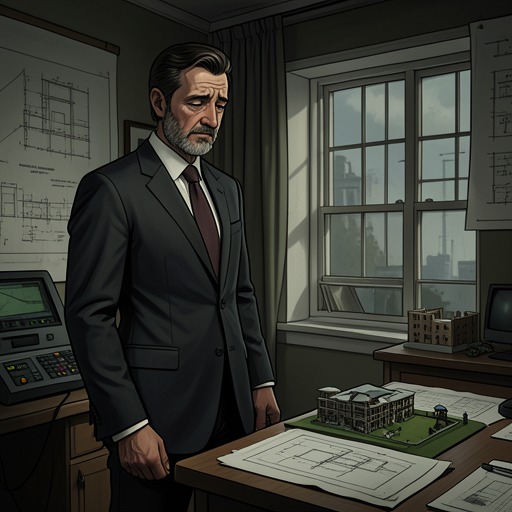
Arson attack on Gerry’s Derry office
Midwinter BreakThe arson attack on Gerry’s Derry office is recalled not as a solved act of political violence but as a devastation whose authorship and purpose remain unknown. In Gerry’s memory, the fire consumes more than a workplace: it turns architectural plans, models, and accumulated labor into ash, making the destruction of a place of creation the attack’s lasting wound.
Background and Uncertainty
The memory surfaces as Gerry watches television news showing burning buildings and tanks. He wonders whether the images come from Beirut, Syria, or Iraq, then recalls that the office where he worked on the Diamond in Derry had been firebombed. Nobody ever discovered who carried out the attack or why. Gerry speculates that the perpetrators might have been young people egging each other on, and considers whether the Provisional IRA could have been responsible; neither thought resolves the uncertainty.
The uncertainty sharpens his anger at the political logic of destruction. He questions how a struggle for Irish freedom could include the burning of books and buildings, and thinks of the Irish Republican Army as destroyers of architecture. He also remembers that the Irish Republican Army had tried to burn down the Linen Hall Library in Belfast. These thoughts connect the attack on his office to a broader pattern of damage, without establishing who set this particular fire.
The Fire Imagined as a City in Miniature
Gerry tries to reconstruct the office fire by imagining it as a film staged among architectural models. In this miniature city, plan chests, rolls of tracing paper, T-squares, set squares, protractors, templates, and stencils become fuel alongside tiny cars and wire-like trees. Fire appears both as actual flame and as its reflection in model windows; small trees hiss away, and model streets, churches, schools, and halls of residence catch as their curtains become flames and their blinds twist.
The imagined blaze reaches Burt Chapel, whose copper roof becomes an inferno of apple-green flames. Labels scorch; steeples topple and bell towers collapse. Heat enters the drawers, turning handles red-hot and curling the tracing sheets until the layers of architectural work resemble pastry. The inventory gives the loss its measure: drawings, ideas, notes, materials, quantities, and measurements—hours and days of work—are reduced to ash. Gerry’s imagined city also recalls the Bombay Street burnings, where Catholics were burned out by a Loyalist mob. The association links distinct acts of violence through the image of homes and buildings consumed by fire, not through any claim that the events had the same perpetrators.
Aftermath and Meaning
When Stella heard about the office attack, her response was that nobody had been killed, and she gave thanks for that. The next morning, Gerry picked his way through the devastation looking for anything salvageable. The wood was blackened, the surviving light shades hung in distorted shapes, and blinds that had escaped melting were buckled and warped. Biscuits near his shoe still looked edible amid the wreckage, an ordinary remnant against the destruction of the working space.
The smell of the fire stayed in Gerry’s clothes for weeks, and even after that he was unsure it had completely gone. The attack therefore persists in the recollection through both its physical residue and the work it erased. The office was a place where things were made; its burning leaves an absence that Gerry connects to violence committed in the name of political struggle and religion. His remembered image of the fire is vivid, but the central facts remain stark: the office was firebombed, its creative labor was devastated, and the people responsible were never identified.