Begijnhof Church Prayer Book
Midwinter BreakThe Begijnhof Church Prayer Book brings the private voices of earlier visitors into Gerry and Stella’s present. Found on a wooden shelf at the back of a dark church, it first appears as an old, physical object; as they read its varied entries, it becomes a record of need whose most affecting story reaches beyond its pages and tests what responsibility for other people’s grief might mean.
Material Form and Setting
Gerry wanders to the rear of the church, where the light is dim and the wood is old: the floor planks and roof beams are blackened and irregular in size. On a wooden shelf lies the book. Its title appears in several languages: “Buch der Gebete,” “Book for your prayers,” and “Livre pour vos prières.” The multilingual labels establish a devotional object meant to be approached across linguistic boundaries; its pages extend that impression through the different hands and inks of those who have written in it.
A ballpoint pen lies beside the book, a small practical invitation to add another entry. Some earlier contributions are in pencil, others in coloured ink. Gerry recognizes French and German but cannot follow what they say, so the book offers him both access and limitation: its varied scripts make the past visibly present, while the languages leave parts of that past unreadable to him. He turns the pages, encountering not a single continuous account but a succession of brief appeals, most only a line or two long.
The Entries and the Abandoned Pregnant Woman
The short prayers range from the serious to the comic. Gerry laughs at one request, “May Arsenal win just one piece of silverware this season,” and Stella shushes him. The entry’s ordinary, even playful wish sits among appeals addressed to God, showing that the book accommodates the full range of what visitors bring to prayer rather than preserving only solemn declarations.
A longer entry catches Gerry’s attention. Its English handwriting has slanted loops and downstrokes that he takes to be American. He infers that its writer is a girl because she says she is pregnant, and notices further entries in the same hand: she has returned to pray for three days in a row. At first, she asks God for help. On the second day, her words register disappointment: “Yesterday I prayed and nothing happened. The miracle of Amsterdam, indeed!!!” The three exclamation marks give the complaint a sharp, almost bitter emphasis, while Gerry’s wry observation that two would have been enough cannot diminish the distress behind them.
The source of that distress is not the pregnancy alone. The writer says her lover has abandoned her and is unwilling to accept responsibility for the unborn child. She is not pursuing him, yet she asks why God would allow him to feel and act this way. By the third entry, disappointment has become accusation: “what sort of a God was he” to pass up the chance to bring three beautiful people together—the woman, her lover, and their baby? Her appeal ends in a stark condition: “Make everything right and I’ll believe in You.” The book preserves a changing encounter with faith, from a request for help, through frustrated waiting, to a challenge made by someone close to despair.
Reading as an Act of Witness
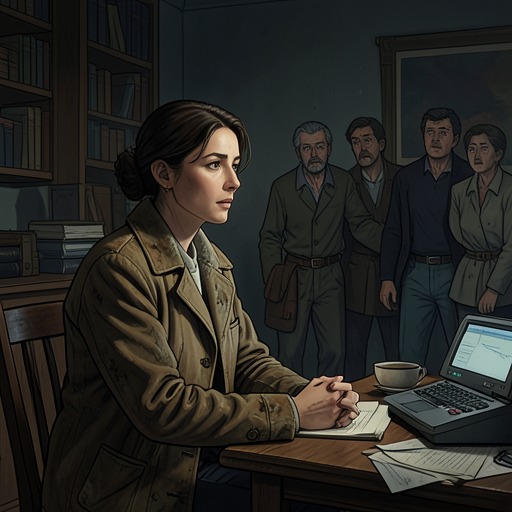
Gerry calls Stella over and points out the sequence, making the repeated visits and the woman’s worsening distress legible to them both. Stella reads the entry and answers, “Poor thing.” Then she pats the written surface as if it were the girl’s hand before returning the book to its most recent page. The gesture does not alter the woman’s circumstances or establish what became of her; it gives the absent writer a moment of imagined bodily presence. The page is no longer only a surface bearing old ink. Stella treats it as the trace of a person to whom compassion can still be directed.
That response contrasts with Gerry’s initial laughter at the football prayer and his amused attention to the woman’s punctuation. As the entries accumulate, the humor gives way to recognition of a specific abandonment: a pregnant woman has come back repeatedly, and the father is running away from responsibility. The book’s fragments do not resolve her story, but their order supplies enough to transform a stranger’s handwriting into testimony. Its silences remain important: neither the writer’s identity nor the eventual fate of her child is disclosed.
The Book’s Afterlife in Conversation
Later, Stella returns to the entry by thinking about the child: “The child would be two,” she says. Gerry replies, “Or nine months after it,” and Stella ignores the remark. The exchange gives the otherwise undated writing a place in their present conversation, while leaving the child’s actual age and fate unconfirmed. What endures is not a resolution but the imagined continuation of a life beyond the prayer book’s pages.
Stella names what stays with her as “The sadness in some people’s lives.” Gerry answers that they cannot be responsible for everybody’s grief; Stella insists, “That’s the only way forward.” Their difference gives the book a significance beyond its function as a collection of petitions. It becomes the occasion for a disagreement about the limits of care: whether recognizing suffering can entail responsibility even when no remedy is available. Stella’s earlier touch on the page anticipates her later position. The book cannot reunite the woman with her lover or answer her challenge to God, but by preserving her words it allows her need to be noticed—and makes turning away from it a question the living must confront.