Belfast
Midwinter BreakBelfast is the site of a private catastrophe and a landscape shaped by public violence. Stella is shot there while pregnant in the early 1970s, and Gerry’s memory of learning she has been injured returns decades later amid his drinking and his life with her in Amsterdam. The city also becomes the setting for Bloody Friday in Belfast, when Gerry witnesses a series of bomb explosions from a rooftop. These episodes make Belfast more than a place in the past: its violence persists in the present as memory, fear, and the unresolved history of sectarian division.
A city shaped by division
The novel presents Belfast through Gerry’s retrospective understanding of its history as well as through what he sees. Looking back at the city from a departing boat, he sees a grey outline beneath a column of black smoke and considers how sectarian hatred shaped the place from its beginnings. He recalls a prime minister who refused to employ Roman Catholics and urged others to do the same, and a Protestant majority that governed Northern Ireland for fifty years. His account also connects local history to British rule and to Bloody Sunday in Derry, which he places within a wider history of British massacres in defence of empire.
Gerry does not make the violence the property of one side alone. He reflects on the responsibility of the Irish Republican Army, loyalist organizations, politicians, and preachers, and imagines hatred being handed from one generation to the next like an inheritance. The thought turns the city’s history into a continuing human obligation: the dead and injured are not only the result of past political choices, but the potential future recipients of a hatred deliberately kept alive.
That reckoning complicates any simple political account of violence. Gerry remembers the murder of three Scottish soldiers, including two brothers, who were lured from a Belfast pub to a false party and killed outside the city. He also thinks of the killings on Bloody Friday in Belfast. Whatever the victims’ politics or persuasion, he cannot accept the killing of civilians as a price worth paying for a United Ireland. Belfast is thus represented through competing claims and histories, but the narrative keeps returning to the human cost that those claims cannot excuse.
Stella’s shooting and Gerry at the hospital
The hospital memory begins with Gerry at work. Two men from the Royal Ulster Constabulary arrive at his office and ask whether he is Gerald Gilmore, then verify his address. Their insistence that he sit down, the older man’s difficulty meeting his eyes, and the men’s unease make Gerry fear that someone has died before they tell him that his wife has been involved in an accident. The scene’s formal announcement gives almost no detail, leaving the word accident to open a space of dread.
The older officer takes Gerry to hospital in an unmarked blue Cortina. The driver and his colleague speak to one another as though Gerry is not there; he concludes that they regard him as a job to be completed rather than a person. At Casualty, the busy reception and the officer’s manner reinforce his sense that he is being treated as a second-class citizen. Gerry believes that his name has identified him as Catholic from the outset. The officers’ conduct places sectarian discrimination inside an apparently routine journey to obtain news about his wife.
At the hospital, Gerry waits through uncertainty rather than receiving an immediate account of Stella’s condition. Mavis, a volunteer known as a Pink Lady, brings him tea and tells him that Stella has left a message: all shall be well, repeated twice, with the assurance that Gerry would understand. The message carries a private meaning between the couple, but the scene offers it in a public waiting room, among cigarettes, ambulance sirens, and other people arriving for treatment. Gerry remains there for hours, unable to tell whether the sirens signal a bomb or another emergency. His fear is sharpened by the possibility of a no-warning attack, for which there would be no sirens in advance.
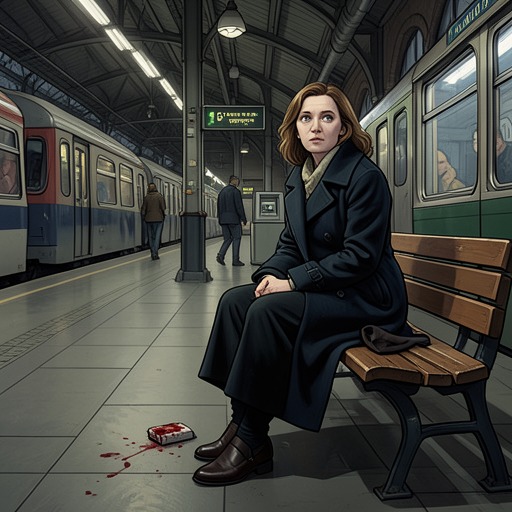
The later disclosure clarifies what the original report withheld. Stella tells Kathleen that she was very pregnant when she was shot in the stomach in Belfast. Lying on the pavement, unsure whether she was bleeding or her waters had broken, she prayed that the child would be spared and vowed to devote the rest of her life to God. The bullet passed through her body, and the child lived. She says she had never told anyone, not even Gerry. Belfast is therefore the setting of an event central to Stella’s private religious history, but one that her husband did not know about. The delayed telling makes the wound recur not only as Gerry’s traumatic memory but as Stella’s long-kept secret and unfulfilled vow.
Bloody Friday in Belfast
A separate memory places Gerry on the roof of a topping-out ceremony on the Lisburn Road, at a building associated with the City Hospital complex. It is late July; workers, architects, journalists, and guests are gathered among hard hats, safety waistcoats, food, and drinks. Gerry watches birds turning over the hills and talks with an architect friend. The ordinary ceremony is interrupted by the first bomb, whose thump makes people duck even though nothing visible appears to have happened.
A second explosion follows, then a third farther away. The people on the roof stop pretending the gathering can continue. Gerry sees a white puff of smoke near Cave Hill, and the changing distance of the blasts makes the danger difficult to locate. The bombs are understood through bodily effects as much as sight: the shock seems to fill the chest and churn the stomach. Gerry immediately thinks of Stella, who has gone by bus to Dungiven for the school holidays, and of a nurse friend who might be working in Casualty.
Only later do the scale and consequences become known: the Provisional IRA exploded more than twenty bombs, killing nine people and injuring one hundred and thirty. The delayed information distinguishes what Gerry can perceive in the moment from what he and others learn afterward. As ambulances begin to sound, people below are herded into public parks, away from buildings and cars. From the roof, Gerry and the others can look out over the city but are afraid to return to street level. The view of Belfast offers no secure distance from the violence.
Memory, distance, and private disaster
Belfast returns to Gerry in fragments. At one point in Amsterdam, remembering the Royal Ulster Constabulary officers at his office, he tries to turn his attention back to the whiskey in his glass; the memory grows harder to resist as he drinks. On waking, he again sees the older officer’s face in his mind and recalls the ride to hospital. The repetition links his present drinking to a past he wants buried, while showing that the memory remains active despite his efforts to explain away his physical discomfort.
The city’s departure image offers no clean escape from this history. Gerry looks back from the boat at Belfast beneath smoke, weighing its political past against the deaths of civilians and soldiers. The narrative places that broad history beside the intimate details of the hospital: the officer’s fidgeting fingers, Mavis’s tea, and the message Stella sent before surgery. In Belfast, sectarian conflict reaches into marriage and family life; decades later, its personal consequences still surface in what Gerry remembers and in what Stella has only now chosen to tell.