Faith and doubt
Midwinter BreakFaith and doubt name a central difference between Stella and Gerry, but not a simple opposition between belief and disbelief. Stella’s Catholic faith is expressed through repeated practices and an urgent wish to live well; Gerry questions supernatural explanations and resists her spiritual language, yet he watches, remembers, and sometimes joins her at the edges of religious life. Their difference becomes part of a wider marital question: how to use the time remaining, and whether a life can be changed without abandoning the person beside you.
Practice, memory, and the ordinary
Stella’s faith is not presented as an abstract set of convictions. She has gone several times on pilgrimage to Lough Derg, where the retreat meant three days of prayer and fasting, bare feet in the rain, no sleep, black tea, and burned toast. Gerry jokes that such an ordeal hardly qualifies as a holiday, but Stella defends the pilgrimage as a step away from ordinary life in order to concentrate on what matters. Her recollection also includes the cigarette smoke of those days: religious experience sits alongside bodily discomfort and everyday particulars rather than outside them.
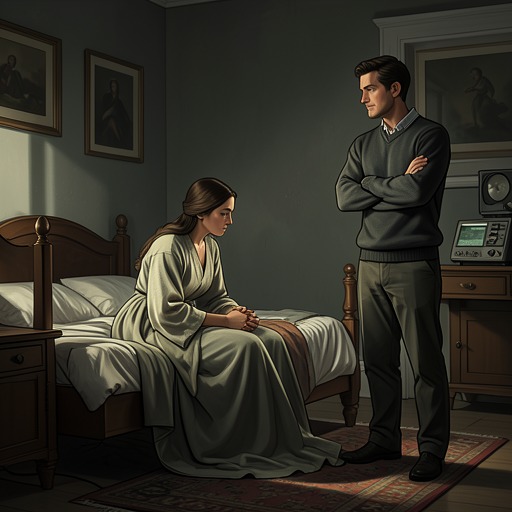
At the hotel, Gerry unexpectedly sees Stella kneeling beside the bed in her white nightdress. He first thinks she has dropped something, then recognizes that she is praying. Their usual domestic arrangement allows them to go to bed at different times and preserve their own space; this quiet act reveals a part of Stella’s life he had not known she still maintained. He considers making a joke, but stops himself and gives her time. The moment makes his restraint a form of attention, even though it does not make him a believer.
Stella’s prayer follows a framework that keeps her from drifting. She moves through the people she loves—her parents, siblings, and family elsewhere—then gives thanks for her life and survival, asking to be held in God’s care. The practice draws on memories of her father’s death: his body lay in the front room, accompanied so that he would not be alone, a rosary tied around his hands. Later, people gathered in the kitchen and a man sang. Prayer thus gathers family affection, mourning, gratitude, and religious habit into a repeated evening and morning observance.
Her prayers also extend beyond her family to refugees and people fleeing war, alongside those who are oppressed and afraid. Yet the narration registers a tension in this routine: Stella calls such prayers a kind of spiritual tidying, something done before sleep and after waking, as though putting the world to rites. The modest phrase does not cancel the compassion in the practice. It shows instead how a vast concern for suffering becomes something she can repeat, even when prayer cannot itself alter the world she is contemplating.
Sacred spaces and competing accounts of miracles
In a church they enter during their explorations, Stella recognizes a Catholic setting by the red sacristy lamp. She blesses herself, kneels briefly, and reads an English leaflet describing how Catholic worship was banned by Protestant authorities in the 1600s, forcing people to celebrate Mass in their own houses. The building makes history tangible: its old boards, dark wood, and religious use place private worship in a space shaped by earlier restrictions. Stella reads the account aloud because they are alone, making the church both a place of prayer and a setting for shared inquiry.
The story of a church built to commemorate an indestructible host becomes a compact exchange about belief. Gerry dismisses the miracle as minor, while Stella answers that miracles come in different sizes and adds that she knows this herself. Gerry counters that what happened to her was not miraculous but within the bounds of possibility. His response draws a boundary between extraordinary survival and supernatural intervention; it does not deny the force of her experience, but refuses the explanation she may attach to it. His practical pleasure that the miracle led to a church, which keeps architects employed, turns skepticism into a joke without resolving their disagreement.
Their difference surfaces again after Stella recalls an exhibition of religious relics: bones, scraps of cloth, and locks of hair that moved mostly older visitors because they seemed to offer the possibility of a cure. Gerry calls such faith superstition and jokes that the purported fragments of the true cross could build another Forth Rail Bridge. Stella does not continue the argument. Instead, she produces a postcard of an old woman reading, bought after the museum shop had run out of the particular image she wanted. Her response changes the subject without settling the question of relics; the scene leaves the desire for healing and Gerry’s suspicion of its material tokens side by side.
Belief as a question of how to live
Stella’s search becomes more explicit when she says that important questions remain: how best to live and how to live good lives. She wants a more devout life, a word from childhood that she feels has fallen out of everyday speech. She links devotion to charity and prayer, while describing herself as still exploring. She does not claim to have found settled answers; she expects that finding what she seeks will lead to harder questions. Faith here is a discipline of inquiry as much as a source of certainty.
That inquiry is bound to the stage of life she and Gerry have reached. Stella feels she has been marking time: the family has been raised and the work is done, yet perhaps ten or twenty years remain. She says they have cut the cloth of their lives wrongly and that it does not fit, then names their different beliefs. The difference is not new, but she feels circumstances have changed. She wants to do something with the time left beyond watching Gerry drink. When he asks whether he appears in her storyboard, she says he does not, giving her spiritual and ethical restlessness a direct consequence for their marriage.
Gerry’s own relation to religious practice is more complicated than simple indifference. At Christmas Mass he knows the ritual from childhood and sits beside Stella without feeling involved. Later, while pouring himself another whiskey, he recalls the exchange of peace and remembers Stella telling him that she and Sister Francis are Eucharistic ministers that night. He had watched her leave him for the altar, receive communion from the priest, and distribute hosts from a gold chalice beside the nun. Seeing Stella in that role makes her seem older and less fully known to him. After she returns to her seat and covers her face, he wonders whether she is distressed about being apart from their son and grandson, but does not intrude. His memory is filtered through uncertainty: he notices her grief but cannot confidently name its cause.
Shared language without shared certainty
The couple’s difference remains, but it does not prevent moments of recognition. Gerry’s recollection of Stella serving communion shows him encountering her as someone with a spiritual life and public role beyond the person he knows at home. In another church, he arrives at the Begijnhof and sees her reading in the dimness. The scene is marked by his breathlessness and by the thrill he still feels at finding her unexpectedly. Religious space, for him, does not produce a confession of belief; it becomes a place where attention to Stella is renewed.
At the airport, after Stella concludes that an all-female religious collective is no longer an option, she makes the future of their flat conditional on Gerry keeping his word about giving up drinking. He touches her arm, and the silence between them holds the practical stakes of their relationship. Gerry says, “All shall be well.” At Stella’s prompting he repeats the next words, “And all shall be well.” The phrase offers no proof that their problems will disappear, and the scene does not convert him to her faith. Instead, it gives them a shared utterance at a moment when they are deciding whether to continue together. The novel’s treatment of faith and doubt rests in that distinction: belief may remain unequal, while ritual, memory, restraint, and a promise can still make room for connection.