Gerry Gilmore
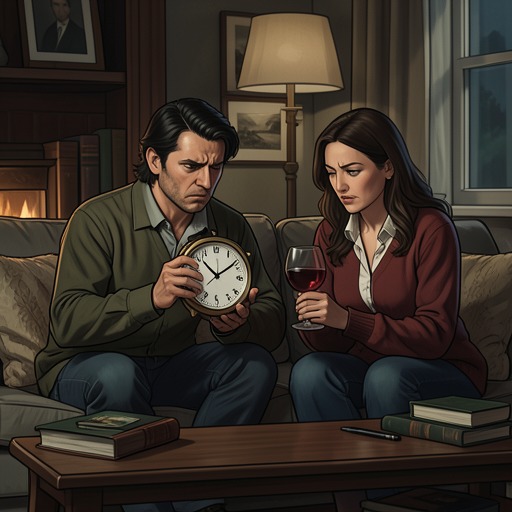
Midwinter BreakGerry Gilmore, a retired architect from Ireland who now lives in Scotland with Stella Gilmore, enters the Amsterdam trip as a familiar husband whose habits have become a source of serious distance. He is forgetful and set in his ways; she is tired of his drinking, troubled by his dismissiveness toward her faith, and increasingly uncertain about their marriage. Their long weekend is meant to refresh them and help them take stock, but its four days expose how much of their shared life Gerry has failed to see. His arc turns on whether he can recognize that his drinking is not a private indulgence, and whether a promise to stop can begin to repair the trust worn down by concealment.
Identity and Background
Gerry’s architectural career remains part of how he understands the world. He had met Stella by the late 1960s, and not long afterward took her to see a church he was working on, built at the foot of an ancient fort. He noticed the relationship between the two structures; Stella attended more to the view and to the feeling of being Celtic. The contrast suits them: Gerry is inclined to think in terms of construction and practical form, while Stella’s attention can turn toward landscape, memory, and spiritual meaning.
He remembers architecture as a practical service: a building must deliver what its users need and, above all, must not endanger them. That professional standard stands in uneasy contrast to his carelessness about his own health. On the Amsterdam holiday, his memory troubles are no longer only an eccentric inconvenience. He wonders whether he is drinking too much because he loses the ends of evenings and struggles to recall people’s names and faces. At home, he could rely on an appointments diary to greet a visitor by the name written there, even when the visitor turned out to be someone else. Stella, by contrast, remembers people and details about them. The difference makes his lapses conspicuous within their marriage.
Drinking and Self-Deception
Gerry’s drinking is presented through the small arrangements that make it seem manageable to him. At home, after Stella has gone to bed, he fills a Kilkenny jug, pours whiskey into his favourite Waterford crystal tumbler, and tops it with water. He values the glass’s weight and the drink’s heft. Although he says openly that he has a substantial dram at night, he places the glass below the arm of the sofa, where Stella cannot see how much is in it. He insists to himself that he is not hiding the drink, even as he arranges it out of sight. That contradiction captures the self-deception at the centre of his habit.
He treats whiskey as a route to sleep and readiness for the next day, telling himself that a few drinks will help him get over the night. On the Amsterdam trip, the same reasoning appears in a different setting. After Stella has returned to sleep, he tries to fend off a memory by concentrating on his drink. He distinguishes Jameson Irish whiskey from whiskey made in the North through the old sectarian labels attached to them, then claims that alcohol makes him non-sectarian. The distinction is both a remnant of the world he came from and a joke that lets him avoid the memory pressing in. He finishes one glass and pours another; the more he drinks, the less able he is to resist what he is remembering.
Gerry also measures his drinking by the effects he chooses to notice. He believes that alcohol makes him easier with people and unlike those who become violent or spiteful. Yet on the trip he wakes with a bruised chin after falling in the shower, wonders whether the drinks he had beforehand contributed, and gives Stella an account of terrible cramp while she was asleep. His recollection is vague: he has glimpses of corridors and silver bins but cannot confidently say what happened. The incident brings physical risk and memory loss into the same frame, while his explanation keeps both at a distance.
Memory and Ireland
A conversation about locked doors and rebel songs from an Irish pub brings Belfast back to Gerry. The past does not arrive as a story he calmly chooses to tell; he tries to turn away from the images and focus instead on the first mouthful of whiskey. But drinking fails to contain the memory. Its return links the couple’s present holiday to a troubled period in their native Ireland and shows how easily an ordinary stimulus can unsettle Gerry’s attempts at control.
The recalled scene takes him to his architecture office after lunch with two other architects. Two men identifying themselves as members of the Royal Ulster Constabulary are waiting in a meeting room. Their insistence that Gerry sit down makes him fear that something terrible has happened; he remains standing until a chair clangs against another and he finally takes his seat. The older officer fidgets with the tassels of a scarf and asks whether Gerry’s name is Gerald Gilmore, then checks his address. The news is that his wife has been involved in an accident. The memory breaks off with Gerry waking in a hotel room, uncertain how long he has slept or whether his watch is showing British time. It supplies no full account of the accident’s consequences, but its abrupt return makes clear that the old crisis remains active in his present consciousness.
Marriage, Faith, and the Future
Stella’s religious searching is a central pressure on Gerry because it asks her to imagine a life not organized around his habits. She wants to live more devoutly, associating that possibility with charity and prayer, while acknowledging that exploration may lead to harder questions. Gerry asks how she would pursue such a life, but Stella doubts he would understand as a non-believer. Their difference in belief is not new; what has changed is Stella’s sense that time is passing and should be used for something beyond watching him drink.
When Gerry asks whether he has a place in her imagined future, Stella says he does not. Her answer is not presented as a simple rejection but as the sharp measure of how far the marriage has drifted. Gerry is also unsettled by her talk of the flower and the gardener and by her plan to meet someone about a religious community. He cannot easily interpret these intentions, even as he recognizes that Stella is serious. Their long-established familiarity has not made him attentive to what she is becoming.
The conflict is made especially plain when Stella asks whether she could take herself away from him and whether he would blame her. Gerry says he would not. She recalls that he used to be kind and considerate and tells him that he has become nothing but appetite. Her accusation joins the drinking to the larger failure of attention: she is not only objecting to the quantity he consumes but confronting the person his repeated choices have made him seem to be. Later she names the deception directly. She knows how much he drinks, she says, and cannot mention it without being cast as a nag; no one can fix the problem for him but himself.
Promise and Change
Gerry’s response is at first defensive. When questioned about why he waters his whiskey, he says he dislikes it straight and that water takes away its burn. Stella walks away rather than continue the argument in a situation where they would be isolated together. His explanation answers the immediate practical question while evading the significance of the habit. In another exchange, he insists that he was abstemious in the hotel and expects Stella to be proud of him, but her question about why he is doing all this shows that a brief claim of restraint does not settle the deeper issue.
The shift comes when Stella says she is serious and Gerry answers that he is too. He says that after the previous night he has quit, and when she asks whether he is making a vow, he says yes. The promise follows her challenge that his drinking is accompanied by concealment and that change cannot be delegated to her. It is a decisive admission of responsibility, though the exchange does not establish how long he will keep the vow.
Gerry’s apology gives the commitment an intimate, rather than merely declarative, form. He takes Stella’s hand and strokes its back before saying he is sorry for everything. He tells her that when he looks at her he sees the ways she was, and then corrects himself to include the person she is now. His words recognize both the history he cherishes and the present Stella he has risked overlooking. He also acknowledges that she could have married anyone and made it work. The moment offers tenderness and recognition, not proof that their marriage has been repaired. Gerry’s significance lies in that unresolved interval: he can finally name the damage and make a vow, while the trust that would give the vow weight remains to be lived.