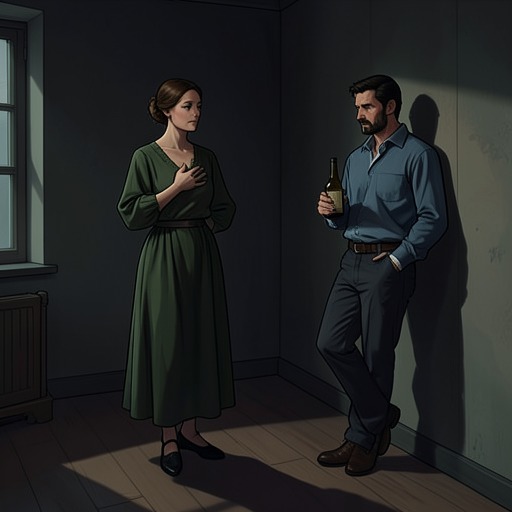
Gerry vows to stop drinking
Midwinter BreakGerry’s vow to stop drinking is a moment of accountability within his troubled marriage to Stella: after she exposes the secrecy and loneliness his drinking has caused, he says he has quit and accepts that any change must be his own. The promise matters not because it guarantees recovery, which the scene does not establish, but because it moves the question from what Stella can endure to what Gerry will do.
The confrontation
Stella makes clear that Gerry’s drinking is neither invisible nor contained. If she raises it, she says, she risks being treated as a nag; meanwhile, she has eyes and a nose, and can tell what is happening. Her objection reaches beyond the quantity he drinks to the concealment that accompanies it. She warns that he could carry on secretly until his liver was ruined, but insists that the damage is already relational: deception is part of the problem, not a separate matter that can be excused once the drinking is addressed.
The decisive limit in her account is that nobody else can fix Gerry’s drinking for him. Stella’s directness denies him the comfort of treating her awareness as the cause of the conflict or her intervention as the cure. When Gerry answers, “So after last night I quit,” his declaration follows her insistence that responsibility cannot be transferred. The reference to the previous night gives the decision an immediate occasion, but the exchange does not explain what happened then; its emphasis is on what Gerry now says he will do.
What the vow means
Stella asks whether Gerry is making a vow, then whether it is sacred. He answers that he does not believe in sacred vows and calls it his own: “It’s what I say I will do.” That distinction makes the promise personal rather than religious. Its authority, as he frames it, comes from his willingness to commit himself, not from invoking a sacred sanction.
The exchange also gives the vow a contingency. When Stella asks what will happen if he fails, Gerry says he will get help and make the vow again. He does not claim that failure is impossible, nor present a first declaration as proof that the problem has ended. Instead, he names a response to failure: seek assistance and renew the commitment. Stella, in turn, insists that he is the only person who can make the changes. Together, their words set out a demanding distinction: other people may recognize the problem, support him, or be hurt by it, but they cannot perform his recovery in his place.
A history of hidden habits
Gerry invokes an earlier struggle with smoking, calling giving it up the hardest thing he had done. His recollection includes a concrete image of concealment: smoking cheroots in the hearth and puffing the smoke up the chimney after Stella had gone to bed. He presents the eventual cessation as evidence that he has made a difficult change before, though the memory also makes the parallel uncomfortable. The earlier effort, too, involved hiding his habit from the person closest to him.
Stella replies that she noticed. In the mornings, when she went in to pull the curtains, she could detect what Gerry had been doing. She says she was proud of him when he eventually stopped. Her response recognizes both the accomplishment and the secrecy that preceded it: Gerry’s success did not mean that his private behavior had escaped her attention. The story of smoking therefore offers a precedent for change, but not a guarantee that the same pattern will resolve his drinking. It also shows that Stella’s knowledge is not new; her present confrontation follows a history of observing more than Gerry may have wished her to see.
Apology and the limits of the promise
After the vow, Gerry takes Stella’s hand and strokes its back. He apologizes, first without specifying a single offense and then, when asked, for “Everything.” He tells her that he sees the ways she was and is, and says that she could have married anybody and made it work. The apology opens onto an expression of love and admiration, but the scene does not let affection substitute for changed conduct. Stella tells him that he would behave differently if he loved her as he claims; his drinking, she says, ruins everything and leaves the other person lonely.
That answer gives the vow its immediate emotional stakes. Gerry’s declaration is not simply a private resolution about alcohol: Stella connects his behavior to what it is like to live beside him. A gentle gesture and an apology may express remorse, but neither resolves the loneliness she names. Gerry’s promise is therefore tested against the effect of his actions on another person, not merely against his own account of his intentions.
The conversation also sits within a trip Stella says she planned as a notion she needed to look into. That detail underscores the difference between Gerry’s sudden declaration after the previous night and Stella’s deliberate effort to examine something for herself. The scene leaves the outcome open. Gerry has named a vow, a possible response to failure, and a history of having stopped smoking; Stella has named the harm and the limits of what she can do for him. Whether his words become sustained change remains unresolved.