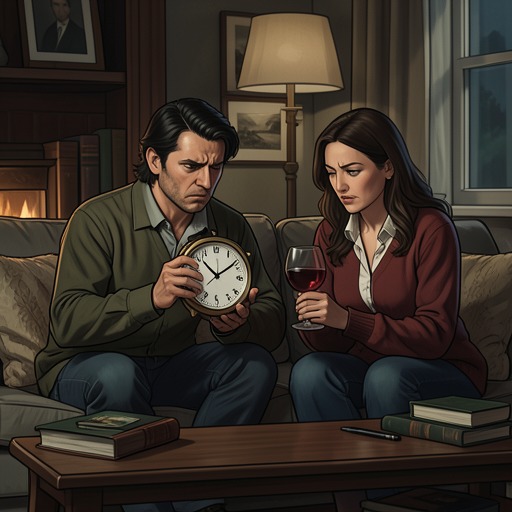
Gerry's alcohol dependence
Midwinter BreakGerry’s alcohol dependence is presented not as a single collapse but as a practiced system of drinking, concealment, and self-justification that steadily narrows his life and injures his marriage. From the hidden glass beside his sofa at home to the half-bottles he carries and refills during the Amsterdam trip, alcohol becomes both a private comfort and a secret he can no longer keep from Stella.
The private ritual
At home, Gerry waits for Stella to close the bedroom door before going to the drinks cupboard. He fills a Kilkenny jug, pours whiskey into his favourite Waterford crystal tumbler, and tops the drink with water. The glass rests on a low bookshelf, out of Stella’s sight from the doorway. He insists that he is not hiding his drinking: he is willing to say that he has a substantial dram at night while listening to music. Yet he deliberately positions the glass so that Stella cannot see how much it contains. Her small glass of wine with a meal, which she regards as sufficient, provides a measure against which his own drinking is both normalized and concealed.
The ritual is carefully fitted around the house and the couple’s bedtime. After Stella has gone to bed, Gerry puts on headphones, turns the music up, and sips. He describes the drink as a means of ensuring a good night’s rest before their early holiday start; he also knows that he will need a couple more to get through. The account makes the contradiction plain: he frames alcohol as preparation for the next day even as it is already shaping the night before it.
Gerry’s language for drinking shifts with the amount consumed. A small drink, he thinks, creates distance from the immediate world; more makes him feel that he can soar, see more sharply, and love better. When Stella is asleep during the trip, he pours what he calls a modest measure and then adds another. He resists the simple division between drunk and sober by imagining subtler gradations, as though naming an in-between state could keep excess under control. The successive measures, however, describe a progression rather than a boundary.
Concealment and the drinking cycle
The same pattern follows Gerry away from home. While Stella rests in the hotel, he listens to music on an old, bulky iPod and pours himself whiskey, presenting it to himself as no more than something to keep him going. A friend who had repeatedly gone in to dry out has warned him against drinking alone: other people can act as brakes, whereas drinkers like them set their own pace. The friend also described their drinking as a form of temporary suicide, followed by the chance to begin again the next day. Gerry’s situation makes that warning difficult to dismiss: Stella hardly drinks, so companionship cannot serve as the restraint his friend recommends.
At a restaurant, Gerry turns a small tub of margarine into an opportunity to leave the table and buy whiskey from a nearby supermarket. He chooses a half-bottle small enough to fit into his pocket, accepts an unfamiliar brand because it comes in the right shape, and buys a second bottle as well. Back in the hotel room, he takes one bottle from his jacket while Stella sleeps, opens it in the bathroom, and drinks. Later, he pours the remaining contents of the half-bottles into the larger duty-free bottle, concealing the empties in his pockets before trying to dispose of them. His efforts to make the bottles and the drinking disappear become a second, laborious activity alongside drinking itself.
The details show how self-deception coexists with practical ingenuity. Gerry worries that Stella might hear a bottle glug in his pocket in the lift, and he uses a cough to mask the sound of opening a screw cap. He takes an extra hotel key so he can leave the door ajar without plunging the room into darkness or waking Stella. Yet he fails to notice that he has gone into the corridor in stocking feet with his shirt untucked, and an empty bottle makes a loud metallic bang when he drops it into a bin. The careful plan repeatedly produces evidence of its own existence.
Bodily and mental consequences
Gerry sees the physical signs of drinking in a hotel mirror after secretly taking his statin. He notices a red or discoloured nose, the possibility of a pocked surface, a whiskey-weathered complexion, and a developing dewlap. He imagines alcohol’s effects extending beyond what is visible, to his liver and other organs, and recognizes that the habits are shaping the person he is becoming. His concern does not immediately lead him to disclose the amount he drinks: instead, he thinks that keeping it from Stella is the answer, even though he admits that he often does not know how much he has consumed.
His memory is another measure of the cost. Gerry wonders whether he is drinking too much because he cannot recall how evenings ended, and struggles to remember people, names, or faces. He has devised a domestic workaround: visitors’ names go into an appointments diary, allowing him to greet someone by checking the entry. The workaround can fail when the person at the door is not the expected visitor, or when the electricity meter reader has a familiar name, leaving Gerry uncertain about how well he knows him. Stella, by contrast, remembers people and details. Their difference makes his impairment visible within the marriage rather than merely a private worry.
Alcohol also gives Gerry a reassuring account of his own character. He believes that drink makes some people vicious and violent but insists that it has the opposite effect on him: he feels more loving and wants to embrace people. That self-assessment sits beside his secrecy, impaired memory, and increasing dependence on a supply of alcohol. The contrast is not that he sees no danger; he recognizes bodily damage and worries about losing Stella. Rather, the pleasurable and flattering effects he attributes to drink keep competing with what he knows about its consequences.
Confrontation and the vow
At the airport, Gerry gets another large whiskey and complains about its price. Stella notices the liquid sound when he rocks his shoulder bag, though he says she cannot hear anything. Later, he tries to pour water and ice into the duty-free bottle; ice cubes strike its mouth and clatter into the bag. When liquid drips onto the floor, he calls it melting ice. Stella warns him that airlines can prevent drunk passengers from boarding. The concealed supply has become difficult to disguise even as Gerry continues to explain away what is happening.
The conflict moves beyond the bottle when Stella asks whether she could leave him and whether he would blame her. Gerry says he would not. She recalls that he used to be kind and considerate and tells him that he has become nothing but appetite. He tries to move closer and take her hand, but she pulls away and leaves for a walk. Her response marks the relational cost of his drinking: the intimacy he claims alcohol helps him feel cannot substitute for the consideration and trust that his actions have undermined.
When the possibility of selling the flat and changing their life is discussed, Stella identifies the necessary compromises as those of a deluded alcoholic. Gerry rejects the description, but Stella points out that his denial confirms it. The exchange gives a direct name to the gap between his self-image and the pattern she has been living with. Her account does not leave him room to treat the drinking as a harmless private ritual.
Gerry says that he has quit after the previous night and accepts Stella’s description of this decision as a vow, while insisting that it is a commitment he makes in his own words rather than a matter of belief in vows themselves. When Stella asks what he will do if he fails, he says he will get help and make the vow again. The ending records a declared intention and a contingency, not a demonstrated recovery: Gerry’s recognition has advanced from hiding the amount to naming a change he must make, but the need to renew the promise also leaves its difficulty in view.