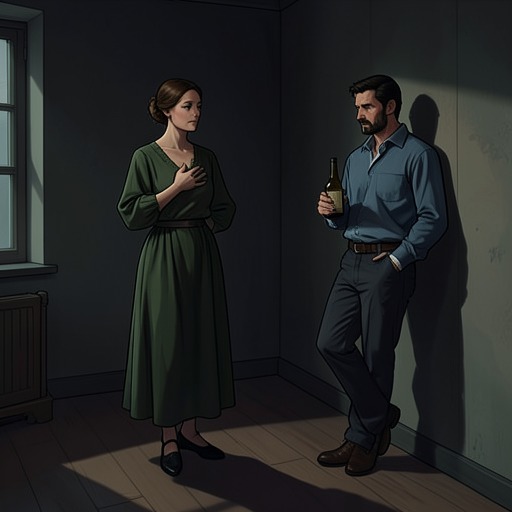
Gerry’s vow to quit drinking
Midwinter BreakGerry’s vow to quit drinking is a self-imposed commitment made after Stella challenges him over both his alcohol use and the concealment that accompanies it. Rather than grounding the promise in religious belief or treating it as an assured cure, Gerry defines it as an undertaking he must carry out himself, with help and renewal as possible responses to failure. The exchange makes accountability, not solemn language, the test of the vow.
The confrontation behind the vow
Stella presents the drinking as more than a private habit. She tells Gerry that she knows how much he drinks, rejects his assumption that raising the issue would make her merely a nag, and points to the deception required to keep drinking behind her back. Her warning that “There’s nobody can fix this but yourself” identifies the central condition of any promise he might make: she can name the problem, but she cannot make the change for him.
Gerry first responds to her challenge by saying, “If you’re serious, then so am I.” Stella’s question about how many times she has heard this before places his declaration against a history of previous assurances. He shrugs and says, “So after last night I quit.” The reference to the previous night marks a turning point for him, but the exchange does not specify what happened then. What it does establish is that Stella’s skepticism is grounded in repetition, while Gerry presents this declaration as a decision prompted by a recent experience.
A personal rather than sacred promise
When Stella asks whether he is making a vow, Gerry answers yes. Her follow-up—whether it is a sacred vow—draws out a distinction between religious solemnity and personal responsibility. He says, “I don’t believe in such things. It’s my vow. It’s what I say I will do.” The commitment is therefore not presented as an appeal to religious authority; its force rests on Gerry’s own words and on whether he acts in accordance with them.
Stella then asks what will happen if he fails. Gerry does not claim that the vow makes failure impossible. Instead, he says, “I’ll get help. Make it again.” His answer gives the promise a contingency: failure would require assistance and renewed commitment, not a declaration that the original undertaking never mattered. At the same time, the proposed repetition leaves the burden of change with him. Stella underscores that point by telling him, “You are the only one who can make the changes.”
Responsibility, precedent, and limits
The conversation presents the vow as an act of speech whose significance depends on subsequent conduct. Gerry’s declaration makes his intention explicit, but neither his words nor Stella’s response confirms that he has stopped drinking or sought help. The vow is thus a commitment made under pressure and in full view of Stella’s doubt, not evidence of a completed recovery.
Stella answers the promise with an example from her own experience: she gave up smoking, which she calls “the hardest thing I ever did,” but recalls secretly lying in the hearth and puffing cheroots up the chimney after Gerry had gone to bed. The memory makes concealment concrete and complicates any simple contrast between Gerry’s wrongdoing and Stella’s success: she, too, describes hiding a habit. Her example does not erase the difference between their situations, but it gives the exchange a personal precedent for how difficult stopping can be—and how easily a private resolve can coexist with secrecy. Against that history, Gerry’s vow matters as a stated willingness to take responsibility; whether it becomes lasting change remains unresolved in this exchange.