Hotel Theo
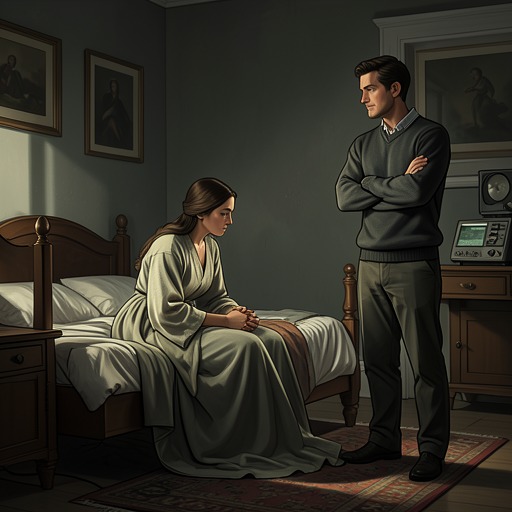
Midwinter BreakHotel Theo is the setting for a sequence in which holiday routine, private reflection, and sudden physical vulnerability bring Gerry and Stella’s marriage into close focus. A dark room responds to a key card and a joke about light; a bath offers Stella a rare interval alone; later, Gerry slips in the bath and calls for her. The hotel’s rooms and amenities are more than a backdrop: within their temporary privacy, the couple’s distance becomes visible, and a moment of care briefly interrupts it.
Arrival and the Room
Following the arrows on their floor, Gerry and Stella find their room and use a plastic key card to open it. The curtains are drawn, leaving the room dark. Gerry inserts the card into the wall slot and theatrically calls for light; the simple hotel mechanism answers the gesture. The scene gives their arrival a note of playfulness, but its comedy is also practical: the couple are learning the small routines of an unfamiliar room.
The television screen welcomes them by name and displays a message from Hotel Theo wishing them a pleasant stay and inviting them to ask for help. Gerry replies that a free drink would be welcome. The exchange establishes the hotel as a courteous service environment while letting Gerry turn its formality into a joke about what he wants. In later scenes, the promise of assistance takes on a more immediate meaning: when he falls, Stella is the one who answers his call.
Stella’s Bath and a Moment Alone
In the hotel bathroom, Stella wears the towelling dressing gown and gathers her hair beneath a plastic shower cap before settling into a bath filled with foam. The scene unfolds at a slower pace than the couple’s exchanges elsewhere. She relishes the unusual luxury of a holiday bath, the lavender scent, and the silence after she turns off the tap; the television can still be heard faintly from outside. The hotel gives her a small pocket of privacy within a shared trip.
As she examines her hands above the suds, the rings on her left hand remain visible: both her wedding and engagement rings. The foam clings to them, and its small gleam of gold draws attention to the objects that mark her marriage. The water also brings her body into view, including the track left by her clothing, the scar near her navel, and the pale line of her Caesarean-section scar. She thinks of the scar on her back, which she cannot see without twisting toward the mirror, and of wearing a black one-piece swimsuit on beach holidays. The intimate inventory joins the pleasures of the bath to the bodily history she carries.
Her thoughts turn from her body to the possibility of change. Leaving Gerry seems nearly impossible, but she recalls the responsibilities she already manages: chairing the residents’ association, serving as a Eucharistic minister in her parish, organizing sales, and arranging flats for their son, Michael. Gerry calls her his transport captain because she can plan a complicated journey before they leave home. At the hotel, the contrast between her competence in organizing other people’s lives and her uncertainty about changing her own makes solitude feel consequential rather than merely restful.
Gerry’s Fall
Later, Gerry takes a bath of his own. He has been drinking whiskey and uses a replacement hotel shampoo miniature, whose strong scent he dislikes and which does not help his dandruff. He sets out a replacement conditioner bottle, thinking of paired things—shampoo and conditioner, as well as himself and Stella. When he turns to reach for it, his heel slips on the enamel. The fall abruptly converts an ordinary act of washing into a frightening loss of control.
The narration makes the absence of a foothold central to the moment: Gerry reaches for support and finds only air, then strikes the bath. He ends up the right way round beneath the running shower, with a throbbing jaw and reddened knees and thighs. His cry brings Stella from the next room. She opens the bathroom door and laughs at the sight, while Gerry lies stunned, his heart pounding. Her laughter does not prevent her from checking whether he is hurt; the scene holds comic embarrassment and real alarm together.
Gerry checks his limbs and coccyx and finds no apparent injury. Once Stella switches off the shower, they can hear each other more clearly. She jokes that she will sue because there is no rubber mat, insisting that every bath should have one for the elderly even as she knows Gerry denies being elderly. The joke turns the fall into a shared exchange, but it also names the bodily risk that neither can simply laugh away.
Stella unfolds a towel and offers her hand through its dry fabric. Gerry grips it as she helps him stand; he holds the stainless-steel handles and groans while climbing over the bath’s edge. She warns him to be steady, guides him onto the bathmat, wraps him in the towel, and leads him to lie down. The fall ends not in a serious injury but in a practical act of assistance, with the room’s ordinary fixtures—the handles, towel, and mat—forming the means by which Stella gets him safely out of the bath.
The Hotel as a Temporary Domestic Space
Hotel Theo brings the couple’s private habits into unfamiliar surroundings without resolving their larger difficulties. Stella’s bath offers quiet and a chance to think about her marriage; Gerry’s bath follows whiskey and becomes a scene of vulnerability. The contrast between their two episodes is sharp: Stella is alone by choice for a while, while Gerry’s fall makes solitude impossible and sends him calling for her.
The room also frames a shift in the way they relate to each other. Earlier, Stella reflects that Gerry has ceased to do many things except drink. At the end of the fall, however, he depends on her hand and she supports him with careful, concrete gestures. The episode does not erase the strain between them, nor does the hotel’s promise of service solve it. Instead, the stay makes the contradiction legible: their marriage contains distance and disappointment, but in an urgent moment Stella still responds, and Gerry accepts her help.