Irish Republican Army
Midwinter BreakThe Irish Republican Army enters the novel less as a fully described organization than as a charged presence in music, political memory, and the destruction of buildings. Gerry Gilmore’s encounters with Irish Republican Army rebel songs and his recollection of arson sharpen a central distinction: a claim made in the name of freedom does not, in his view, excuse violence against people, homes, or places of work.
Appearance in the Amsterdam pub
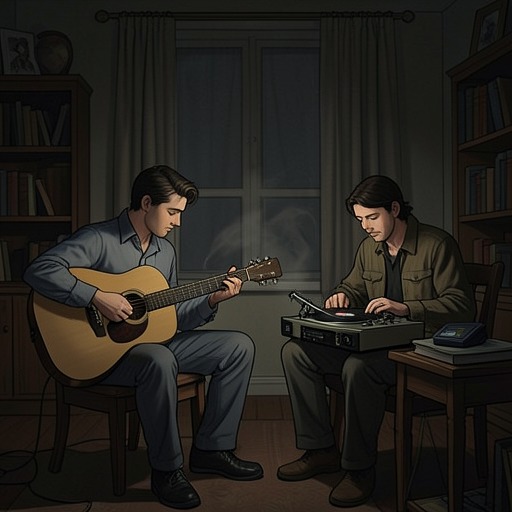
During Gerry and Stella’s stay in Amsterdam, a band plays Irish songs in a crowded pub. After “The Jug of Punch” and “Will ye Go, Lassie, Go,” the musicians turn to Irish Republican Army rebel songs, including “Sean South of Garryowen” and “The Patriot Game.” The sequence shifts the atmosphere from communal participation to politics: the singer has already invited the audience to join choruses, and Gerry has remarked on the irony of Ireland exporting both a lesson in enjoyment and the car bomb. Stella’s response is immediate. She says, “I hate this stuff,” pulls a face, and asks to leave; Gerry agrees. The scene gives the songs a social consequence without claiming that every listener shares their politics. Their performance makes an assumption of political allegiance feel present in the room, but Stella rejects the music rather than joining its implied cause. Outside the performance, Gerry articulates the pressure he perceives in that assumption: “They just assume we support violence. A wink and a nod. Ireland’s fight for fucking freedom.” The line objects to treating Irish identity as consent to armed struggle. His anger is complicated by his action at the end of the exchange: he drains his whiskey. The political protest and the act of drinking sit side by side, without the scene suggesting that either cancels the other.
Gerry’s recollection of arson
Later, news footage of burning buildings prompts Gerry to remember that his architecture office in the Diamond in Derry was firebombed. The perpetrators and their motive were never discovered. Gerry speculates that the attack might have involved young people egging one another on, then considers the possibility that Irish Republican Army militants were responsible. The passage reports his suspicion, not a finding about who carried out the attack; the uncertainty remains explicit. His anger also draws on a separate allegation: he recalls that Irish Republican Army members had tried to burn down the Linen Hall Library in Belfast. For Gerry, the burning of a library makes the language of liberation particularly difficult to reconcile with the act itself. He asks himself since when a fight for Irish freedom included burning books, and reduces the contradiction to a devastating architectural image: “The IRA were disarchitects. Destroyers. Show me a building and I’ll turn it into a car park.” The phrasing turns the organization’s presence in his thoughts into an opposition between making and unmaking.
Buildings, memory, and political blame
Gerry’s account does not treat every fire as an Irish Republican Army action. His imagined model-city conflagration folds together several kinds of destruction, and the narration separately recalls Bombay Street, where Catholic residents were burned out by a Loyalist mob. The contrast matters: the passage locates violence on more than one side of the conflict and does not make the Irish Republican Army responsible for the burning of Bombay Street. Gerry’s phrase about “disarchitects” is a bitter judgment on destruction, not a neutral description of the organization’s entire history or structure. The office fire remains concrete in its aftermath. The next morning, Gerry walks through charred wood, warped blinds, and the remains of the workplace, looking for anything salvageable. The biscuits at his feet look almost edible, a mundane detail set against the ruin. He remembers that the smell of burned work clung to his clothes for weeks. The loss is not abstract: it is the destruction of drawings, materials, notes, measurements, and accumulated labor. His condemnation of political violence is rooted in the material cost of turning a place of creation into ash.
Limits and significance of the portrayal
The novel supplies no account here of the Irish Republican Army’s leadership, membership, internal organization, or wider program. Instead, it shows how the organization is invoked in Gerry’s immediate experience: through songs that carry an expectation of political solidarity, through his suspicion about an arson whose authors remain unknown, and through his recollection of an attempted attack on a library. Keeping those levels distinct prevents his suspicions from becoming established facts. Stella’s response to the pub songs and Gerry’s memory of the burned office provide different measures of the same conflict. She refuses the performance’s political atmosphere; he measures political claims against what violence leaves behind. His image of architectural destruction gives the organization its sharpest meaning in these passages, while the unresolved identity of his office’s attackers preserves the difference between anger, suspicion, and proof.