Royal Ulster Constabulary
Midwinter BreakThe Royal Ulster Constabulary enters the narrative through a personal crisis rather than an account of the force’s wider structure or activities. Two of its plainclothes officers arrive at Gerry Gilmore’s architectural office with news that his wife has been involved in an accident. Their visit leaves him with a memory in which official procedure, dread, and his sense of being marked as Catholic are tightly bound together.
The officers at Gerry’s office
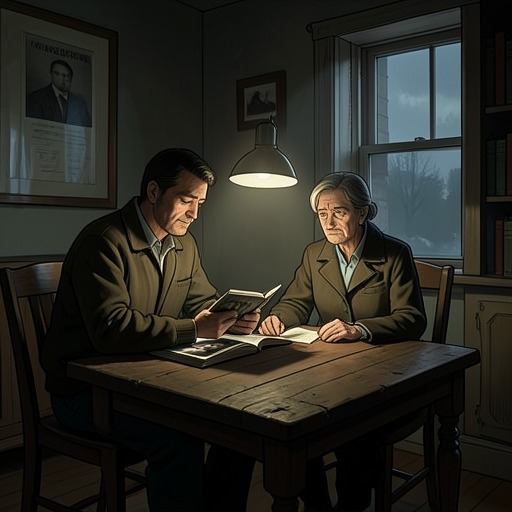
Gerry is called into a meeting room off the main office, where a bulky middle-aged man and a younger man identify themselves as members of the Royal Ulster Constabulary. Their presence has already unsettled the workplace: Gerry finds the others looking at him expectantly as he goes in. The older officer’s difficulty meeting his eye, his fidgeting with the tassels of a maroon paisley scarf, and the younger officer’s repeated gestures toward a chair make the encounter feel ominous before its purpose is stated.
The officers check whether Gerry is Gerald Gilmore and confirm his address. He remains standing until the younger man motions him to sit; when he finally does, the chair clangs against another. Gerry’s physical response—jelly-like knees and an icy feeling in his stomach—registers the fear generated by the formal questioning. The older officer then tells him that there has been an accident and that his wife was involved. The scene gives the force no broader institutional description: its presence is conveyed through the two men, their manner, and the news they bring.
Taking Gerry to the hospital
The older officer accompanies Gerry in an unmarked blue Cortina driven by his younger colleague. In the car, the older man turns to look at Gerry and says that they are lucky to be going that way, adding that they do not believe in special treatment. The remark, and the officers’ subsequent conversation in a tone that excludes Gerry, deepen his impression that he is being carried along as an unwanted task rather than treated as someone in distress. The older man’s hat, set on the dashboard, leaves its track visible across his hair; Gerry also remembers the bald spot and the scarf showing above his coat collar. These precise details persist in the memory while the younger driver remains less distinct.
At the hospital, the driver stays with the car while the older officer takes Gerry into reception. He directs him to sit as they wait, then speaks to a nurse through an opening in the glass. Before leaving, he says that the hospital staff will look after Gerry. A nurse later leads Gerry down the corridors. The officers’ role in this passage is practical and limited: they bring him to the hospital and hand him over to its staff, while the uncertainty about his wife’s condition continues.
Sectarian meaning and remembered encounter
Gerry interprets the hospital encounter as evidence that he is being treated as a second-class citizen. He connects that impression to his name, reasoning that the combination of Gerry and Gilmore identifies him to the officers as Catholic. In the office, too, he wonders whether the older officer’s reluctance to meet his eyes has to do with the news or with having recognised him as Catholic. The narrative presents these as Gerry’s perceptions, not as an explicit statement of policy by the Royal Ulster Constabulary; their force comes from the way fear, withheld eye contact, and the unequal-feeling encounter accumulate for him.
The memory returns later and remains difficult for Gerry to put aside. He recalls the older officer twisting around in the Cortina, the casual announcement that they were fortunate to be travelling that way, and the sense that the officers did not meet his eye. Its recurrence makes the encounter more than a brief episode of notification and transport: it is one of the forms through which the novel gives personal texture to sectarian suspicion and vulnerability. The evidence, however, concerns this encounter and Gerry’s recollection of it, not the force’s wider organization or conduct.