Schiphol Airport
Midwinter BreakSchiphol Airport is the setting for a journey abruptly suspended by snow, where the practical problem of finding somewhere to wait gives way to a more intimate reckoning between Stella and Gerry. The airport’s crowded gates and uncertain announcements make the disruption tangible; its long, stalled hours also provide the space in which Stella confronts Gerry about his drinking and dishonesty, and he expresses regret for the ways he has failed her.
Weather, delays, and an uncertain journey
At Schiphol Airport, the disruption begins as a frustrating wait rather than an emergency that demands an immediate return home. Stella checks the information screen and finds the word “delayed” repeated across it. She and Gerry have no connection to catch and no pressing reason to get home, but that freedom from a deadline does not remove the irritation of having their plans interrupted.
When Stella joins the queue at the information desk, the staff member can offer no firm estimate. Dozens of flights have been delayed or cancelled; a strike by Spanish air-traffic controllers compounds the problem, while snow affects the United Kingdom and Germany. Airport crews are using snowploughs to keep the runways clear, but more heavy snow and black ice are expected that night. The exchange ends with a shared shrug and smile: neither Stella nor the employee can make the weather predictable.
A later announcement makes the outlook definitive for the evening. After a Dutch announcement, a translation into English tells passengers that conditions are so adverse that flights will remain disrupted for the foreseeable future, and that there will be no more arrivals or departures that night. Complaints spread across the waiting passengers; one woman begins to weep. Stella, still browsing magazines, accepts that she and Gerry will not leave that night and goes back to tell him.
A crowded place to wait
The airport’s gates offer little privacy or comfort as the delay draws on. At one gate, Stella finds plenty of people but still some empty seats in a corner facing outward into the night. Gerry stands swaying and says he wants to stretch out; Stella points out that he cannot take three seats. Their exchange registers the immediate negotiations of a crowded waiting area, where even resting has to be balanced against the needs of other passengers.
As the hours pass, the crowd grows. Nearly every seat is occupied, and people sit on the floor; children sleep on coats spread out as mattresses. Stella notices a little girl sucking her thumb and looking up at her, then the girl’s mother stroking the hair at her neck and a grandmother figure talking beside them. The three generations make an ordinary family tableau amid the disruption. Around them, the airport is no longer functioning simply as a passage between destinations: passengers have to make temporary places to sleep and wait within it.
Stella joins the information queue while Gerry remains behind. By the time she returns, she has lost her seat to an old man in a red baseball cap who is asleep. Gerry has turned toward the wall. She wakes him long enough to explain that all flights are cancelled for the night, tells him to go back to sleep, and asks him to keep an eye on their bags. The detail of the bags remains part of the scene’s practical burden: even in a crowded terminal, their belongings require attention.
The quieter gate
After returning to Gerry, Stella wanders again through the airport. She passes a Meditation Centre but resists going in, recalling other airport prayer spaces that she regards as generic and makeshift: a Sacred Heart picture in a cupboard and a wardrobe containing clothes for women to wear while praying. Rather than seek refuge there, she goes to the shops. Outside, the wind drives snow against the building.
Stella later finds a gate with reduced lighting and no destination displayed. It is quieter than the crowded gates, dark and warm, with empty seats beside her and a few travellers stretched across seats to sleep. She cannot tell whether the gate is unused because it is out of service or because something has fused; the uncertainty is part of the place as she encounters it. She extends her legs and feels the seat support her back. This improvised refuge suits her better than the Meditation Centre, though the low light makes reading difficult. When she gives up on her novel, the partial darkness makes the snow outside more visible, falling silently beyond the airport.
The contrast between the two spaces matters: the busy gates are exposed to announcements, complaints, and competition for seats, while the dim gate offers a brief interval of stillness. Schiphol Airport contains both conditions at once, without resolving the storm that keeps travellers there.
An enforced pause in the relationship
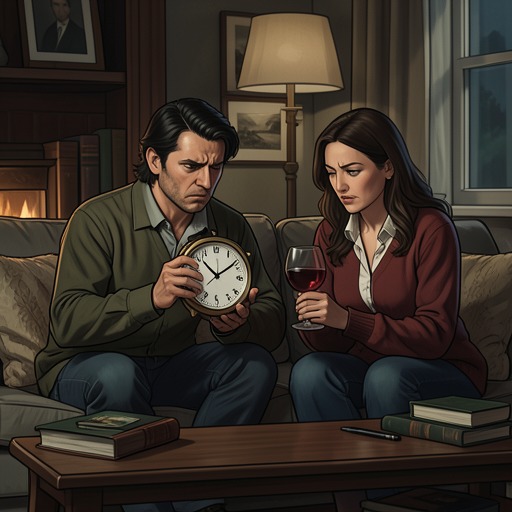
The airport’s delay also frames a confrontation that is more consequential than the travel disruption. Stella tells Gerry that she knows how much he drinks and objects not only to the drinking but to the deception that accompanies it. She rejects the position of being cast as a nag whenever she raises the subject, and insists that he alone can fix the problem. Her bluntness turns the waiting period into a moment when evasion is no longer enough.
Gerry answers that he is serious, but Stella points out that she has heard the same assurance before. Later, he apologizes for everything and tells her that when he looks at her, he sees all the ways she was and still is; he adds that she could have married anyone and made it work. Stella replies that this evidently did not include him. His admission of admiration sits beside the harm she has named, rather than cancelling it. In this way, Schiphol Airport is not merely the place where weather prevents departure: the enforced pause holds Gerry and Stella in the same space while their marital conflict is spoken plainly, leaving remorse present but the underlying problem unresolved.