Sectarian conflict and political violence in Northern Ireland
Midwinter BreakSectarian conflict and political violence in Northern Ireland enters Gerry Gilmore’s life not as a single episode but as a force that recurs in private fear, public performance, institutional encounters, and the destruction of places. Belfast remains present even when he is elsewhere: it shapes how he interprets a locked door, how he hears rebel songs, and how he remembers being treated by police. The damage is at once bodily and civic, but the firebombing of his architecture office gives it a particularly intimate measure: violence can erase not only buildings, but the accumulated work through which people imagine and make them.
Violence as a Presence in Everyday Life
In a quiet room, music and drink do not wholly insulate Gerry from danger. Wearing headphones, he feels vulnerable to someone entering behind him despite the locked front door and bolted windows. His mind turns to Belfast and the possibility of being garrotted by a Loyalist murder gang. The imagined attack is not a new assault unfolding before him; it is an old political fear intruding upon an ordinary evening. The headphones intensify the isolation, while the thought that someone might approach unseen makes the supposedly secure domestic space feel exposed.
That unease returns through sounds and images associated with Ireland. After a night out, the mention of locked doors and the rebel songs heard in an Irish pub brings Belfast back to Gerry. He tries to direct his attention to whiskey, distinguishing Jameson, made in the south, from Bushmills, made in the north, and joking inwardly that alcohol makes him non-sectarian. But drinking cannot keep the memory at a distance. The more he drinks, the less able he is to resist it. The contrast is pointed: a drink can be categorized by place and religion, yet Gerry claims a temporary indifference to those divisions even as political memory reasserts itself.
Songs, Identity, and Assumed Allegiance
At an Irish pub, music first offers a shared, convivial scene. The band plays Irish songs, including “The Jug of Punch” and “Will ye Go, Lassie, Go,” and Stella recognizes one of them with pleasure. The room is small enough that amplification strikes Gerry as excessive; he has to shout to be heard, and the singer invites the audience to join in the choruses. The performance gives the patrons a ready-made sense of collective participation, but that sense changes when the band moves on to Irish Republican Army rebel songs, including “Sean South of Garryowen” and “The Patriot Game.”
Stella dislikes the turn and asks to leave. Gerry agrees, but the songs have already made the pub feel politically charged. He objects that the musicians seem to assume that the couple support violence, as though their presence requires a knowing endorsement of Ireland’s armed struggle. His anger is sharpened by the contrast between songs about freedom and the car bomb, which he names in the same breath. He drains his whiskey as he complains: the scene binds entertainment, national identity, and political violence together, leaving little room for an Irish identity that refuses the implied choice between solidarity and approval of armed action.
Policing and Sectarian Treatment
Gerry’s recollection of the police brings the conflict into an institutional setting. At his architecture office, two men identify themselves as members of the Royal Ulster Constabulary and tell him that his wife has been in an accident. Their manner makes the meeting ominous before they deliver the news: colleagues watch Gerry go into the room, the older officer avoids his eye, and the men insist that he sit down. Gerry reads their gestures and their insistence through fear, wondering whether someone has died and why he is being made to take a seat in his own workplace.
The journey to the hospital deepens his sense that he is being treated as a second-class citizen. One officer drives while the older man accompanies Gerry into the busy reception area, then speaks to a nurse through the glass and leaves. Gerry connects the officers’ lack of eye contact and his own name with their recognition of him as Catholic. The scene does not establish an explicit explanation from the officers; it presents Gerry interpreting their conduct amid a crisis in which he has little control and is waiting to learn what has happened to Stella. In that uncertainty, ordinary details of procedure—being directed to sit, following a nurse down a corridor—take on the weight of unequal treatment.
The Firebombing of a Place of Creation
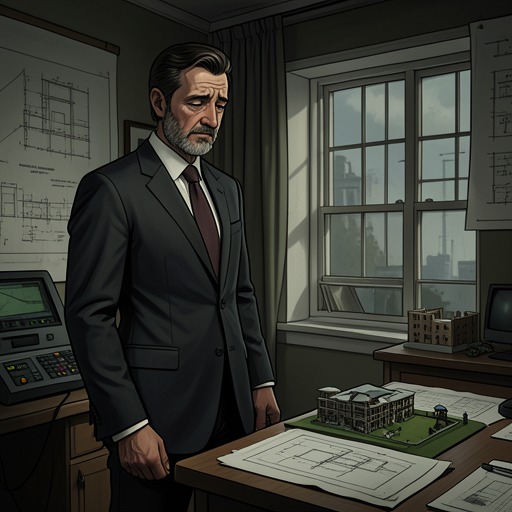
The political violence directed at Gerry’s work is remembered through a news broadcast showing buildings burning, black smoke, and tanks. He recalls that his office in the Diamond in Derry was firebombed; who carried it out and why was never discovered. He suspects that the Provisional IRA might have been responsible, but his thought remains speculation, not an established account of the attack. His anger is directed beyond the identity of the perpetrators toward the act itself: he cannot reconcile a claimed struggle for Irish freedom with the burning of books and the destruction of buildings.
His memory turns the office into a miniature city under attack. Drawing tools, plans, models, trees, churches, schools, and halls of residence become vulnerable components in an imagined blaze. The scale models make destruction legible as a chain of material losses: windows catch fire, tiny trees disappear, steeples topple, and carefully prepared drawings curl into ash. Gerry imagines the office’s contents as a whole built world, so that the attack is not simply damage to property but the annihilation of design, thought, and labor. He calls the Irish Republican Army destroyers of architecture, opposing the work of making buildings to the violence that turns them into ruins.
That imagined fire converges with the remembered burning of Bombay Street, where Catholics were burned out by a Loyalist mob. The parallel does not make the events identical; it shows how Gerry’s mind places separate acts of destruction within the same landscape of communal violence. In his vision, the office’s model buildings burn beside the homes and streets of Belfast, while religious language and political struggle fail to restore what has been lost. Stella’s response to the office attack is relief that nobody was killed. The next morning, Gerry walks through the devastation looking for anything salvageable: the wood is blackened, surviving blinds are buckled, and the smell of wasted work stays in his clothes for weeks.
Architecture, Memory, and the Cost of Violence
The novel makes architecture both Gerry’s profession and a way of measuring the consequences of conflict. His office holds the physical traces of collaboration and sustained labor: plans, drawings, instruments, notes, and models. Their destruction gives the political violence a specific human cost without reducing it to an abstract symbol. Gerry remembers the materials and the hours invested in them, and the ruined workplace becomes a place where creative effort has been forcibly converted into absence.
Across these scenes, the conflict persists through recurrence rather than through a single explanatory account. A locked door evokes a feared attack; a pub’s music turns enjoyment into a test of allegiance; police procedure becomes entangled with Gerry’s sense of Catholic identity; and television news opens onto the office fire and the earlier burning of homes. The episodes reveal different forms and settings of violence, while also preserving distinctions between what Gerry knows, what he suspects, and what he fears. His recollections make the conflict intimate: it is present in the habits of listening, drinking, interpreting a glance, and trying to salvage what remains after a place of creation has been burned.