Stella asks about living at the Begijnhof
Midwinter BreakStella asks about living at the Begijnhof because she is looking for more than accommodation: she hopes to shape her remaining life around devotion, charity, and prayer. The enquiry brings her face to face with the difference between the Beguines’ religious past and the modern residential community, and with an age limit that closes the future she had imagined. Its failure does not resolve her spiritual longing; instead, it makes her reconsider what change is still possible in her life with Gerry.
The enquiry and its purpose
Stella’s visit grows out of questions she has begun asking about how to live well. She tells Gerry that she is tired of the way they live and wants to pursue a more devout life, involving prayer and charity. Her interest in the Begijnhof gives that desire a possible shape: a women’s community where a life of religious seriousness might be practised in everyday surroundings.
The search is not sudden. Stella recalls first hearing about the Beguines around thirty years earlier, at a teachers’ conference. She was intrigued then, but felt no urgency. Now the idea returns as a serious possibility, as she tries to find a way to live her Catholic faith more fully. Her private prayer gives this aspiration a daily form: at night she prays for her family, gives thanks for her survival, and extends her concern to refugees and people fleeing war. She regards these repeated prayers as a kind of spiritual tidying, but they also reveal how charity and devotion are already woven into her habits.
The community she encounters
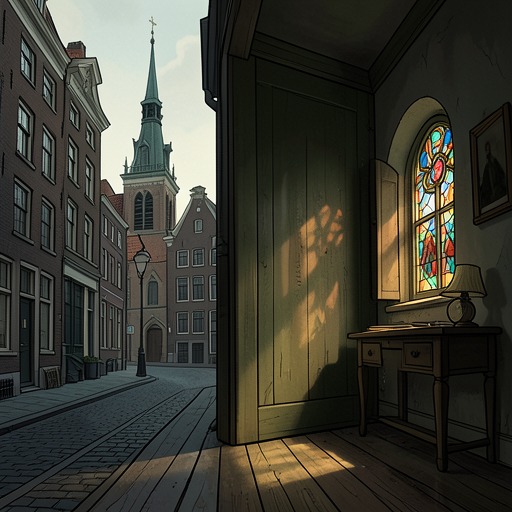
On her visit to the Begijnhof office, Stella follows the familiar route from the hotel through the passageway and garden. She waits while the woman at the desk speaks Dutch on the telephone, checking that she still has the business card given to her on an earlier visit. When the call ends, she presents the card. The woman shakes her head, points her toward red plastic chairs, and asks her to wait. Stella cannot understand the conversation, but reads its ending through its repetitions and gestures.
The person Stella had hoped to see is delayed, so Kathleen Walsh, a resident, introduces herself and offers to show Stella where she lives. When Stella later explains that she wants to investigate the community and its way of life, Kathleen asks what she knows about it. She describes the Beguines as a women’s movement dating to the twelfth century, when women prayed and cared for the sick before choosing to live together. They were not exactly nuns: they did not take vows and were less strictly governed than other orders, though they were expected to live independently and the prohibition on men in the community was firm.
Kathleen also corrects Stella’s impression of the institution. There is no longer a religious order at the Begijnhof, and the last nun there died in 1971. What remains is a group of about a hundred apartments, with vacancies arising only occasionally. Kathleen herself had been a nun with the Sisters of Mercy in Ireland before leaving; she calls the Begijnhof a halfway house that suits her better. Her presence preserves a living connection to religious life, but her account makes clear that Stella cannot simply enter the historic order she had imagined.
Rules, age, and disappointment
The possibility of living there is not entirely closed. Kathleen explains that women may still live at the Begijnhof, but the waiting list is long—perhaps five years or more. Applicants must be women prepared to live by themselves, between thirty and sixty-five, and able to afford an apartment. The requirements turn Stella’s spiritual enquiry into a practical question of age, independence, money, and available housing.
Stella hears the age limit as a verdict on her own future. She concludes that she is too old, and Kathleen tries to soften the blow by saying she looks younger. Stella does not feel reassured. The community’s surviving sisterhood is real, Kathleen explains, but its religious character has largely disappeared. Stella had sought a religious home; what the Begijnhof can offer is independent residence under strict eligibility conditions.
A later conversation with Astrid Hoogendorp, the woman in charge, confirms Kathleen’s account. Astrid speaks straightforwardly and explains that there is no religious order to join. The present arrangement is a community of women living independent lives, and its apartments are allocated within the existing rules. Stella does not tell Astrid what happened to her in Belfast. She feels that her history is too complicated to explain in this encounter, and Astrid does not have Kathleen’s warmth. The exchange leaves Stella feeling not only excluded by age but treated as though she has misunderstood the nature of the place. The prospect of waiting years for an apartment makes the obstacle more final: by then, she thinks, she could be dead.
What the failed application reveals
At the airport, Stella weeps alone in a toilet cubicle, ashamed that she had built such a dream around the Begijnhof. She understands that her plan to repay a spiritual debt by joining a religious community has failed. Yet the episode does not make her faith seem merely dependent on institutional membership. She wants a Catholicism grounded in kindness, ritual, service, humility, and care for others; she recognizes that these values have shaped her life even as she criticizes the Church’s abuses and restrictions. Her faith, she reflects, comes from her humane heart rather than her head. The Begijnhof cannot give her the religious life she sought, but its refusal clarifies what that life meant to her.
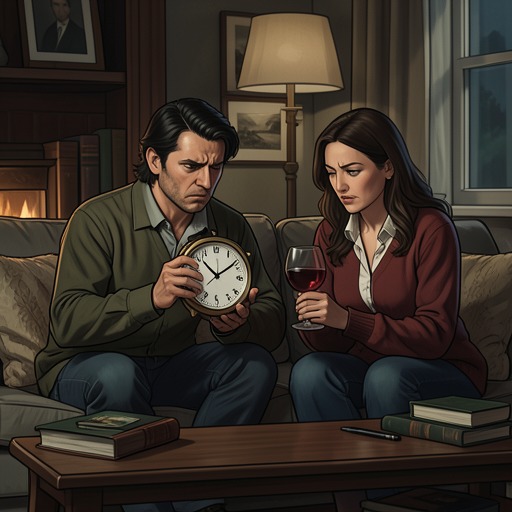
The rejection also changes how Stella thinks about her marriage. Leaving Gerry had seemed impossible, but the scale of his drinking has made separation imaginable. She begins to picture selling their tenement flat and buying two smaller homes, imagining a garden for herself while still slipping into the familiar habit of organizing Gerry’s future for him. At the airport, she makes a different possibility conditional: if Gerry keeps his word about giving up drinking, perhaps their home need not be sold. Gerry answers with the repeated reassurance that all shall be well. The exchange does not erase Stella’s disappointment or settle their crisis, but it redirects the question of a useful, devout life from an unavailable institution toward choices that remain open between them.