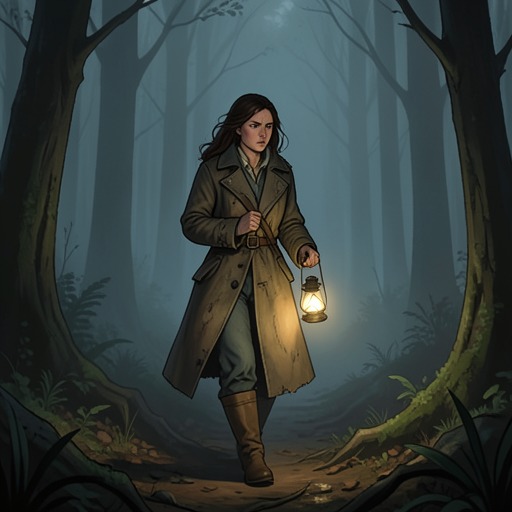
Stella seeks to join a Beguine-style women’s community
Midwinter BreakStella’s attempt to find a home in the Begijnhof turns an old fascination with the Beguines into a present-day enquiry about belonging. She asks how a woman might live there, only to discover that the religious community she had imagined has largely disappeared and that admission depends on strict practical conditions. The visit leaves her confronting both a changed institution and the possibility that she has arrived too late.
The return to the Begijnhof
Stella walks the now familiar route from her hotel through the passageway and garden to the Begijnhof office. Before entering, she checks that she still has the business card from her previous visit and studies the name of the person she is meant to see, trying to pronounce it. The small preparations make her purpose tangible: she has returned with a specific person to meet and a question she has not yet found a way to ask.
The woman at the desk is speaking Dutch on the telephone. Stella cannot understand the conversation, but reads its ending in the repetitions and nods. When the woman looks up, her smile is bleak and without warmth. Stella knows she speaks little or no English, yet greets her anyway. She places the card on the desk with its named side turned away from herself. The woman looks at it and shakes her head. The encounter stalls before Stella can reach the person she came to see.
That person has been delayed, Stella learns. Kathleen Walsh, a resident, introduces herself and offers to show Stella where she lives over tea or coffee while they wait. The offer moves the enquiry out of the office and into conversation with someone who can explain the community from within. Stella accepts the hospitality, but the visit is not simply a social call: she has come to ask whether she might make a life there.
An old interest becomes an urgent question
Over tea, Stella asks directly how difficult it is to join the organisation. She explains that about thirty years earlier, at a teachers’ conference, someone told her about the Beguines. She had been intrigued then, but there had been no urgency. Now she asks about living there. The contrast between the earlier curiosity and the present enquiry is clear, though the visit does not specify what has made the question urgent now.
Kathleen describes the Beguine tradition as beginning in the twelfth century. In her account, women first gathered to pray and care for the sick, and later chose to live together in a community. They were not exactly nuns: they did not take vows, and their life was less strict than that of other religious orders. One boundary, however, was firm: women had to be prepared to live without men. Their devotion was situated in ordinary life rather than in isolation as anchorites or in the desert.
The explanation clarifies what Stella has come seeking while also qualifying it. The Beguines’ historical combination of women’s religious practice, mutual life, and service to the sick is not the same as the institution Stella can apply to enter. Kathleen says that the religious order has gone; the last nun at the Begijnhof died in 1971. Yet she distinguishes that disappearance from the end of the community altogether: the sisterhood remains real, and women still live there, even though the religious dimension has largely faded.
The conditions of residence
The present-day Begijnhof has about a hundred apartments, Kathleen explains, with vacancies arising only occasionally. The resulting waiting list may last five years or more. Residence is not presented as a matter of religious qualification: the stated criteria are that an applicant must be a woman prepared to live by herself, be between thirty and sixty-five, and be able to afford it. A historical women’s community has become, in practical terms, a scarce residential opportunity with explicit limits on age, finances, and household life.
Stella listens for a long time, her lips tightening and her face sagging as she takes in the age restriction. Kathleen tries to reassure her that she does not look over sixty-five, but Stella replies that she does not feel that young. Her response makes the rule more than an administrative detail: it is the point at which the possibility she has been considering appears to close. “Well, that’s that. I’m too old.”
A possibility narrowed, not resolved
The visit ends its available account not with an application or acceptance, but with Stella asking whether another place has a similar arrangement. Her question follows from the gap between what she hoped to find and what the Begijnhof now offers. The community remains accessible to some women, but its long wait and age limit make it unavailable to Stella as she understands her own situation. Whether another community exists, or what Stella will do next, is left unanswered.
The enquiry therefore holds two versions of the Begijnhof in tension: the tradition of women praying and caring for the sick together, and a present community where women may live independently in one of roughly a hundred apartments. Stella’s return gives her old interest a concrete stake, but the encounter does not restore the religious order she had imagined. Instead, it leaves her with a changed understanding of the place and a search that must continue elsewhere.