Stella’s Belfast accident
Midwinter BreakStella’s Belfast accident is the formative wound behind her private vow to God: shot in the stomach while heavily pregnant, she prays for her unborn child’s life and promises a life of devotion if the baby is spared. The novel first lets the event surface indirectly, through Gerry Gilmore’s shock at the hospital and Stella’s recurring bodily memories; only later does Stella give Kathleen the story in her own words.
The Shooting and Its Immediate Aftermath
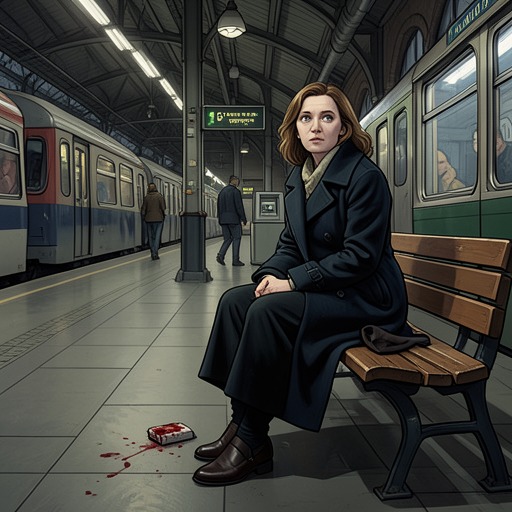
The attack takes place in Belfast in the early 1970s, during an ambush in which Stella is caught in the violence. In her recollection, the scene is reduced to immediate physical impressions: she is down beside a low red-brick wall at Safeways, near dandelions growing from a niche in the ground. A soldier lies on the other side of the wall and shouts, but she cannot make out what he is saying. Her attention turns anxiously to the child she is carrying, whom she has imagined as a boy; she remembers seeing pale points move across her stomach when he kicked. An ambulance eventually arrives, and the realization that its siren is for her makes the danger personal and undeniable.
Inside the ambulance, a clear plastic breathing mask covers her face while a paramedic tends to her and tries to reassure her. Stella understands that if she has been shot, the baby may have been shot too. Her prayer rises from that fear: she asks that the child, rather than she herself, be spared, and makes a vow as she trembles. The remembered scene establishes the life-or-death stakes before the reader knows the full history of the promise, joining the violence of the street to the obligation that will shape Stella’s later search for a religious community.
Gerry Learns of the Accident
The event reaches Gerry Gilmore first as an interruption at work. Two men from the Royal Ulster Constabulary summon him to a meeting room, where their insistence that he sit down and their hesitation before speaking sharpen his fear. The older officer finally tells him that his wife has been in an accident. The novel later returns to this memory through Gerry’s waking thoughts in the hotel, placing the news not as a settled piece of history but as an image that still breaks into the present.
At the Belfast hospital, the older officer takes Gerry to reception and leaves him there. Gerry reads the officer’s lack of eye contact and the way he is treated as signs that he is being regarded as a second-class citizen: his name, he thinks, has already marked him as Catholic. A nurse leads him down corridors past armed soldiers to a waiting area, where he imagines the worst and briefly clings to the possibility that the hospital has mistaken Stella for someone else. The room’s exercise equipment and a brightly coloured wire-maze toy sit strangely alongside the gravity of the people waiting there.
Gerry spends the long wait smoking and listening for news. Mavis, one of the volunteer Pink Ladies, brings him milky tea and explains that Stella is in theatre; she cannot tell him whether his wife will live. When Mavis returns, she carries a message Stella gave while being prepared for surgery: “All shall be well and all shall be well.” Its repetition gives Gerry something to hold on to without resolving the uncertainty. In the same suspended wait, ambulance sirens leave him unable to distinguish ordinary emergencies from the possibility of a bombing, while his thoughts turn to the clothes Stella may have been wearing and the nurses’ work of cutting the injured free of them.
The Wound Revisited and the Vow Disclosed
Years later, Stella’s memory of being shot returns through an encounter with a medical image rather than a direct account of the attack. At the Hunterian Museum, she sees a nearly life-sized illustration of a woman at full term, dissected to expose the child in her womb. The image is identified as a drawing from William Hunter’s The Anatomy of the Human Gravid Uterus Exhibited in Figures (1774). Its clinical display of the opened body unsettles Stella: the woman is rendered with her legs cut away and her womb exposed, yet the label names the artist, collector, and anatomist without naming her. Stella imagines this unnamed woman as someone ordinary who died on the brink of joy, and pauses to mourn her and pray for her and the child.
The museum scene binds Stella’s private history to a body made public for the sake of knowledge. She recognizes herself in the figure as splayed and wounded, and in the narrow gap between the depicted baby’s knee and a finger sees either a passage or a miracle. When her young son Michael returns, she steps between him and the image and shepherds him toward the dinosaurs and stuffed animals. The protective gesture carries the memory’s force: for Stella, the drawing is not an abstract lesson in anatomy but an exposure she cannot bear to share with her child. It also gives form to an experience she has long kept out of conversation, in which her own body was penetrated by violence while carrying him.
Stella eventually tells Kathleen what the accident meant to her. She describes being very pregnant when she was shot in the stomach in Belfast, during the early 1970s, and lying on the pavement unsure whether she had wet herself, whether her waters had broken, or whether she was bleeding. In that extremity, she could recall an Act of Contrition but felt that it was a prayer for her own salvation, not for the baby. She prayed instead for the child to live and promised God that she would devote the rest of her life in return. The disclosure makes clear that the vow was not a general turn toward religion: Stella understood it as a debt incurred in a moment when she believed her unborn child might die.
She had never told anyone—not even her husband—about the pledge. The bullet seemed to have passed through her, entering on one side and leaving through the other. Doctors told her that the only lasting physical damage was that she could have no more children; Michael remained her only child. The incident appeared in Irish newspapers only as the story of a pregnant woman who had been shot, without her name. After the family moved to Scotland, Stella did not publicize it: she knew that telling people would make the shooting the only thing they wanted to discuss. The event therefore persisted both as a bodily consequence and as a silence, until her confession to Kathleen gave the vow a witness.
The Body and the Unfinished Debt
The shooting remains legible to Stella not only as a remembered crisis but as a mark on the body she examines years later. In the bath, she notices the scar on her back and the pale line of her Caesarean section; the damage to her nails from handling luggage and the track left by elastic at her stomach make this an unidealized inventory of age and bodily change. Her wedding and engagement rings are still on her hand, but her thoughts turn to the marriage they signify: Gerry Gilmore has long since stopped commenting on her scar and, in her view, stopped doing most things except drinking. The old injury thus sits beside a present form of hurt, in which survival has not restored their intimacy.
Stella considers how difficult it would be to leave at her age, with so much still to be done, but also measures herself against the capable organizer she has become. She chairs the residents’ association, serves as a Eucharistic minister, arranges charitable sales, and has managed flats and complicated journeys for the family; her degrees reinforce her conviction that she ought to be able to stand up for herself. She rehearses what she might say to Gerry and postpones the decision until tomorrow, imagining that a different life could offer sanctuary. The accident’s vow therefore persists not as a settled answer but as pressure on the life she has built: its physical traces, her marriage’s estrangement, and her wish for a place of refuge remain entangled.