The Sparrow in the Hall
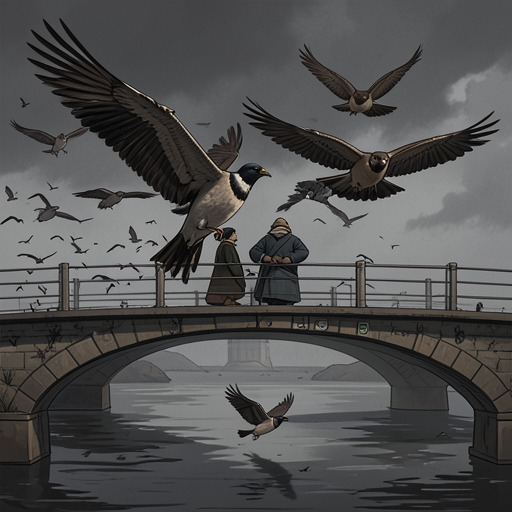
Midwinter BreakThe Sparrow in the Hall is Stella’s image of a sparrow driven by a storm through a Viking banquet hall, entering through one door and leaving through another. She calls it an image of life: a brief passage through a world of shelter, food, fire, and eventual departure. Its force lies in the scale of the bird’s journey. The sparrow does not stay to claim the hall; it passes through, and the movement becomes a way to think about human life as finite and increasingly swift.
The image and its remembered flight
The image returns to Stella while she is lying awake in her hotel room. Wrapped in a heavy bedcover, she cannot sleep: pictures keep coming, and she tries to distinguish miracle from possibility and to chronicle the projectile’s journey. The thought of a sparrow passing in one door and out the other belongs to this rush of images. Her recollection shifts to the day she first visited the Hunterian Museum with Michael, who had not yet started school. They had taken shelter from the rain beneath a colonnade at the university, then followed a sign to the museum; once the lift doors opened, Michael ran ahead.
In the museum’s entrance hall, a large book displaying an image of a woman’s opened womb arrests Stella. The image’s life-size scale and the visible child within it leave her rooted before the glass. The remembered museum encounter places the sparrow’s passage alongside an intense confrontation with birth and the body. The connection is not presented as a tidy explanation of either image: rather, the images arrive together in Stella’s restless attempt to make sense of what can be known, what seems miraculous, and how a life moves through time. The small bird’s flight offers movement where the museum image holds her still.
Stella’s account of the hall
Later, over tea with Kathleen, Stella identifies the sparrow as a Viking version of the idea of waifs and strays. In her telling, the bird flies in out of the storm through a banqueting hall and continues out the other side. Kathleen asks whether that is all, and Stella answers that it is an image of life. The exchange matters because Stella does not turn the bird into a hero or give it a lasting place in the hall. Its significance is precisely that it passes through.
Stella draws out the hall’s brief promise of warmth and plenty: fire, food, and the finite. These are not separate destinations in her account but elements of a single bounded experience. The storm makes the hall a place of temporary refuge; the banquet offers sustenance and company, but neither abolishes the limits of time. Against the apparent abundance of the hall, the bird’s swift crossing makes transience visible. Stella’s conclusion that life goes quicker as one gets older gives the image a personal temporal edge, without turning it into a claim that shelter or pleasure can stop time.
Meaning and recurrence
The expression’s meaning develops through its recurrence in two different circumstances: first as one of the pictures moving through Stella’s sleepless mind, and then as an image she deliberately shares with Kathleen. In the bedroom, it is part of an unsettled effort to order memory and possibility. In conversation, it becomes a compact account of existence, offered while Stella is discussing waifs and strays and receiving Kathleen’s hospitality. The shift from private image to spoken explanation makes the bird’s passage available as a way of understanding life without making its uncertainty disappear.
The sparrow also gives form to a tension between being sheltered and remaining transient. A hall can protect a bird from a storm, and a shared meal can suggest warmth and plenty, but the bird does not become permanent there. Stella’s emphasis falls on the whole brief passage—entry, shelter, and exit—rather than on arrival as a final achievement. The image’s simplicity is part of its reach: one bird, two doors, and a moment inside offer Stella a way to hold together refuge, mortality, and the sense that time accelerates with age.