Traveller’s Friend whiskey bottle
Midwinter BreakThe Traveller’s Friend whiskey bottle is more than a supply of drink: it is the portable reassurance around which Gerry organizes his drinking when he is away from home. Its presence in his shoulder bag promises security; at the airport, its sloshing, leakage, and eventual depletion turn that reassurance into an exposed and increasingly urgent need. Across these episodes, the bottle gives material form to the gap between Gerry’s claim to control his drinking and the behavior that makes alcohol feel indispensable.
A reserve that promises security
Gerry’s reliance on the bottle is clearest in Stella’s recollection of his admission that, if he knew there was a bottle of Jameson Irish whiskey at home, he was all right, even if he might take the notion to drink. Away from home, the Traveller’s Friend had to be in place. The distinction is telling: the bottle does not simply meet thirst in the moment. Its availability reassures him in advance, making possession itself part of the comfort. Stella understands the arrangement as a need for security, while the promise that he may or may not drink leaves the dependence tucked inside a language of choice.
The Amsterdam episode gives that reserve a public setting. After a long day, Gerry stops at a supermarket beside the restaurant where he and Stella have eaten and buys more Tyrone Superior. He then goes to an Irish bar, where he sits facing the door with Guinness and whiskey before him. At first, the untouched drinks satisfy him simply by being there: he feels satisfaction in not touching them and in knowing that his supplies are in. His attention to the whiskey bottle belongs to a wider effort to make alcohol available without yet admitting what that availability means.
The bottle and the performance of control
At the airport, the bottle becomes harder to treat as an abstract reserve. Gerry has gone to the bar for another large drink and picks up his shoulder bag; rocking it, he lets Stella hear liquid inside. When she says the bottle will not be allowed through security, she offers a practical alternative: it should have been packed in his case, wrapped in his dark pyjamas. Gerry does not accept the possibility of confiscation. He checks that the barman is occupied, produces the duty-free bag, and pours himself a substantial measure without taking out the bottle. His justification is that he will not let someone in uniform pour the whiskey away. The maneuver turns a security rule into a reason to drink immediately.
Stella identifies the contradiction in his solution: rather than allowing the contents to be poured down the drain, Gerry is pouring them into himself. He agrees. The bottle’s portability gives him a way to keep his supply close, but it also creates a problem he answers by consuming the very reserve he meant to preserve. His explanation about having once seen airport staff dispose of a full bottle of vodka and then a pot of jam supplies a vivid precedent for his fear of confiscation; it does not change the immediate fact that he is drinking to prevent the bottle from being taken.
A visible object, a strained exchange
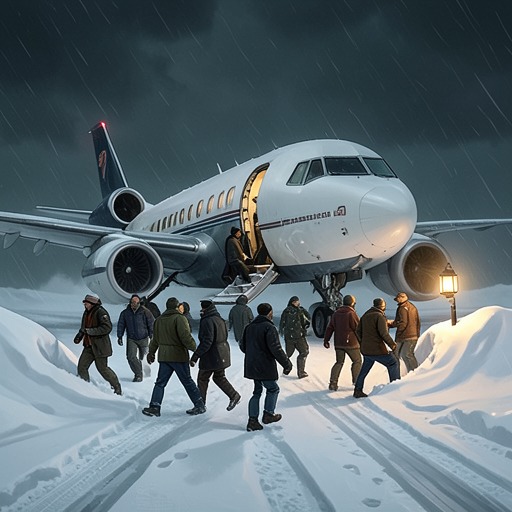
The bottle’s physical presence becomes especially conspicuous as snow falls beyond the airport window. Stella watches Gerry’s reflection in the glass and hears the small sounds of him unscrewing the metal cap, drinking, and screwing it back on. She sees that he has taken the bottle out of its bag and is holding it naked in his hand. The reflection lets her observe him without turning around, while the snow remains visible beyond him; the scene places his repeated drinking inside her watchful, indirect view. The bottle is no longer merely a reassuring item stored out of sight. Its cap, tilt, and movement register each return to the drink.
When Stella warns him that airlines can stop someone they consider drunk from boarding, Gerry says he is sitting there finishing the heel of the bottle. He then explains that he has put water in it and is determined to drink the security man’s share before they go through. Dilution becomes part of the same effort to exhaust the contents before anyone can take them. Stella warns that he will damage himself; Gerry answers as though her concern is doubtful. The exchange makes the object a focus of conflict between her recognition of the danger and his insistence on completing the bottle’s contents.
Depletion and what remains
The duty-free bag leaks onto the floor. Gerry calls the puddle melting ice, but Stella’s warning about being barred for drunkenness keeps the attention on the consequences of his drinking. The bag that concealed the supply has itself become a visible sign of disorder: liquid escapes while Gerry continues to protect what remains from confiscation. Later, he finishes the bottle. Its depletion resolves the immediate question of whether a reserve remains, but not the pattern that made its presence necessary in the first place.
The bottle also sharpens the contrast between Gerry’s airport behavior and Stella’s memory of him at civic receptions. In those social settings, she says, he usually managed his drinking: he ate canapés, drank water, avoided too much wine, and did not disgrace himself by slurring or staggering. The Traveller’s Friend belongs to a different circumstance. Away from home, the need to have it in place follows him into travel and shapes what he does when security threatens his supply. The object links private dependence to public conduct without making them identical: Gerry can appear responsible in familiar social rituals and still organize his decisions around the bottle.
As an object in the story, the Traveller’s Friend moves from an assurance kept available to a burden that must be hidden, defended, and emptied. The slosh in the bag first announces that the supply is there; the cap sounds and the bottle in Gerry’s hand make his use of it unmistakable; the leak and the final depletion mark the cost of trying to control access by drinking faster. Its significance lies in that progression. What Gerry treats as protection against uncertainty becomes evidence of how much his sense of security depends on alcohol.