“came back broken”
Missing YouThe expression “came back broken” names a painful disagreement over what Jessica Mastriani brought home from Afghanistan: not only the loss of her ability to find missing people through dreams, but a deeper injury that has altered her relationship with herself and the people around her. Rob Wilkins applies the phrase to Jessica during a confrontation, insisting that the damage cannot be reduced to a vanished power; Jessica first resists that judgment, then begins to entertain it. Its force lies in this movement between accusation and reluctant recognition.
Definition and First Use
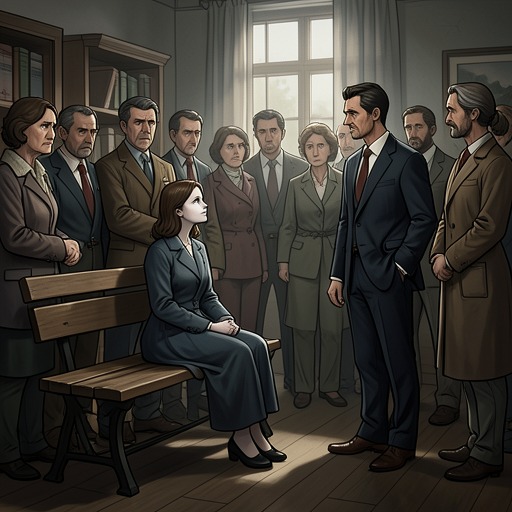
Rob gives the expression its defining form while speaking privately with Jessica at a restaurant. He acknowledges the pressure she endured and the things she saw, then tells her, “You came back broken.” He explicitly distinguishes this from the fact that she can no longer find people: in his view, the injury concerns Jessica herself, not merely the loss of a particular ability. The phrase thus turns a return home into something other than a simple end to wartime service. Jessica has returned physically, but, as Rob sees it, the experience has left a rupture that ordinary life has not repaired.
The exchange makes the expression confrontational. Rob argues that the government used Jessica until she had nothing more to give, then sent her away, and that she refuses to let the people who love her help. Jessica tries to interrupt, but he continues, challenging her to distinguish what she knows about other people from what she assumes about him. His claim that she was never a mind reader sharpens the conflict: her remarkable ability to locate missing people has not given her access to the private feelings she is now being asked to face. In this scene, “came back broken” is not a neutral diagnosis. It is Rob’s forceful account of Jessica’s condition and of the distance between them.
The War Behind the Metaphor
The phrase draws its weight from the work Jessica performed during the war. Rather than watching reports from a distance, she was in Afghanistan, directing people toward caves where others might be found. She first tried to help from home and later from Washington, but when searchers returned saying no one was at the location she identified, she remained convinced that her power was right. She eventually insisted on being sent to show them herself.
What she found did not yield one uncomplicated kind of result. Some people became the subject of public news reports; others remained secret. Some were inaccessible in mountain hideouts, some were monitored while authorities waited, and some were dead. Jessica’s insistence that she found them all sits beside this varied and sometimes terrible aftermath. Her work was successful in locating people, but success did not mean that everyone could be reached or saved.
Afterward, nightmares kept her from sleeping, and without dreams she could no longer find anyone. The people around her called the condition posttraumatic stress syndrome and tried drugs, therapy, and a week beside a pool in Dubai. Nothing restored her sleep, and she was sent home in the hope that familiar surroundings would help. The expectation that home would return her to normality immediately meets its contradiction: everything there had changed. The metaphor therefore gathers together a chain of consequences—exposure to war, recurring nightmares, sleeplessness, the disappearance of her ability, and estrangement from the life to which she returned—without treating the loss of the ability as the whole wound.
Jessica’s Resistance and Reassessment
Jessica initially answers Rob’s judgment with anger. Looking at the photograph between them, she tells herself that she is furious at the presumption of calling her broken. She accepts a narrower description: she is messed up after a year in which closing her eyes brought back things she did not want to see or hear. But she rejects Rob’s claim that she has kept everyone from helping her. She points to working with Ruth on an arts program and to Mike living with the family, and notes that she has begun sleeping through most nights. These are not proof that the injury has disappeared; they are evidence, to Jessica, that she is taking steps toward recovery.
Her most important distinction is between the damaged or absent capacity and the person who possesses it. She allows that the part of her that once found people may be broken, while denying that this makes her, as a whole, broken. That distinction gives the phrase its central tension: Rob uses it to describe a person, while Jessica tries to confine its reach to an ability. Neither position can be treated as a simple summary of the other. Rob sees pain and isolation that Jessica resists naming; Jessica points to concrete efforts and returning sleep that complicate his totalizing verdict.
The phrase returns to Jessica’s thoughts after the argument. Before going with Rob to look for Hannah, she considers whether helping with the search is a risk she needs to take. She knows that producing an address was already a significant step, and wonders why she cannot stop there and return to work with Ruth. But she recalls Rob’s words and admits that part of her did return from overseas different, perhaps broken. She also recognizes that the change may not be limited to the ability she once used in her sleep. The expression has shifted by then: what first felt like an insult becomes a possibility Jessica can examine, even though she does not simply accept Rob’s whole account.
Recurrence and Narrative Significance
Jessica’s later reflections widen the phrase beyond the immediate argument with Rob. At Pine Heights School, she imagines that attending a different school might have changed the course of her life: she would not have been struck by lightning walking home from Ernie Pyle High School if she had already reached home from the nearer school before the rain. The counterfactual connects her present sense of damage to the earlier event that gave her extraordinary abilities. It does not establish that one altered school route would have resolved her difficulties; instead, it shows how readily Jessica links the question of being broken to the turns that made her life unlike other people’s.
Her uncertainty also attaches to place and belonging. In Indiana, she wonders why she has not returned to New York City, where she thinks her current life is located; yet she remembers not feeling at home there either. She consequently turns the judgment inward, wondering whether the problem is not either place but her own capacity for happiness. The possibility that she is permanently broken appears as a fear, not a settled fact. That distinction matters: the phrase recurs as an interpretation Jessica is wrestling with, not as an authoritative conclusion about her future.
Across these scenes, “came back broken” links the public demands placed on Jessica during wartime with the private difficulty of resuming relationships and ordinary life afterward. Its repetition also marks a change in what she can acknowledge: first the lost ability, then a broader alteration in herself, and finally the fear that the damage might be permanent. The narrative leaves room between these stages. Jessica’s returning sleep, her work with Ruth, and her willingness to consider Rob’s words all complicate the metaphor, without erasing the nightmares and estrangement that gave it force.