Arts education as empowerment
Missing YouArts education as empowerment is a recurring idea in the novel, tested in practice through a summer program for children and proposed as the foundation of a different kind of high school. Its force lies in making art something young people do, not a privilege reserved for those already recognized as talented: a child receives an instrument, tries it, and discovers that a new skill may be within reach. The idea also changes Jessica Mastriani’s understanding of teaching, connecting artistic possibility for children with a future she might choose for herself.
The Summer Program and Its Purpose
Ruth’s nonprofit summer job organizes musicians, actors, and other artists to visit inner-city day-care centers and camps. There, they help children put on plays and musicals. The program responds to a shortage of city funding for certified teachers, but it is not described merely as a substitute for conventional instruction. It brings artistic activity directly into children’s everyday settings and gives them the chance to take part in making something together.
Jessica initially doubts that putting on a play can matter much to a child facing serious problems at home. Her skepticism shifts when she visits Ruth to return a forgotten wallet. Seeing the camp changes the question: the children’s circumstances have not vanished, but participating in a play can still make a meaningful difference. The possibility becomes concrete in the contrast between a child who has never seen a play and one who is suddenly acting in one, or between never having touched an instrument and beginning to play it.
Learning Through Performance
Music instruction gives the program one of its clearest examples of how participation can alter a child’s sense of what is possible. Jessica plays the flute for the children, including fast, demanding music such as Flight of the Bumblebee and Tchaikovsky, then tells them she can teach them to play too if they practice. Their disbelief is part of the scene’s significance: they assume the performance is beyond their reach, and Jessica answers by demonstrating that the skill can be learned.
The sequence is not simply a performance for an audience. The impressive music catches the children’s attention, but the offer to teach them turns that attention toward their own capacity. Practice supplies a path between hearing an accomplished player and becoming a player themselves. The moment’s promise is modest and specific: it does not guarantee that every child will become a musician, but it makes an unfamiliar ability imaginable and gives the children an invitation to try.
The work matters to Jessica as well. She enjoys playing her flute with the children and finds this more rewarding than the alternative of spending the summer playing in an orchestra. The difference is not that one activity involves music and the other does not; it is the relationship between performance and teaching. At camp, her playing becomes an opening for children to participate. Ruth’s program therefore joins artistic expression to instruction, rather than treating art as either entertainment alone or a credentialed specialty kept at a distance from children.
A Different Model of School
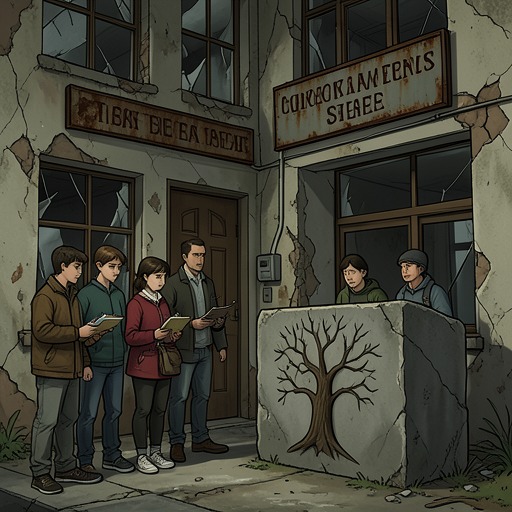
The same educational ideal informs Douglas Mastriani and Tasha Thompkins’s proposal to turn Pine Heights School into an alternative high school. On their three-block walk to the school, they explain that the proposed school would let students work at their own pace. Rather than following a standardized state curriculum as its emphasis, it would center music, drawing, sculpture, drama, and dance. The plan also excludes sports, a choice Tasha supports firmly.
Their proposal contrasts with Ernie Pyle High School, which Douglas describes as large and impersonal, like an education factory. The contrast is not only between two buildings or between standard and alternative labels. It concerns what school is organized to value: a single, standardized pace and impersonal scale on one side; student pace and sustained engagement with the arts on the other. The proposal imagines a school where creative disciplines are central to education rather than an incidental extra.
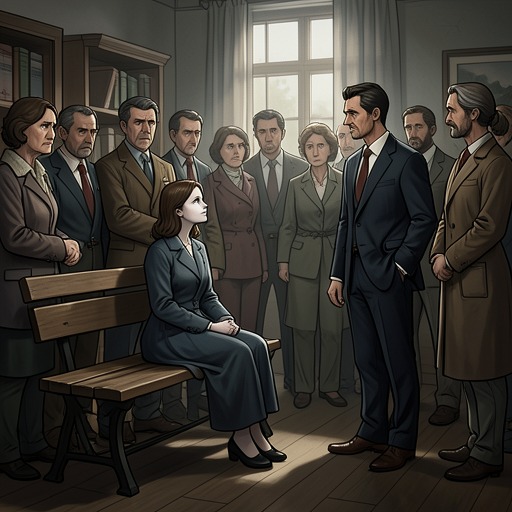
At a community meeting, the plan draws both approval and suspicion. Douglas responds to concern that an alternative school would leave teenagers unsupervised by clarifying that teachers would need state certification and that students could not loiter on school grounds after hours. When a neighborhood resident characterizes alternative-school students as expelled troublemakers, the exchange exposes the stigma the proposal must contend with. The school’s stated alternative is not an absence of structure: it includes certified teachers and rules, while questioning whether mainstream schooling’s usual measures and assumptions are sufficient.
Personal and Community Possibilities
For Jessica, the proposal carries a personal implication. She is moved by the idea of a school that students and parents could love and take pride in, and she considers how a different school might have changed her own experience. She connects the distance from home to the place where she was struck by lightning while walking back from Ernie Pyle High School, contrasting that route with Pine Heights School’s closeness. Her reflection remains counterfactual; it does not establish what her life would otherwise have been. It does show that the proposed school makes educational design feel consequential to her, not abstract.
Later, Douglas and Tasha suggest that Jessica might return to teach at the school. Douglas points to her summer work with Ruth as evidence that teaching is not foreign to her: she is already helping children learn music. The suggestion links the program’s immediate lessons to the longer horizon of a school organized around the arts. It also reframes Jessica’s musical ability as something that can be shared through teaching, rather than something valuable only as individual performance.
That possibility connects with advice from Jessica’s father, who encourages her to consider work she actually enjoys and recalls the children’s response when she gave them a donated flute and offered to teach them. His counsel does not settle her future, but it helps her recognize the camp as a source of happiness at a time when she struggles to remember feeling happy. Arts education consequently works in two directions: it offers children a chance to discover what they can do, and it helps Jessica recognize a form of work she may want to pursue.
Significance and Limits
Across the camp and the proposed school, the novel presents artistic education as a practical form of possibility. Its examples depend on access, instruction, and active participation: artists go to the camps, a flute is placed in a child’s hands, and a teacher makes practice seem worthwhile. The larger proposal extends that principle into school structure by making art central and allowing students to work at their own pace.
The evidence does not show that the proposed high school has opened or establish the long-term outcomes of either educational model. Instead, it presents the camp’s immediate encounters and the school plan’s public debate as different scales of the same aspiration. The children’s surprise at what they can learn supplies the idea with its most vivid proof, while the school proposal asks whether that kind of discovery can be given a lasting institutional home.