Douglas Mastriani
Missing YouDouglas Mastriani is Jessica Mastriani’s brother, a comic-book enthusiast whose movement from isolation into civic leadership changes how she understands him. Once bullied and inclined to keep to himself, he becomes an independent adult, a public speaker, and the leader of a campaign to remake a local school. His story also gives Jessica support at two consequential moments: he urges her to serve when she hesitates, and later helps ensure that police arrive in time to arrest Randy Whitehead Jr.
Identity and Background
For much of his earlier life, Douglas was associated with comic books and solitude. Jessica recalls that he used to come home crying because a larger boy had taken his lunch money and bullied him. The contrast matters to her when she later sees him address a crowd: the brother she remembers as vulnerable and withdrawn is now leading a public campaign, and people are listening.
His earlier difficulties had made the family fear that he might not manage on his own. Jessica remembers a period when they thought he might not make it at all. By the time of her return to Indiana, however, Douglas is living separately from their parents in a studio apartment above one of their restaurants, which had been rebuilt after a fire. His former room in their parents’ home has been converted into an office for their father, who had previously handled the restaurant books at the dining-room table.
Douglas works in a comic-book shop and draws as well. Jessica thinks his work is good enough to give him a possible future as a comic-book writer and illustrator. She wonders whether the voices he used to hear in his head have anything to do with the quality of his work, but the narrative does not define those experiences further. Her pride in his drawing sits alongside her awareness of how uncertain his earlier prospects once seemed.
Support for Jessica
When the war begins, Jessica is not yet finished with high school, and she initially tries to refuse military service despite believing that innocent people need help. The person she had expected to oppose her decision is Douglas. Instead, he tells her that she has to go, and she does. His encouragement does not erase the gravity of her choice; it supplies a decisive push from within the family at a moment when Jessica is torn between reluctance and a perceived obligation to act.
Later, after Jessica returns from service and says she can no longer use her former ability, she resists Rob Wilkins’s suggestion that Douglas thinks otherwise. She argues that Douglas cannot know more than the army’s many mental-health professionals. Rob answers that Douglas may know more about Jessica herself. The exchange gives Douglas an offstage influence: although he is not present in that conversation, his understanding of his sister challenges the authority of outside experts and prompts her to reconsider what he might recognize about her.
The School Campaign
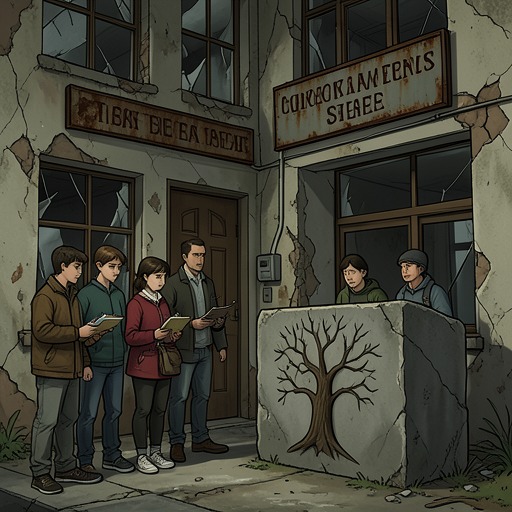
Douglas’s public work centers on a proposal to turn Pine Heights School into an alternative high school. During a walk to the school, he and his girlfriend, Tasha Thompkins, explain the plan to Jessica. Douglas distinguishes the proposed school from Ernie Pyle High School, which he considers too large and impersonal, like an education factory. Tasha, an education major at IU, describes a model in which students can work at their own pace.
At the public discussion, the proposal meets opposition from residents worried that an alternative high school will reduce neighborhood real-estate values. Tasha counters that the school will have strict admission requirements and that applicants will need references. The argument is therefore about more than whether to reopen a building: supporters and opponents disagree over what kind of school belongs in the neighborhood and what concerns should govern its future.
Jessica is struck less by the dispute itself than by Douglas’s role in it. He is leading a group of residents in a campaign for change in a neighborhood where he no longer lives. The boy who had once been bullied is now speaking before a crowd with a talent Jessica had not known he possessed. The reversal is made public in the scene’s simplest measure: people listen to him.
Action, Family, and Resolution
Douglas’s campaign and his loyalty to Jessica intersect during the police action against Randy Whitehead Jr. As officers enter Mr. Whitehead’s office and order Randy to put his hands against the wall, Douglas arrives behind them wearing a Hellboy T-shirt and carrying an X-Men comic. He asks Jessica whether he got the police there on time, as she had requested. She confirms that he did. His contribution is practical and precisely timed: his arrival accompanies the arrest, but the evidence does not make him the investigator or the person who conducts it.
Afterward, Douglas says he is glad to help rid the world of smut-peddlers, while jokingly treating Sin City as wholesome entertainment. He then crosses the street toward Underground Comix. His involvement also links the arrest to the school campaign: Mr. Whitehead is supposed to present a donation check personally to the head of the Pine Heights Alternative School committee, and Douglas is that committee head. The promised contribution gives the campaign a concrete consequence of the events surrounding Randy’s exposure.
Douglas is affectionate but not always unobtrusive. He tries to play matchmaker between Jessica and Rob, meaning well even as Jessica finds the interference unwelcome when matters between them are already awkward. Their teasing, familiar exchange does not diminish her respect for him. At the end of the school episode, Douglas tells her that the town can finally have a school parents and students can love and take pride in. Tasha adds that it might be the kind of school Jessica would want to return to as a teacher, an invitation that leaves Jessica astonished.
Change and Narrative Significance
Douglas’s arc is defined by a change in scale: the traits once linked to retreat—his solitary interests and comic-book world—coexist with a growing ability to act publicly and organize others. The story does not present his earlier vulnerability as simply erased. Instead, Jessica’s memory of it sharpens the force of his present leadership, while his independent home and creative work show other forms of progress beyond the campaign.
His importance to Jessica is similarly practical as well as emotional. He urges her toward service when she doubts herself, understands her in a way Rob believes professional treatment may not capture, and helps carry out her request for timely police intervention. His civic work, meanwhile, turns a private family surprise into a local change: he helps build support for an alternative school and stands to receive the donation connected to Randy’s arrest. Douglas’s transformation is not a departure from his earlier interests so much as an expansion of what he can do, from drawing and reading comics to persuading a community and helping his sister act.