Jessica Mastriani
Missing YouJessica Mastriani is the lightning-struck young woman once known to the press as “Lightning Girl,” but her defining struggle is not simply having a psychic ability: it is deciding whether, when, and for whom to use it. After insisting that she can no longer find missing people, she returns to the search for Rob Wilkins’s sister, Hannah Wilkins. By the end, her powers have returned, yet she chooses a future in Indiana centered on teaching rather than a compulsory return to government work.
Identity and Public Image
Jessica introduces herself by name, while also making clear that recognition is not something she seeks. The press gave her the label “Lightning Girl” after she was struck by lightning and began finding missing people in her dreams. The ability made her a public figure, particularly in Indiana, and her life even became the basis of a cable television show. That adaptation invented major details: it sent her to Quantico to train as an FBI agent and killed off her father, who is alive in reality. Jessica tolerates the show because she is paid for the use of her name and story, but the gap between her actual life and its televised version underscores how easily public accounts turn her into a character others can reshape.
The money from the show is invested by her parents. Jessica draws on the interest occasionally when she is short of cash for food or rent, but says she has not touched the principal. At the time she describes her circumstances, she also has a summer job. These ordinary financial details sit against the sensational identity attached to her: the celebrated psychic is also a young woman managing rent, food, work, and a public reputation she would rather not have.
The Ability and Its Costs
The power began with a lightning strike Jessica did not choose. She describes the event and its aftermath as a departure from the life she had planned, and says the ability is not an uncomplicated gift: it may help the people she finds, but it has been difficult for her. The press’s dramatic label conceals that difference between the value of the result to others and the personal cost of being expected to produce it.
Jessica worked for almost a year for a special division of the Federal Bureau of Investigation headed by Cyrus Krantz. That experience makes her later resistance to returning especially consequential. She has previously said publicly that she no longer finds people, first to get the press to leave her alone when the attention upset Douglas Mastriani, and later to discourage the government from recruiting her. Rob Wilkins recognizes the earlier denials as a tactic. Jessica distinguishes the present from those performances: this time, she says, she really cannot do it. Her insistence marks not a public-relations maneuver but a limit she believes is real.
Hannah Wilkins and the Return to the Search
Rob’s appeal changes the immediate course of Jessica’s refusal. When he asks whether she will find his sister, Jessica makes the practical consequence explicit: she needs to go back to Indiana with him. The decision does not erase her earlier claim that her power is unavailable; it shows how the possibility of helping a particular person reopens a question she had tried to close. Jessica’s return is tied to Hannah Wilkins, rather than to a general declaration that she is ready to resume psychic work for the press or the government.
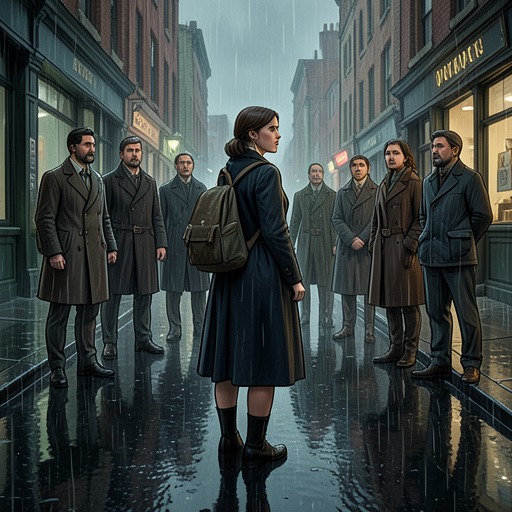
At the apartment door, Jessica answers the question of who is there with “Me,” then tells Hannah Wilkins to open up. Hannah does not yet know who Jessica is. The small encounter makes Jessica’s approach to the search concrete: she gets through the door without relying on the public identity attached to her, introducing herself in an ordinary, direct way. Later, when Jessica meets Randall Whitehead Sr., she crosses the office and extends her hand, greeting him coolly by name before introducing Rob and explaining that his son knows Rob’s younger sister. In the confrontation that follows, Rob identifies Jessica simply as “Lightning Girl.” The famous label enters a room where her actions have implicated other girls and the police, and Randall Whitehead Sr. threatens that she will regret it. Jessica’s public identity is thus both a shorthand others use to understand her and a source of hostility when she intervenes.
Relationships, Recovery, and Choice
Rob is both the person who asks Jessica to return and the person who understands that her earlier claims of having stopped were not always true. His support does not amount to deciding for her: the later conversation with a government representative recognizes that past pressure contributed to her having nothing left to give, and tells her that use of her restored powers is her choice. That recognition reframes her ability as something she may govern, not a service others can claim because she once provided it.
Jessica’s answer about her future is specific. She agrees to transfer to Indiana and obtain her teaching certificate, after her brother has asked her to teach at an alternative school he is opening. The choice places a form of help within ordinary work with children, rather than defining her only by dream-searches or federal service. Her powers are back, but the fact of their return does not dictate what she must do with them.
The ending gives that distinction a playful, physical edge. After Nancy hurries away, Jessica tells Rob, “I’m not broken anymore.” Rob asks what happened to her commitment to nonviolence. Jessica answers that she did not hit Nancy; she only threatened her. The exchange treats recovery as more than the restoration of psychic capacity: Jessica can acknowledge that she feels no longer broken while still negotiating the limits of how she acts. Her ending is not a return to an earlier, uncomplicated version of herself, but a renewed ability to choose her work, her powers, and her response to conflict.