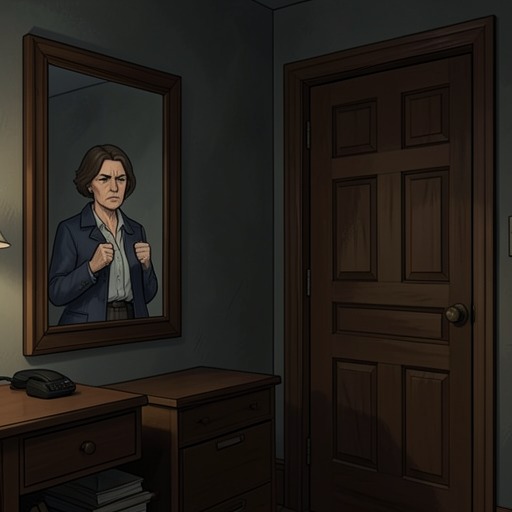
Jessica’s turn toward nonviolence
Missing YouJessica’s turn toward nonviolence marks a change in how she responds to conflict: after seeing enough violence to last a lifetime, she has put aside the fists she once relied on and begun seeking solutions that use her judgment instead. Rob Wilkins recognizes this shift as more than an announced refusal to fight. He praises its practical results, while the closing exchange with Nancy shows both the force and the limits of Jessica’s new commitment: she does not hit, but she does threaten, and calls the restraint meaningful.
Rejection of Physical Force
The shift is discussed on the ride to Rob Wilkins’s place, after Jessica and Rob have been occupied explaining to the district attorney what Randy Whitehead Jr. did. Jessica thinks there is little left to discuss about what happened in Randall Whitehead Sr.’s office, but Rob raises her “new nonviolence thing.” The casual label makes the change sound like a recent habit; Jessica’s inward response suggests it is more consequential. She does not want to explain to Rob—or anyone—why hitting no longer appeals to her. Her reason is grounded in experience: she has seen enough violence to last a lifetime and has hung up her figurative brass knuckles.
The brass-knuckles image frames nonviolence as a choice to stop using a familiar instrument, not as an inability to fight. Jessica does not offer a doctrine or claim that violence has become harmless. She wants the decision to stand without having to justify it, and her reluctance to explain emphasizes the personal weight behind what Rob initially calls a “thing.” The movement away from physical force begins as a boundary she has set for herself, not an argument she is eager to make on someone else’s terms.
Rob’s Recognition of a Different Strength
Jessica expects Rob to approve because she had once considered attacking him. Instead, he says that is not his reason: he thinks she is good at thinking up nonviolent solutions, and calls what she did in Randall Whitehead Sr.’s office “genius.” His praise ties her new approach to an actual outcome rather than to mere good intentions. The scene does not specify the office tactic in this conversation, but Rob’s reference places her restraint and ingenuity within the same recent conflict that brought them before the district attorney.
His approval unsettles Jessica. She blushes at the compliment, even as she is irritated by how strongly Rob affects her. That reaction adds a personal dimension to the exchange: the change is hers, but his recognition matters to her. Rob keeps his eyes on the road as he recalls having warned her that quick fists could eventually meet someone bigger and that she would not like the result. Jessica jokes that she is too quick on her feet, invoking the image of a butterfly’s speed and a bee’s sting. Rob counters that both Whitehead men would agree her sting is worse when she uses her head than her right hook.
The contrast between head and fist gives the shift its clearest practical formulation. Rob does not praise Jessica for becoming harmless; he argues that she is more effective when she thinks. The old warning about being hit by someone bigger also makes physical force a vulnerability, while her recent success offers a different kind of leverage. In this account, nonviolence does not erase her forcefulness. It redirects it toward devising a solution rather than landing a blow.
The Test of Restraint
Near the end, Jessica tells Rob, “I’m not broken anymore.” His response links that declaration to her conduct toward Nancy: he asks what happened to the nonviolence, and Jessica insists, “I didn’t hit her.” She acknowledges that she threatened Nancy, but distinguishes the threat from physical contact. Rob agrees that she did not hit her and describes the restraint as real self-control.
This exchange makes the commitment more complicated than an absolute rule against aggression. Jessica has not presented herself as incapable of anger or intimidation; her defense rests on the specific line she did not cross. Nor does Rob treat the threat as though nothing happened. He asks about the apparent return to the old pattern, then recognizes that withholding the blow required restraint. The episode therefore measures change in an action, not in a declaration alone: Jessica may still threaten, but she does not strike.
Meaning of the Change
The two conversations form a pointed contrast. In the car, Jessica resists explaining why she has put violence behind her, while Rob identifies the intelligence and effectiveness he sees in her alternative. In the later exchange, she herself names a change in her condition and uses the unlanded blow as evidence. Her claim that she is no longer broken is her own assessment; the scene does not turn it into a general cure or say that conflict has ceased to affect her.
Instead, the narrative presents nonviolence as a practiced, imperfect form of agency. The figurative brass knuckles are set aside, but Jessica retains the capacity to act decisively and even to threaten. Rob’s final recognition that she exercised self-restraint supports her distinction without pretending that every part of the encounter was peaceful. Her turn is therefore not a simple conversion from force to passivity: it is a change in how she uses force, from the right hook toward thought and control, with the closing moment offering a concrete but deliberately qualified sign of progress.