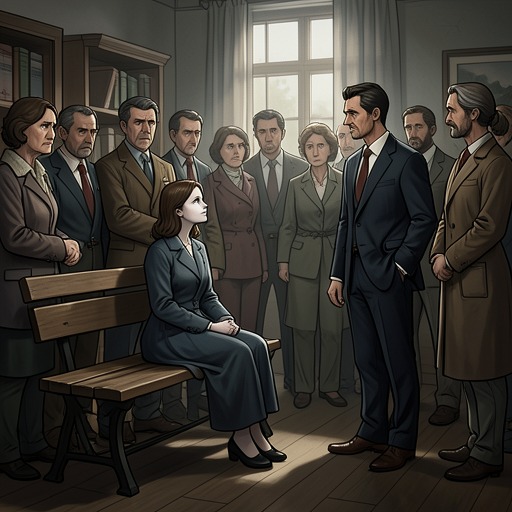
Jessica's Wartime Search for Missing Persons in Afghanistan
Missing YouJessica's Wartime Search for Missing Persons in Afghanistan turns Jessica Mastriani's psychic ability from a private, disruptive consequence of being struck by lightning into a tool used in an active war. Still short of finishing high school, she helped locate people in Afghanistan, first remotely and ultimately in the field. The work found people, but finding them did not mean they could be reached or saved; afterward, trauma and sleeplessness took away the dreaming through which her ability operated.
Call to Service and Deployment
The war arrives in Jessica's account as another unplanned rupture, following the lightning strike that gave her the power to find people. Back in Indiana, its presence is initially represented by American flags on the neighborhood's front lawns and by people following the news. For Jessica, however, it soon ceases to be distant images: officials need her ability because innocent people are dying and searches must happen quickly.
Jessica is not yet finished with twelfth grade when the government calls on her. She initially resists going, but Douglas Mastriani, whom she had expected to oppose her deployment, urges her to go because she is needed. The decision is framed less as a pursuit of adventure than as a response to urgent human need. At first, she is told she can work from home, allowing her to continue school. The demands of the search soon exceed that arrangement: she works from home and later from Washington, before insisting that she be sent to the places where the search teams are looking.
That change in location also changes the scale of her experience. For most Americans, the conflict reaches them through broadcasts about deaths and military operations. Jessica says she does not watch the war on the news; she is there, directing personnel toward caves where people are believed to be hiding. The contrast establishes the defining condition of her service: the same search that may appear as a location or report to others is, for her, an immediate responsibility carried out amid the conflict itself.
How the Search Operates
Jessica's dream-based ability supplies locations, while military personnel must act on those directions in the field. At first, the two parts do not always align. Teams go where she tells them to look and return saying that nobody is there. Jessica remains certain that their reports are wrong, distinguishing the reliability of her power from the limits of the searchers' attempts to confirm it. The repeated mismatch between her knowledge and the empty searches leads her to demand that she be sent to show them herself.
The request is a turning point in her role. Rather than continue to transmit instructions at a distance, Jessica asks to accompany the search and make the location legible to the people who must reach it. Her insistence follows from the operational impasse: she believes the people are present, while the teams' failure to find them threatens to leave that knowledge unused. Her presence does not make the terrain or the outcome controllable, but it brings the source of the information into the search itself.
The account does not present every location as a recoverable objective. Some people Jessica finds become known through the news; others remain secret. Some are hidden deep in the mountains, where personnel cannot get to them. In other cases, the decision is to keep watch and wait rather than move immediately. Some of the people she locates are dead. The repeated distinction between finding someone and reaching or rescuing them defines the limits of her contribution: her power identifies people, but circumstances and military decisions still shape what happens next.
Outcomes and Limits
Jessica insists that she found everyone she located through her ability, but the statement describes the reach of the search, not a universal rescue. The people she finds have sharply different outcomes: public acknowledgment, secrecy, continued observation, inaccessibility, or death. That range prevents the work from becoming a simple account of a supernatural gift solving a military problem. Accurate information can guide a search without removing the danger, distance, or choices that stand between discovery and safety.
The distinction also helps explain the burden of the assignment. Jessica is not merely identifying places on a map; she is directing others toward people in a war zone where innocent people are dying. Her later account stresses that she saw things no one her age, or any age, should have seen. It does not specify every sight or assign her responsibility for every outcome. It does establish that the search exposed her to the war directly, rather than leaving her to experience it as distant news.
Aftermath and Narrative Significance
After the mission, nightmares prevent Jessica from sleeping. Because the ability depends on dreaming, sleeplessness also prevents her from finding anyone. The power that made her valuable in Afghanistan is thus bound to the injury that follows her home: when she can no longer sleep, the means of searching disappears with it. The narrative connects this loss to posttraumatic stress syndrome, or PTSS, as it is named in the account.
Attempts to help her include drugs, therapy, and a week beside a large pool in Dubai. None restores her sleep. In the end, she is sent home in the hope that familiar surroundings might help her recover, but home has changed and is no longer the return to normality others anticipated. Later, Rob Wilkins tells her that he understands the pressure she endured and admires that she returned able to lead a life resembling normalcy, while also telling her that she came back broken. Jessica privately recognizes that something in her did return changed, and that the difference extends beyond the lost ability to find people in her sleep.
The remembered deployment therefore marks both the practical reach and the human cost of Jessica's power. In Afghanistan, it converts dreams into directions for searches whose outcomes she cannot control; afterward, trauma disrupts the dreams themselves. The episode's central reversal is not that the ability proves false, but that a power capable of locating others cannot protect its bearer from the consequences of doing so.