Pine Heights School
Missing YouPine Heights School is the neighborhood elementary school whose proposed closure and redevelopment become a test of the town’s priorities. As Douglas Mastriani and Tasha Thompkins campaign to transform it into an alternative high school, the building stands between two futures: luxury condominiums and a locally rooted school built around individualized learning and the arts. The proposal connects the school’s history as a shared childhood place to arguments about housing, employment, educational opportunity, and the community’s ability to retain young people and teachers.
Identity and Local History
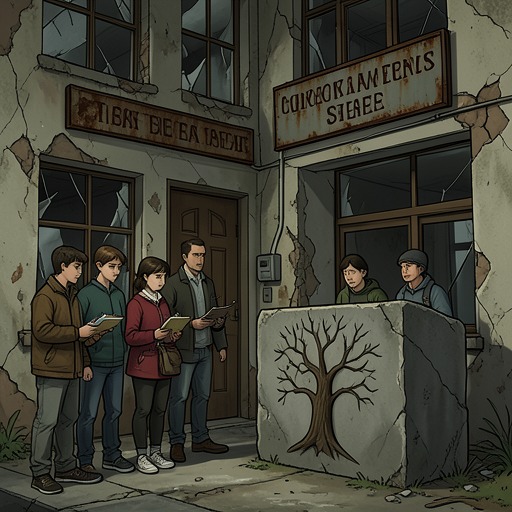
The school had served the neighborhood as its elementary school, and its location made it part of ordinary family routines: it was three blocks away, close enough that children who attended could go home for lunch. The building had been constructed during the Depression by workers employed through the Works Progress Administration. Its age was visible in its paired entrances, one marked for boys and the other for girls, though students in Jessica Mastriani’s generation paid no attention to the old signs. The architecture therefore carried traces of an earlier school culture even as the children who used the building treated those distinctions as obsolete.
By the time the story turns to its future, the neighborhood no longer has enough children to fill the school. The school board is closing it, and the city wants the property converted into luxury condominiums. That proposal makes the site more than an endangered piece of local history: the question is whether a public building in a changing neighborhood will serve residents through education or become housing aimed at a wealthier market. The school’s threatened loss also matters personally to Jessica, who remembers performing as the mouse in a third-grade production of The Lion and the Mouse there.
The Alternative-School Proposal
Douglas and Tasha propose turning the school into an alternative high school rather than allowing the condo plan to determine its next use. Douglas distinguishes their idea from Ernie Pyle High School, which he describes as too large and impersonal, like an education factory. Their alternative would allow students to work at their own pace instead of treating one uniform progression as the answer for everyone. Tasha, an education major at Indiana University, explains that individualized pacing is central to the plan.
The curriculum would emphasize music, drawing, sculpture, drama, and dance rather than the standardized state curriculum. The proposal also excludes sports. Tasha’s firmness on that point has a personal context: her brother had been a football player who received substantial attention, while she, as a shy and studious girl, had been almost an afterthought in her family. The plan’s emphasis on the arts thus offers a different basis for student recognition and participation from the one organized around athletics.
The proposal includes practical conditions as well as an educational philosophy. Douglas tells the public meeting that teachers would need state certification and that students would not be permitted to loiter on school grounds after hours. Those assurances answer concerns that an alternative school would mean an unsupervised one. They also make clear that the organizers are proposing a structured school, not simply a refuge from the existing system.
Public Debate and the Town’s Future
At a public meeting inside the school’s combined auditorium, gym, and cafeteria, the competing plans are made physically visible. Folding chairs face a long table bearing a scale model of the building, redesigned with windows and landscaping that make it resemble an upscale condominium complex. A businessman in an expensive suit stands behind the model with city planners and local politicians. The school’s lack of air-conditioning, noticeable in the summer heat, contrasts with the polished redevelopment image presented to the room.
Douglas asks how far the city council has advanced its review of the alternative-school proposal. The audience’s responses reveal competing assumptions about the neighborhood and its teenagers: one person welcomes the idea, while another objects to teenagers roaming loose in the neighborhood. A woman raises the familiar accusation that students in alternative schools are troublemakers expelled from mainstream schools, and the crowd murmurs in agreement. Douglas responds by separating an alternative model from a lack of supervision and then widens the argument beyond school discipline.
He says that young people can no longer afford to raise children in the community, as people who do not own local businesses move there while conducting business in Indianapolis. He links rising housing costs to young residents leaving for cities such as New York and Chicago, and links overcrowded public schools to talented teachers having no local openings. A new high school, he argues, could employ those teachers while giving teenagers who feel lost in the large public high school a chance to shine. Some people applaud. The city councilperson promises that both the school proposal and the condo plan will receive a thorough review, with a decision expected by the end of the month; the evidence does not establish the decision’s outcome.
People, Education, and Significance
Douglas’s public advocacy marks a striking change in how Jessica sees him. She remembers him as a boy who came home crying after bigger students stole his lunch money and called him a spaz; at the meeting, she sees him leading concerned residents and speaking with a talent she had not known he possessed. Her pride in his speech does not erase his frustration: afterward, he believes he has persuaded some listeners but says the developer has convinced others with promises about property values and making the neighborhood Indiana’s Beverly Hills.
The school’s proposed future also reaches beyond the meeting. Ruth’s summer work organizing musicians and actors to help children put on plays and musicals at day-care centers and camps offers Jessica a practical example of arts education where the city cannot afford to hire certified teachers. Jessica initially doubts what a play can do for a child facing serious difficulties at home, but Douglas later connects that work to the school proposal by suggesting she might return to teach there. Tasha likewise presents the school as a place Jessica might want to teach. The exchange does not establish that Jessica accepts the idea; it makes teaching at Pine Heights a possibility tied to work she has already been doing with Ruth.
Pine Heights School consequently joins a civic dispute to a personal reconsideration of education. The alternative-school proposal challenges the assumption that a large, standardized public high school is the only credible model, while its focus on the arts and student-paced work offers a locally specific response to students who may feel lost. The threatened building matters because it is at once a childhood landmark, a resource the neighborhood may lose, and a possible workplace for teachers the town struggles to retain. Its future remains undecided, but the campaign has already made the choice of what replaces it a public question about whose needs the community will value.